Quick answer
Japan does not publish the number.
That sounds like an evasion, so here is the proof. The figure that circulates in English (Japan solves 99 percent of its murders) comes from the clearance rate published by the National Police Agency. For 2021 that rate was 101 percent.
It is not a typo, and it is not a scandal. It is what the statistic is built to do. The police explain it themselves, in the notes to their own published tables: the cases counted as cleared during a year include cases that were recorded in earlier years, so the rate can exceed 100 percent. The numerator and the denominator are two different populations of cases. A ratio like that can tell you how busy the year was. It cannot tell you how many killings have no answer.
Two further things are true of that number, and both are in the police’s own definitions:
- Attempts are counted as murders. Where the victim survived and can often describe the attacker, the case is far easier to clear, and it sits in the same total.
- Robbery-homicide is not counted as murder at all. It is counted under robbery. Which means the most famous unsolved killing in Japan (four members of one family, in one house, on one night) is not in the murder statistics.
What the state does publish, unambiguously, is a list. As of August 2026 the National Police Agency is advertising rewards in fifteen unsolved cases nationwide. Six of them are robbery-murders. One is the family in Kami-Soshigaya.
The rate that went over 100
Start with the definition, because everything else follows from it. This is the formula printed in the National Police Agency’s statistical materials on penal code offences:
Clearance rate = cases cleared (including the clearance of cases recorded in years before the year in question) ÷ cases recorded in the year × 100
And immediately after it, the agency’s own caveat:
Because the number of cases cleared includes the clearance of cases recorded in years before the year in question, the clearance rate can exceed 100 percent.
Here is what that produces for murder, from the tables published with the 2025 Police White Paper:
| Year | Cases recorded | Cases cleared | Clearance rate |
|---|---|---|---|
| 2020 | 929 | 913 | 98.3% |
| 2021 | 874 | 883 | 101% |
| 2022 | 853 | 817 | 95.8% |
| 2023 | 912 | 872 | 95.6% |
| 2024 | 970 | 937 | 96.6% |
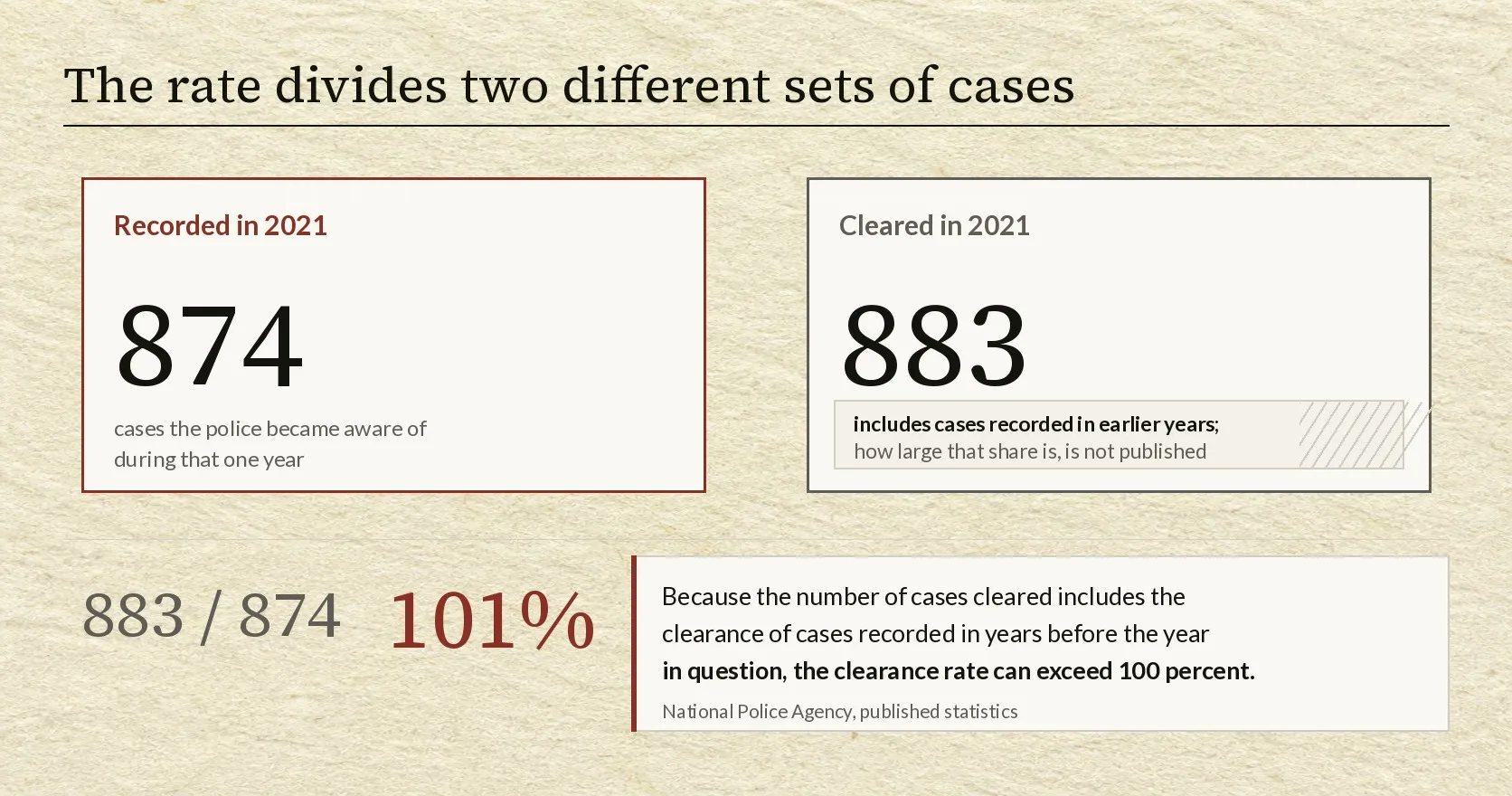
In 2021, police cleared nine more murder cases than they recorded. Some of those clearances belonged to 2020, or 2015, or 1998. The rate is a measure of throughput, not of resolution.
This matters more than a rounding quibble, because the 96-to-99 percent range is doing heavy work in English-language writing about Japan. It is offered as evidence that the country is unusually good at solving killings, and it usually appears next to the total for all penal code offences, which was 38.9 percent in 2024. The contrast is real. But if you want to know how many families are still waiting, the clearance rate is the wrong instrument, and no amount of decimal places will make it the right one.
Subtracting the columns does not rescue it either. Over the five years above, police recorded 4,538 murder cases and cleared 4,422, a gap of 116. That is not 116 unsolved murders. It is the residue of two overlapping populations, and the true figure for those five years could be higher or lower.
What the murder figure includes, and what it leaves out
The same statistical materials define two things that shape the total.
The first is in the general notes: attempts and preparatory offences are, unless otherwise stated, included in the completed offence. So the 970 murder cases recorded in 2024 are not 970 deaths. They include attempted murders, where the intended victim survived, and where, very often, the intended victim knows who did it. Any comparison between countries that do and do not fold attempts into the murder count is a comparison of different things.
The second is the structure of the categories. Japanese crime statistics group the four offences of murder, robbery, arson and non-consensual intercourse as “serious offences,” and within robbery there is a sub-tabulation the police call bodily offences accompanying robbery. It has three members: robbery-homicide and robbery causing death; robbery causing injury; and robbery with non-consensual intercourse.
Robbery-homicide lives inside robbery. Here is a decade of it:
| Year | Robbery-homicide / robbery causing death | Robbery total |
|---|---|---|
| 2015 | 26 | 2,426 |
| 2016 | 17 | 2,332 |
| 2017 | 20 | 1,852 |
| 2018 | 25 | 1,787 |
| 2019 | 21 | 1,511 |
| 2020 | 16 | 1,397 |
| 2021 | 19 | 1,138 |
| 2022 | 14 | 1,148 |
| 2023 | 22 | 1,361 |
| 2024 | 19 | 1,370 |
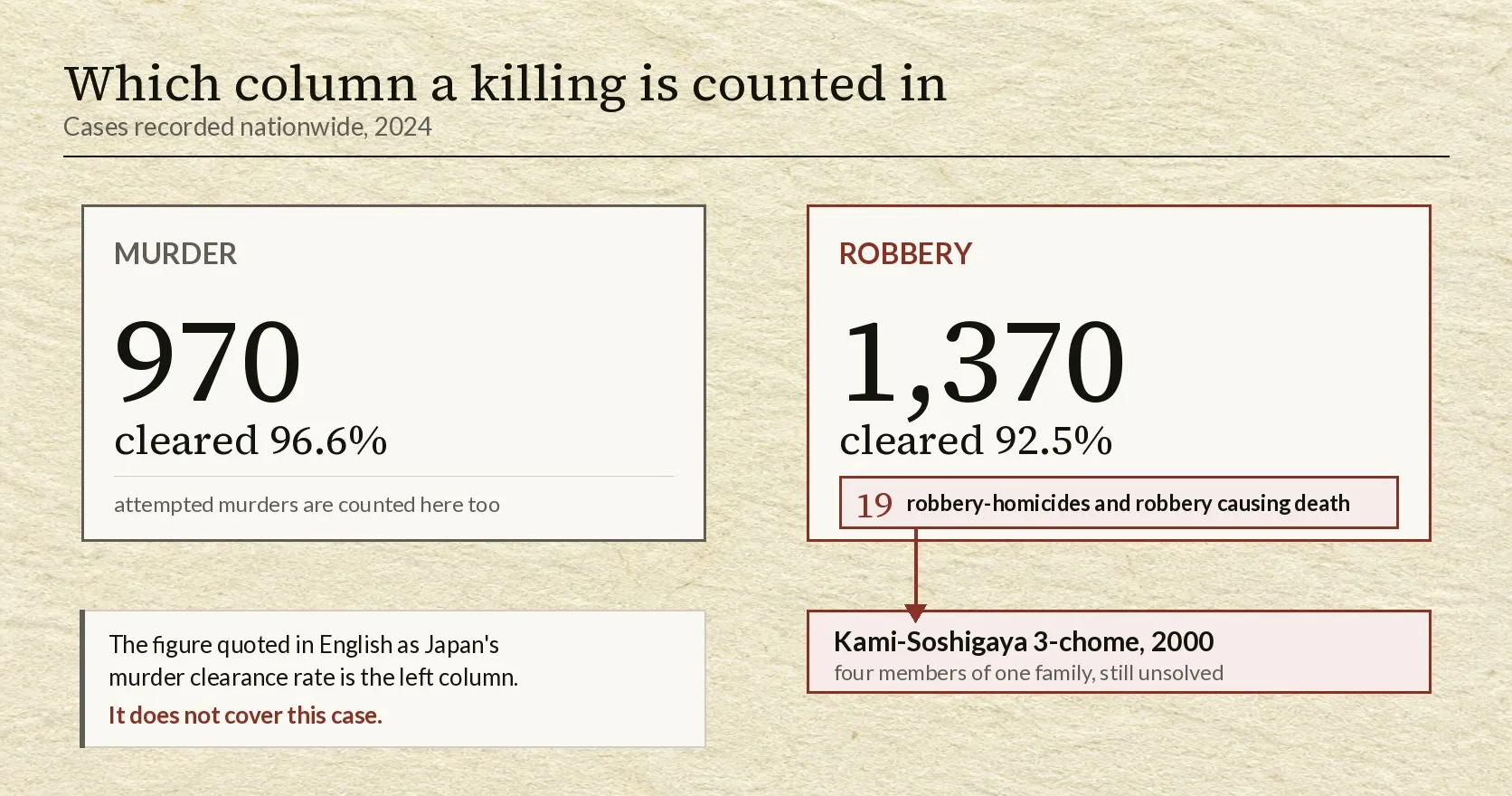
Nineteen cases in 2024. Fourteen in 2022. These are among the gravest killings the country records, and they are counted in the robbery column, whose clearance rate in 2024 was 92.5 percent, not the murder column’s 96.6.
Under Japanese law the distinction is not cosmetic. Robbery-homicide is its own offence, punishable by death or life imprisonment, and it is what a killing in the course of a theft is charged as. It is also, as the next section shows, what happened in the house in Kami-Soshigaya.
There is a further column that never appears in the murder table at all. A killing only enters these figures once the state knows a killing happened, and some of them begin as somebody simply not coming home: 82,563 missing person reports in a year, filed against a rule that orders no search for an ordinary adult and instead compares the paperwork against the register of unidentified bodies.
Others begin as a body the state did look at and did not open. Of the 204,562 bodies Japanese police handled in 2025, 9.9 per cent were autopsied, and the share varies between prefectures by a factor of nine. The 2011 report that recommended raising that rate counted 43 criminal deaths missed since 1998, and found the cause of death had been recorded wrongly in 22 of them.
Japan’s most famous murder is not a murder
In English the case is called the Setagaya family murder. The Tokyo Metropolitan Police Department has never called it that. Its name, on the force’s own page, is:
上祖師谷三丁目一家4人強盗殺人事件
The robbery-murder of a family of four in Kami-Soshigaya 3-chome. The department’s English page uses the same wording (“Robbery and murder involving a family of 4 in Kami-Soshigaya 3-chome”) and gives the date of occurrence as 31 December 2000.
The word order is not an accident of translation. It is the charge. Which means that the case English-language readers know as Japan’s great unsolved murder has never appeared in the murder statistics that are used to argue Japan solves its murders. It is one of the nineteen-or-so robbery-homicides a year, inside a robbery total of more than a thousand.
The police account of the night is spare. Between about 11pm on Saturday 30 December 2000 and the small hours of Sunday 31 December, four members of one family were killed in a house in Kami-Soshigaya 3-chome. The setting is described with an estate agent’s flatness that becomes strange the longer you look at it: to the north, the Komazawa University baseball ground; to the west, the Sengawa river; to the east and south, the Soshigaya park. The surrounding land was inside a zone being cleared for the park’s expansion. At the time of the killings, including the victims’ house, four houses were still standing.
Then the force asks the public for something very specific: for anyone who saw an unfamiliar person or vehicle, and for anyone who knows of a person who moved away suddenly, or who stopped being seen, after the killings.
What is in the file
Most unsolved cases are unsolved because there is nothing to work with. This one is the opposite, and the police publish the inventory.
The offender left clothing. A grey crusher hat in knitted wool with a black line. A hip bag with an 83-centimetre belt, set for a waist of 70 to 75 centimetres. A green scarf checked in red, black, orange and dark green. A black Airtech jacket, size L, made by Uniqlo. Black one-size gloves. Trainers, Japanese size 27.5, Slazenger, made in Korea. And a raglan-sleeved sweatshirt, pale grey body with pale purple sleeves, size L, which he took off and left behind.
The sweatshirt is where the case becomes almost unbearable to read about. Between its release and the day of the killings, 130 were sold in the whole of Japan. In Tokyo, ten. The police name the four shops:
| Shop | Location | Sold |
|---|---|---|
| M/X Seiseki-Sakuragaoka | outside Seiseki-Sakuragaoka station, Keio line | 3 |
| M/X Hachioji Keio SC | inside the Keio Hachioji station building | 2 |
| Marufuru Ogikubo | inside the JR Ogikubo station building | 3 |
| Marufuru Aoto | inside the Aoto station building, Keisei line | 2 |
Both chains have since closed. Of the ten buyers, one is known. The other nine are not, and the investigation headquarters says it is still looking for them.
The force then makes an argument that tells you how long this has gone on. Someone who owns the same sweatshirt might hesitate to come forward, fearing they will be treated as a suspect. There is no need to worry, the police write, because the offender left his at the scene, so still owning one is, if anything, evidence that you are not him.
The rest of the inventory: two black handkerchiefs. One had a slit of about three centimetres near the middle, with the rest of the cloth pulled through it to make a pouch, into which the handle of the knife had been pushed, a grip, so it would not slip. The other was folded into a triangle with pinch marks at both ends, and may have been worn over the face. The knife was a yanagiba blade, brand name Kansuke Roku Ginju. On the handkerchief that had been wrapped around it was a French cologne, Drakkar Noir.
And: the offender injured his hand. His blood type is A.
This is the paradox the case has always had. The evidence is not thin, it is abundant, and abundance is its own kind of dead end. It invites the certainty that the answer must be one step away, and it feeds theories that run far past what the objects can carry. The published record can establish what was recovered and what the police have said about it. It cannot name anyone. Twenty-five years of public discussion has repeatedly turned a forensic detail into a complete biography of a person nobody has identified.
The list the state does publish
If the clearance rate cannot tell you how many killings are unresolved, there is one figure that is exactly what it appears to be: the cases in which the state is currently offering money.
As of August 2026, the National Police Agency’s advertisements cover fifteen cases:
| Case | Force |
|---|---|
| Abduction of a young girl at a pachinko parlour, Takabayashi-Higashi, Ota | Gunma |
| Abduction of a primary-school girl, Kumatori, Sennan district | Osaka |
| Robbery-murder of a taxi driver, Kuko-Nishi 1-chome, Niigata | Niigata |
| Robbery-murder with a handgun in a supermarket office, Owada-cho | Tokyo |
| Murder of a man, Anesaki, Ichihara | Chiba |
| Taxi robbery-murder, Tachikawa-cho 6-chome, Tottori | Tottori |
| Robbery-murder at the Lawson store, Kaga-Kuwabara-cho | Ishikawa |
| Robbery-murder of a high-school girl, Ikoma-cho, Toyota | Aichi |
| Murder, Iwakura-Hataeda-cho, Sakyo ward | Kyoto |
| Robbery-murder of a family of four, Kami-Soshigaya 3-chome | Tokyo |
| Murder of three members of one family, Mitsudera, Gunma-machi (now Takasaki) | Gunma |
| Murder of a woman, Kawai, Miyako | Iwate |
| Murder in a restaurant in a multi-tenant building, Roppongi 5-chome | Tokyo |
| Murder of two university students, Beppu | Oita |
| Arson and murder of a female university student, Shibamata 3-chome | Tokyo |
Fifteen cases, from a country of 124 million. Six are robbery-murders: cases that, by construction, are absent from the murder statistics. Four of the fifteen are in Tokyo alone, and the oldest on the Tokyo list is a 1995 robbery-murder in a supermarket office in Owada-cho.
This is not a register of unsolved killings; it is a register of unsolved killings where the police believe a public advertisement is still worth running. But it is the only number in this whole subject that means precisely what it says.
The reward is a contract, not a bounty
The mechanism is stranger than the amount. The Investigation Special Cash Reward System is not a creature of criminal law at all. The National Police Agency describes it as operating under Articles 529, 529-2 and 532 of the Civil Code, the provisions on prize advertisements.
Article 529 reads:
A person who has advertised that they will give a certain remuneration to a person who performs a certain act is obliged to give that remuneration to the person who performed the act, whether or not that person knew of the advertisement.
Article 529-2 provides that an advertisement which specifies a period for performing the act cannot be withdrawn during that period, unless the advertiser reserved the right to withdraw it. Article 532 covers advertisements offering a reward to the best entry, and settles who decides: the person named in the advertisement judges which act is superior, and if nobody is named, the advertiser judges.
So the legal shape of Japan’s reward for solving a murder is this. The Commissioner General of the National Police Agency publishes an offer to the public. Anyone who supplies the qualifying information can enforce it. The police are the party who judges whose information was best, and the police are the party who pays.
The terms are modest and precise:
- Ceiling: 3 million yen, raised to no more than 10 million where particularly necessary.
- Period: one year as a rule, extendable or shortened.
- Payment in proportion to the contribution to the arrest, divided among multiple informants if there is more than one.
- Excluded from payment: anyone whose identity cannot be established because they are anonymous; police personnel; the suspect, accomplices, and anyone who committed crimes in the course of obtaining the information; and anyone whose receipt of the money would be inappropriate by ordinary social standards.
Read the first exclusion again. An anonymous tip that cracks the case earns nothing, because there is nobody the contract can pay.
For Kami-Soshigaya the advertised ceiling is 20 million yen, and the split is the detail worth keeping. The state’s share is the standard 3 million. The other 17 million comes from the Association Cooperating with the Investigation of the Robbery-Murder of a Family of Four in Kami-Soshigaya 3-chome, a private body that exists to raise it. Both are named as advertisers: the Commissioner General, and the association.
Eighty-five percent of the money on Japan’s most famous unsolved case is not the state’s. And because the advertisement runs one year at a time, somebody has re-issued it, every year, for as long as this has gone on. The current one runs from 16 December 2025 to 15 December 2026.
The clock that was taken away
There is one more reason the case is still open in a legal sense, and it is the part of the story where Japan changed a rule rather than solved a crime.
Until 2010, murder in Japan expired. The prescription period for murder was 25 years, in the National Police Agency’s own summary of the old law: however grave the killing, a person who stayed out of reach for 25 years could not be prosecuted. Bereaved families campaigned against it, and in April 2010 the Diet passed an amendment to the Penal Code and the Code of Criminal Procedure abolishing prescription for fatal offences punishable by death: naming, in the police’s explanation of the reform, murder and robbery-homicide among them.
Here is how the abolition was written. You might expect a clause stating that the limitation period does not run. There is no such clause. Article 250 of the Code of Criminal Procedure lists periods: thirty years for fatal offences carrying life imprisonment, twenty for those carrying up to twenty years, ten for the rest; then a second list for offences that did not cause death, starting at twenty-five years for those punishable by death. Fatal offences punishable by death appear in neither list. The phrase “does not expire” occurs nowhere in the code.
The abolition was performed by omission. The category was taken off the list of things that end.
That same category (offences punishable by death or life imprisonment) is drawn again, in the opposite direction, in a statute passed six years later. When Japan created a system letting prosecutors reward suspects who inform on others, it excluded those offences from it entirely. The state may pursue these killings for ever, and it may not buy help doing so; we set out how that system works, and how rarely it is used, in our article on whether Japan has plea bargaining.
The harder question was who it applied to, and this is where the Kami-Soshigaya file comes closer to having ended than most accounts of it suggest.
The 25-year period was itself new. It arrived in a 2004 amendment, and the published text of that law shows exactly what it did to Article 250: in the first item, covering offences punishable by death, “fifteen years” was replaced by “twenty-five years.” Before January 2005, murder in Japan expired in fifteen years. And the same 2004 law added a transitional rule stating that for crimes committed before it took effect, the prescription period would be governed by the old rules.
Apply that to a killing on the night of 30 December 2000. The clock was the pre-2005 clock: fifteen years, running out at the end of December 2015. The 2004 extension did not reach it. Without a further change in the law, the case would have closed a decade before the twenty-fifth anniversary that the press marked in December 2025.
The 2010 law is the further change. Its transitional provision states that notwithstanding the 2004 rule, the new provisions apply to any offence committed before then whose prescription had not yet run out, while leaving alone anything that had already expired. It was passed in April 2010, with about five years and eight months left on the Kami-Soshigaya clock.
This was the most criticised part of the bill, and the Justice Minister of the day, Keiko Chiba, defended it in the Diet in terms that leave nothing to interpretation:
Particularly where the period is still running, the need to protect what one might call the offender’s expectation that the limitation will soon be complete is, I think, low … considering the intent of the Constitution, and justice, and not allowing an offender to profit by escaping, I accept retroactivity for cases still running.
The phrase that became the amendment’s slogan (nige-doku wo yurusanai, not letting them get away with running) is a strange thing to find in a statute’s legislative history. It is also, for the fifteen cases on the reward list, the entire reason the files are still live.
The House of Councillors attached a unanimous resolution to the bill, and its first two demands read like a warning to the police. Because investigations will now run for much longer, evidence and case materials must be preserved properly and reliably so that there is no room for wrongful convictions, and clearance rates must not be allowed to fall. Its fourth demand is sharper still: since the prescription period now differs enormously according to whether there was intent to kill, investigators must determine that question fairly, on sufficient evidence.
That last point closes the loop on the statistics. Whether a killing goes into the murder column or the robbery column is a judgement about intent made by investigators, and it determines both how long the case can be pursued and which clearance rate it will eventually be counted in.
So how many?
One thing does not wait for an answer. State compensation for a crime victim does not require an offender to be identified, let alone convicted; where nobody has been caught, the scheme has a provisional payment for exactly that situation.
The honest answer has three parts, and only the third is a number.
The state does not publish it. Not because it is hidden, but because the instrument that looks like it should carry the answer (the clearance rate) is defined in a way that cannot. It divides this year’s clearances by this year’s cases, which is why it reached 101 percent in 2021, and why the police print a note saying it may.
The categories move the question. Attempts sit inside the murder total, making it larger and easier to clear. Robbery-homicides sit outside it, in a column with a lower rate, and that is where the killings people actually mean when they talk about Japan’s unsolved cases tend to live.
Fifteen. That is the number of unsolved cases in which the National Police Agency is currently advertising money for information, in August 2026. Six robbery-murders, seven murders, two abductions of children. It is not the count of unsolved killings in Japan and it does not pretend to be. It is the count of the ones the state is still, formally, asking about: a list short enough to print, renewed one year at a time, with the oldest entry dating from 1995.
For the family in Kami-Soshigaya, the file contains a knife with a brand name, a cologne with a brand name, a jacket from a shop that is still trading, nine sweatshirts whose owners have never been found, and a blood type. It does not contain a name. That is the actual state of the record, and the 96.6 percent has nothing to say about it.
We have looked at how Japan’s official numbers are built in our examination of whether Japan is a religious country, where the state publishes a national believer total it declines to define, and at the gap between what a statute forbids and what the police record in our piece on the legality of prostitution. The reason a fatal offence punishable by death is the one category with no clock at all is the subject of our article on why Japan keeps the death penalty.