Quick answer
- Japanese law forbids prostitution in a single sentence and attaches no penalty to it. Article 3 of the Prostitution Prevention Act: no person may either do prostitution or become the customer of it. Search the rest of the act for a punishment for breaking Article 3 and there is none.
- What the act punishes is the apparatus around the act: soliciting in public, procuring, advance payments, contracts, providing premises, financing, running the business. The heaviest sentence in the statute, ten years, is for making a business of having others prostitute.
- The definition does the work of a hundred exemptions. Article 2 covers sexual intercourse with an unspecified person in exchange for compensation. Anything that is not intercourse is not covered. Neither is an arrangement with a specified person.
- The state licenses the buildings. The Entertainment Business Act defines its first category of sex business as a bathhouse that sets up private rooms and provides contact services in them. At the end of 2025, 34,861 such businesses were on file with the police. Cleared cases under the Prostitution Prevention Act that year: 347.
- From outside, the same arrangement has another name. The US State Department has placed Japan in the second tier of its trafficking report every year since 2020, and points at this narrow definition as the mechanism, naming the delivery health services category that holds 22,792 of those filings. A UN committee said much the same in 2024.
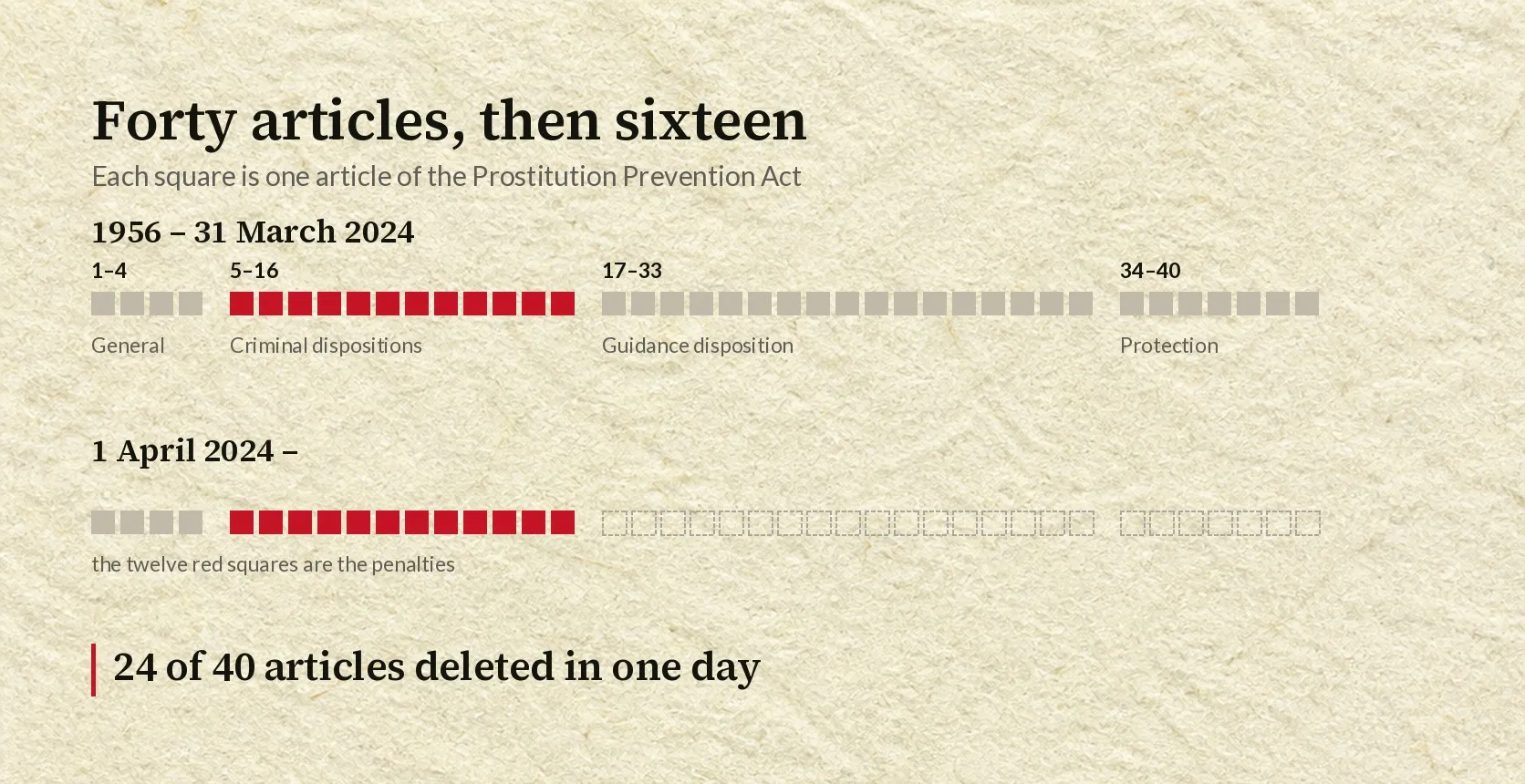
- In 2024, half the law disappeared. Twenty-four of its forty articles (the chapters on guidance disposition and on protection and rehabilitation) were deleted. What remains is sixteen articles, almost all of them penalties.
The sentence that forbids it
Ask the internet whether prostitution is legal in Japan and the answer comes back in the same shape every time: technically illegal, but. Then the qualifications begin: loopholes, grey zones, a definition so narrow that an entire industry walks through it, police who look the other way.
Almost none of these accounts quote the law.
Here is the sentence. Article 3 of the Prostitution Prevention Act of 1956, in full:
No person may either do prostitution or become the customer of it.
One sentence, and it covers both sides of the transaction, not only the person selling, but the person buying.
Now look for the consequence. The act has sixteen articles. Twelve of them sit in a chapter headed Criminal Dispositions, and they set out penalties in the ordinary way: this conduct, that term of imprisonment, that fine. Read them in order and something is missing. None of them punishes a violation of Article 3.
The prohibition has no penalty clause. It is not that the punishment is light, or suspended, or rarely sought. There is no offence to charge.
This is not an accident of drafting, and the act does not hide it. Article 1, the purpose clause, states what the statute intends to do, and it is worth reading slowly:
This Act, in view of the fact that prostitution harms human dignity, is contrary to sexual morality and disturbs the good morals of society, aims to prevent prostitution by punishing acts that promote prostitution and other such acts.
The object of punishment is named in the purpose clause itself, and it is not prostitution. It is acts that promote prostitution. The legislature wrote its own summary of what it was doing, and it says: we are going after the surroundings.
Two articles later comes the last provision of the general chapter, Article 4:
In applying this Act, care must be taken not to unduly infringe the rights of the people.
A prohibition with no penalty, followed by an instruction to tread carefully. Before the statute reaches a single offence, it has already told you how much of the field it intends to occupy.
What the law actually punishes
The chapter on criminal dispositions is short and unusually legible. Set it out and the structure of the whole statute becomes visible at once.
| Conduct | Maximum penalty |
|---|---|
| Soliciting in public, blocking or following people, public touting or advertising | 6 months, or a fine of ¥20,000 |
| Procuring | 2 years, or ¥50,000 |
| Causing prostitution by deception, distress or family influence | 3 years, or ¥100,000 |
| Taking the proceeds after doing so | 5 years and ¥200,000 |
| Advance payments made to induce prostitution | 3 years, or ¥100,000 |
| Contracting to have a person prostitute | 3 years, or ¥100,000 |
| Providing premises | 3 years: as a business, 7 years and ¥300,000 |
| Running a business of having others prostitute | 10 years and ¥300,000 |
| Financing such a business with money, land or buildings | 5 to 7 years and a fine |
Read down the column of penalties and the law’s priorities are unmistakable. The scale rises as you move away from the transaction and towards the organisation of it. Deceiving someone into it, housing them, taking the money, funding the operation. These are where the years accumulate. The heaviest provision in the act, ten years’ imprisonment and a fine, is reserved for a person who houses others in premises they control and makes a business of having them prostitute.
Only one line in that table can reach the person selling: the solicitation offence at the top. Six months, or a fine of twenty thousand yen, a figure set in 1956 and never raised, worth roughly the price of a restaurant meal today. And it does not punish the sale. It punishes soliciting in a way visible to the public, blocking or following people in the street, waiting for customers in public view, advertising. The offence is about the street, not the bed.
Then, at the very end of the chapter, there is Article 16, a provision that most summaries of Japanese law never mention, and that says more about the drafters’ intent than any of the penalties:
Where a person is sentenced to imprisonment for the offence of Article 5 alone, the proviso to Article 25, paragraph 2 of the Penal Code does not apply.
Stripped of the cross-reference: the Penal Code normally bars a court from suspending a sentence a second time in certain circumstances. For the solicitation offence (and for that offence alone), the bar is lifted. The one provision in the act that can reach the person selling comes with a built-in instruction to make suspension easier.
The state wrote a chapter of penalties to dismantle the trade around the person. Where the person herself is concerned, it wrote a minor offence and then made it harder to imprison her for it.
One word does all the work
Every English explanation of Japanese sex work eventually reaches for the word loophole: intercourse is banned, so the industry sells everything except intercourse, and the law is left standing in the doorway.
The premise is right and the conclusion is exactly backwards. Article 2:
In this Act, prostitution means sexual intercourse with an unspecified person in exchange for compensation received, or on the promise of receiving it.
Three conditions, all of which must be met.
Compensation. Money or its equivalent, received or promised.
An unspecified person. This is the condition that English accounts routinely miss. An arrangement with a specified person (one continuing relationship, however commercial) is not prostitution within the meaning of the act. The statute is aimed at the open market, not at the transaction.
Sexual intercourse. Not sexual services. Not physical contact. Intercourse.
Everything the industry sells that is not intercourse is not an evasion of Article 2. It was never inside Article 2. The definition marks a boundary, and the businesses arranged themselves on the far side of it, which is what businesses do with boundaries.
The strongest evidence that this was a choice rather than a failure of imagination sits in another statute, written by the same legislature forty-three years later.
The Act on Punishment of Activities Relating to Child Prostitution, 1999, also has a definition. Where the older act says sexual intercourse, this one says sexual intercourse or any similar act, and then goes further, adding contact with the child’s body for the purpose of satisfying sexual curiosity. And where the older act forbids becoming the customer without penalty, this one states:
A person who engages in child prostitution is punished by imprisonment for not more than five years or a fine of not more than ¥3,000,000.
The buyer. Named, and punished, with a term ten times the solicitation offence and a fine 150 times its maximum.
So Japan is perfectly capable of writing a definition that reaches beyond intercourse, and perfectly capable of prosecuting the purchaser. It has done both, in a statute that has been on the books since 1999. It has simply declined to do either where both parties are adults.
The narrow definition is not a gap the drafters missed. It is a line the drafters drew, and the second statute proves they knew where else it could have gone.
The state licenses the bathhouse
Follow the logic one step further and you arrive at the part that surprises even readers who know the first half.
The businesses on the far side of Article 2 are not merely tolerated. They are defined, categorised and administered by name, in a different act, the same 1948 Entertainment Business Act that licenses pachinko parlours. Its Article 2 sets out a category called sex-related special businesses, and divides it into five kinds: store-based, non-store-based, image-transmission, and two forms of telephone introduction.
Here is the first item of the first kind, in the operative text of the statute:
A business that, as a facility of a bathhouse business, sets up private rooms and, in those private rooms, provides services involving contact with customers of the opposite sex.
That is the legal definition of what English-language writing calls a soap land. A bathhouse (the term is defined by cross-reference to the Public Bath House Act of 1948) with private rooms, in which contact services are provided.
The word intercourse does not appear. Neither does any word for sex. The statute describes a bath, a room and contact, files the business under a category it created for the purpose, and requires notification to the prefectural public safety commission.
Take the two acts together and the architecture is complete. One statute defines prostitution as intercourse and declines to punish it. Another defines a business built around private rooms and contact, and puts it on a register.
The remaining four categories in Article 2 track the industry with the same flat administrative vocabulary: businesses providing contact services in private rooms outside the bathhouse category; venues for shows of undressed figures; facilities for the accommodation of couples; the sale of goods that stimulate sexual curiosity; and, added as the trade moved online, image transmission.
None of these were exempted from anything. There was nothing to exempt them from.
34,861 filings, 347 arrests
The National Police Agency publishes the numbers on both sides of this line every year, in the same document. Its report on 2025 came out in April 2026. Reading those tables carefully matters, because the agency’s categories decide what a number can and cannot show, as they do for the clearance rate examined in our article on how many murders go unsolved in Japan, where the police’s own definition allows the rate to pass 100 percent.
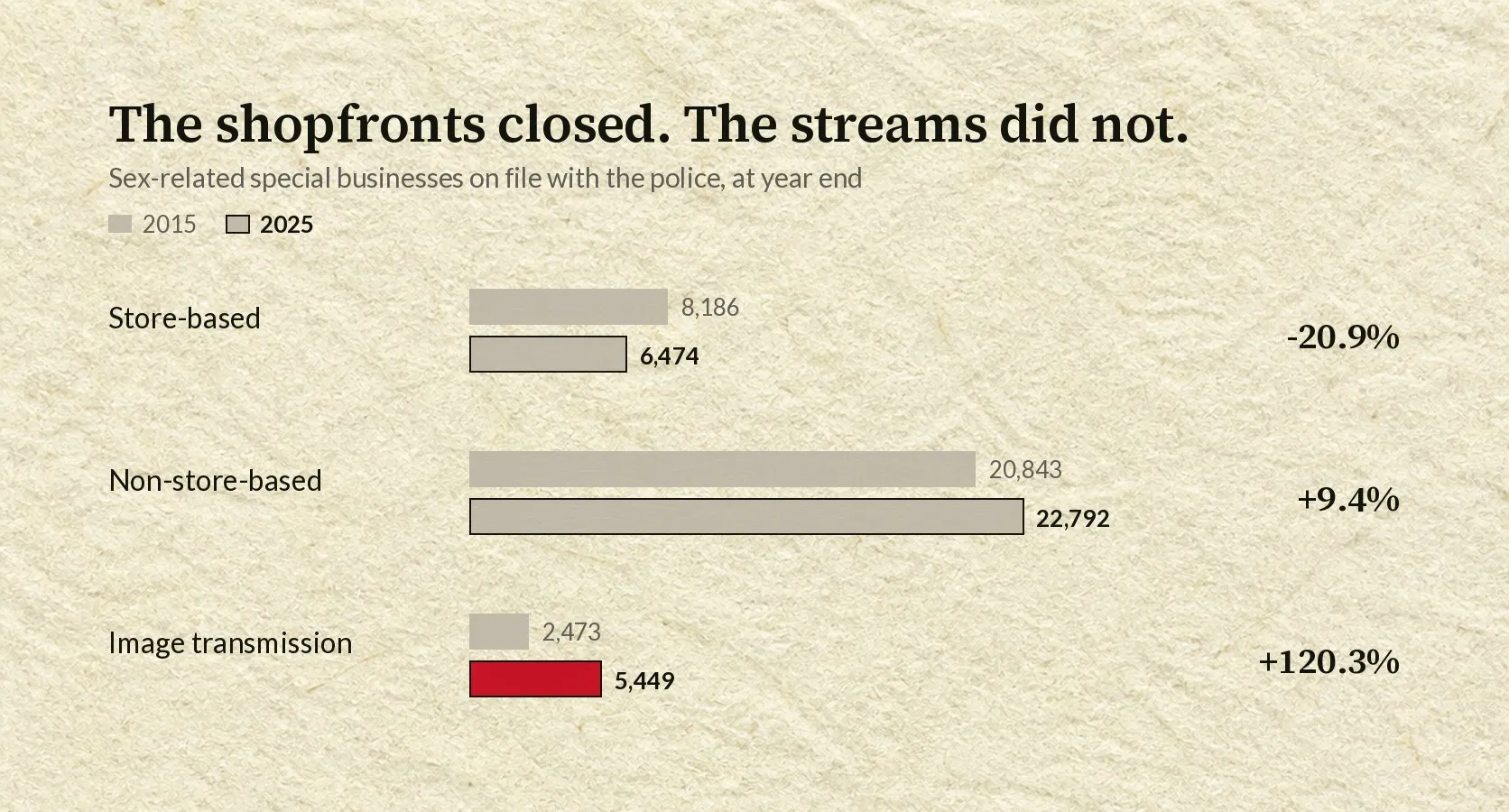
Businesses on file at the end of 2025, and ten years earlier:
| 2025 | 2015 | Change | |
|---|---|---|---|
| All sex-related special businesses | 34,861 | 31,749 | +9.8% |
| Store-based | 6,474 | 8,186 | −20.9% |
| Non-store-based (dispatch) | 22,792 | 20,843 | +9.4% |
| Image transmission | 5,449 | 2,473 | +120.3% |
| Telephone introduction | 146 | 247 | −40.9% |
Cases cleared under the Prostitution Prevention Act, same two years:
| 2025 | 2015 | |
|---|---|---|
| Total | 347 cases / 332 persons | 812 / 538 |
| Solicitation | 200 / 198 | 262 / 236 |
| Procuring | 45 / 42 | 312 / 174 |
| Contracting | 45 / 8 | 157 / 13 |
| Providing premises | 45 / 75 | 66 / 99 |
| Running the business | 2 / 4 | 6 / 6 |
Thirty-four thousand businesses on the register. Three hundred and forty-seven cases in a year. The two numbers are not measuring the same thing, and that is precisely the point: one counts what the state has admitted to its files, the other counts what it has decided to treat as crime, and between them lies everything the statutes leave unnamed.
What a Japanese ministry counts, and what it quietly declines to count, is worth holding in mind whenever official figures are read here. The same state keeps a register of religious believers that comes to 141 percent of the population, because it records what each corporation reports and has no mechanism to ask anyone twice.
Three things in the detail are worth holding onto.
Solicitation accounts for 200 of the 347 cases, well over half of all enforcement under an act whose ten-year sentence is aimed at organisers. The most-used provision in the Prostitution Prevention Act is the one about standing in the street.
Procuring collapsed. From 312 cases in 2015 to 45 in 2025, a fall of 86 percent, while businesses on the register rose. Nothing in these figures explains why; they record what was cleared, not what occurred.
The trade moved indoors and then online. Store-based businesses fell by a fifth in ten years while image-transmission businesses more than doubled. The buildings that English-language writing about Japan tends to photograph (the ones with the signs) are the shrinking part.
We have written before about an underworld that contracts every year while the statute naming it stays fully operative. This is the mirror image: an industry that grows on the register while the act that forbids it is enforced less and less.
One caution on the enforcement figures. The police tables label their rows by conduct (solicitation, procuring, providing premises), and do not print article numbers. The mapping to Articles 5, 6 and 11 follows from the structure of the act rather than from anything stated in the statistics, and the older tables used a different set of category names, so the ten-year comparison should be read as indicative rather than exact.
The word used from outside
Everything so far has been Japan describing itself: its statutes, its categories, its own count of what it files and what it clears. Read from outside, the same arrangement carries a different name.
The United States Department of State publishes an annual assessment of every country’s efforts against human trafficking, sorting them into tiers. Japan reached the top tier in 2018. In 2020 it was moved down, in a paragraph that ends: “Therefore Japan was downgraded to Tier 2.” It has remained there in every report since, including the most recent, published in 2025.
What the 2025 report says about why is worth reading against the first half of this article. The narrow definition described above (the one that leaves everything except intercourse outside the statute) appears there not as a curiosity of Japanese drafting, but as the mechanism:
Due to the limited scope of laws prohibiting commercial sex, widespread exploitation of children and adults took place within a legalized but largely unregulated range of “delivery health services” and urban entertainment centers that facilitated commercial sex acts.
Delivery health services is the non-store-based category from the police table above: the one with 22,792 businesses on file, the one that grew while the shopfronts closed.
The report also states what Japan does not have:
Japan did not have a comprehensive anti-trafficking statute, instead criminalizing sex trafficking and labor trafficking crimes through disparate penal code laws pertaining to “prostitution” of adults and children, child welfare, immigration, and employment standards.
The Prostitution Prevention Act is one of those disparate laws. The report names its Article 7 (the provision on causing prostitution through deception or distress) as one of the instruments Japan uses in place of a trafficking statute.
The numbers the report gives for 2024 are small. The government identified 66 trafficking victims. It prosecuted 47 alleged traffickers and convicted 33, the same figure as in 2022 and 2023. Of those 33, twenty-eight received prison terms ranging from seven months to fourteen years, and seventeen of those sentences were fully suspended. Five were fined and not imprisoned at all.
Japan’s own police statistics run parallel: 96 cases cleared as trafficking offences in 2024, 57 persons, 63 people recorded as protected.
Alongside these sits the report’s observation about children. Between 2018 and 2023, Japanese authorities handled between 577 and 956 “child prostitution” cases a year without formally investigating them as trafficking crimes.
The criticism is not only American. In October 2024 the United Nations Committee on the Elimination of Discrimination against Women reviewed Japan and recommended that it revise its legal provisions
to ensure that they adequately address non-coercive forms of exploitation in labour trafficking, targeting in particular “abuse of power” and “vulnerability”
The committee’s concern is the same shape as the one running through this article: the law is built around force, and around a tightly drawn definition, so exploitation that does not look like force (the exploitation of someone’s circumstances) falls outside it. The committee also noted that the pandemic drove young women and girls into prostitution and sexual exploitation.
Two things should be said plainly about these documents. They are assessments by a foreign government and by a UN treaty body, not findings of fact by a Japanese court. And Japan does not accept the premise that it lacks the means: its own interagency reporting states that the 2005 amendment to the Penal Code, which created the offence of buying and selling persons, made every act falling within the international definition of trafficking a crime in Japan, and it has run a national action plan since 2004, most recently revised in 2022.
But hold the international criticism against the table of penalties from earlier in this article, because the two fit together in an uncomfortable way. The Prostitution Prevention Act already punishes coercion severely. Causing prostitution by deception or distress: three years, five if the proceeds are taken. Making a business of housing people and having them prostitute: ten years, the heaviest provision in the statute.
Those are the articles aimed at exactly what the outside criticism describes. In 2025, the number of cleared cases under the heaviest of them was two.
The provisions exist. The definition around them is narrow, the screening that would bring cases to them is what both the State Department and the UN committee say is missing, and the chapter of the same act that once dealt with the people found inside those cases was deleted in 2024, which is where this article goes next.
The half of the law that vanished in 2024
Everything above describes a statute of sixteen articles. Until two years ago it had forty.
The Prostitution Prevention Act as it stood from 1956 until 1 April 2024 had four chapters. General provisions, then criminal dispositions, and then two more that no longer exist:
| Chapter | Articles | Fate |
|---|---|---|
| 1. General provisions | 1–4 | remains |
| 2. Criminal dispositions | 5–16 | remains |
| 3. Guidance disposition | 17–33 | deleted |
| 4. Protection and rehabilitation | 34–40 | deleted |
Twenty-four articles of forty, removed in a single day. Chapter 3 had provided for guidance disposition, a regime under which a woman convicted of the solicitation offence could be committed to an institution instead of serving her sentence. Chapter 4 had established the women’s consultation offices and the framework of state funding behind them. The Women’s Guidance Home Act was abolished on the same date.
They went because a new statute took over the work: the Act on Support for Women in Difficult Circumstances, passed in 2022 and in force from April 2024. The Ministry of Health, Labour and Welfare’s own explanatory material sets out why, and its language is the most revealing document in this entire article. The ministry described the purpose of the old law as
the guidance disposition and protection and rehabilitation of women likely to engage in prostitution
and gave the reform’s aim as moving the legal basis for supporting women in difficulty away from a statute built on that idea.
Read that twice. For sixty-eight years, the legal home of Japan’s support system for women in crisis (domestic violence, poverty, homelessness) was a chapter of the law against prostitution, and the category it filed them under was women likely to engage in prostitution. Support was administered as an annexe to a criminal statute. In 2022 a member of the House of Councillors put the change on the record in committee, noting that Chapters 3 and 4 would be deleted while Article 5, the solicitation offence, would remain.
That is what happened. The chapters that offered something were removed to a new act. The chapter that punishes stayed where it was.
And it leaves the statute in a shape worth stating plainly. Of the sixteen articles now remaining, twelve are penalties, three are definitional or procedural, and one is an instruction not to infringe rights unduly. The Prostitution Prevention Act, in 2026, contains no provision that helps anybody.
There is a final detail in the supplementary provisions, and it closes the circle. When the act was passed in 1956, it did not all begin at once:
This Act comes into force on 1 April 1957, provided that Chapter 2 and paragraph 2 of the supplementary provisions come into force on 1 April 1958.
Chapter 2 (the penalties) was held back for a year. The legislature enacted a prohibition, then gave the trade twelve months before the offences attached.
The chapter that arrived last is the one still standing.
So is it legal?
The question assumes a binary the statute does not offer, so the honest answer has to be given in the law’s own terms.
Prostitution is forbidden in Japan and is not a crime. Article 3 forbids it, on both sides. No penalty attaches. Buying is forbidden by the same sentence and is likewise not an offence, unless the other person is under 18, in which case a different act punishes the buyer with five years.
The definition is narrow, and deliberately so. Compensation, an unspecified person, intercourse. Miss any one of the three and the act does not apply. The 1999 child prostitution statute demonstrates that the drafters could have written it wider whenever they chose.
The industry outside that definition is not tolerated but administered: five statutory categories, a notification regime, 34,861 businesses on file.
Enforcement runs at 347 cases a year, and its most-used provision is about soliciting in the street.
And from outside, that combination is not described as a legal curiosity but as a mechanism. The US State Department has ranked Japan in the second tier since 2020 and names the narrow definition as the reason exploitation persists inside a legalised, largely unregulated trade; a UN committee asked Japan in 2024 to reach the exploitation that does not involve force. The act contains provisions of three, five and ten years aimed at precisely that conduct. In 2025 the ten-year provision produced two cleared cases.
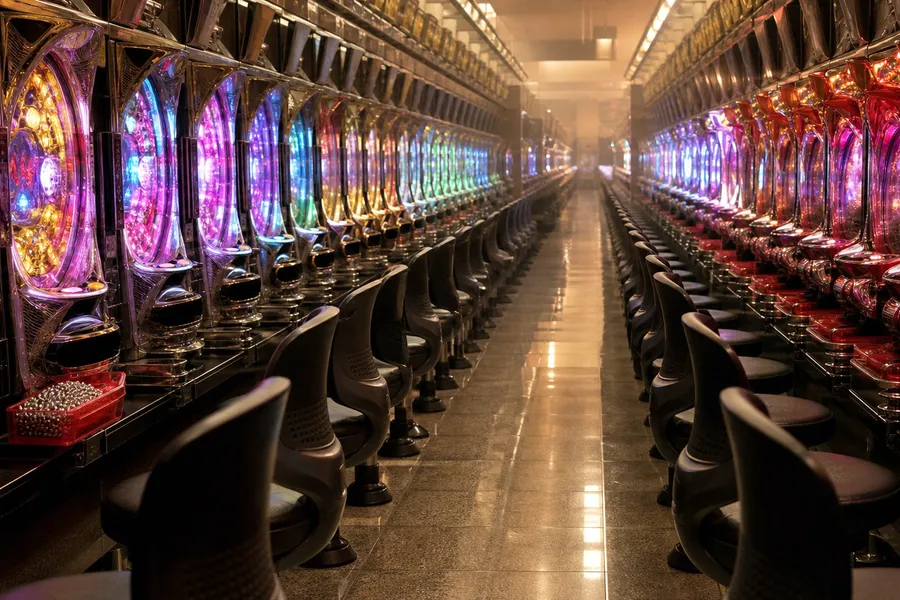
Readers of this site will recognise the instrument by now. Japan regulates pachinko to the yen while declining to say whether the cash at the end of it is lawful. It designates organised crime groups rather than outlawing them, and writes their internal rituals into the statute book without banning the organisations that practise them. It dissolved a religious corporation through the courts while creating no category for dangerous religion.
The same technique, applied here, produced something more austere than in any of those cases. The state condemned the act in the purpose clause of its own statute (harms human dignity, contrary to sexual morality) declined to make it an offence, drew the definition tightly enough that most of the trade fell outside it, opened a register for what remained, and then, in 2024, removed the half of the law that had been about helping anyone.
What is left is a sentence that forbids, with nothing behind it, and a filing cabinet with 34,861 entries.