Quick answer
Yes. In 2023, 162,761 people in Japan were sentenced by a judge who never saw them. No hearing. No courtroom. A summary court judge read the file the prosecutor sent over, decided it was appropriate, and issued an order imposing a fine.
That is 68.3 per cent of everyone Japan prosecuted that year.
The instrument is called a ryakushiki meirei, a summary order. It can impose a fine of up to 1,000,000 yen and nothing heavier, it is issued by the smallest court in the system, and the entire proceeding consists of a judge reading paper.
Two things make it stranger than it first sounds. The first is that it cannot be done to you without your written agreement. The prosecutor is required by statute to tell you that you may have an ordinary trial instead, and to obtain your consent in writing before asking for the order. The second is that you have fourteen days to tear it up, and almost nothing published tells you how many people do.
What follows is drawn from the Code of Criminal Procedure itself, the Road Traffic Act, the Supreme Court’s published outline of Japanese criminal justice, and the training text the Ministry of Justice produces for foreign officials. Where we could not verify something, we say so.
The number nobody divides
“Japan has a 99.9 per cent conviction rate” is the most repeated sentence in English about Japanese criminal justice. It is usually offered as a finished thought.
It is a fraction, and the interesting part is underneath the line.
Here is what Japanese prosecutors did with the people who came to them in 2023, from the Supreme Court’s own published outline, which draws on the Ministry of Justice’s annual prosecution statistics:
| Disposition | People | Share |
|---|---|---|
| Not prosecuted | 507,221 | 64.1% |
| Referred to family court | 46,091 | 5.8% |
| Prosecuted | 238,145 | 30.1% |
| Total | 791,457 | 100.0% |
Then the prosecuted 238,145 splits again:
| Route | People | Share of those prosecuted |
|---|---|---|
| Application for a summary order | 162,761 | 68.3% |
| Formal prosecution | 75,384 | 31.7% |
Of the formal prosecutions, 72,457 went to district courts and 2,927 to summary courts.
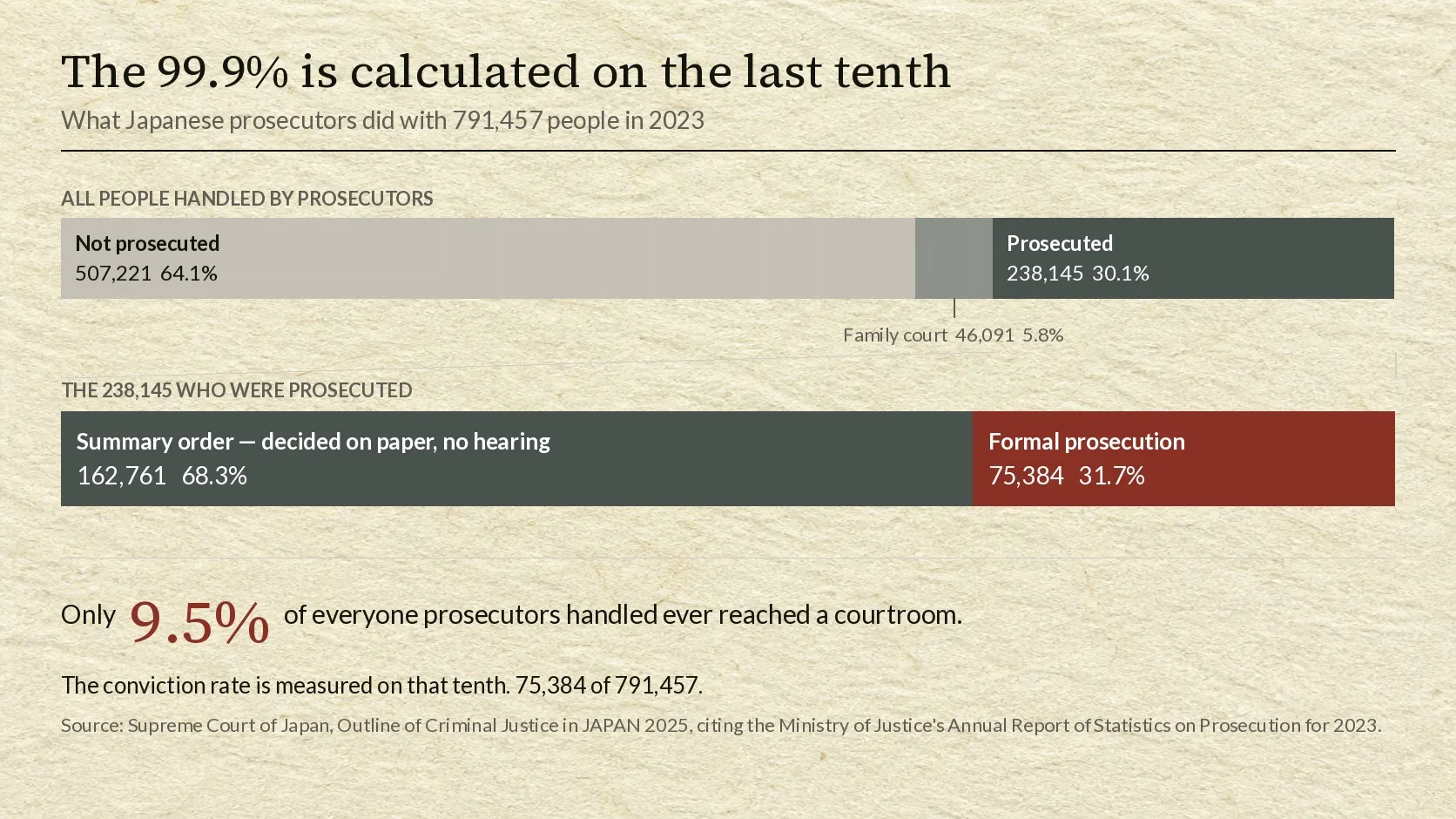
Run those two tables together. Out of 791,457 people, the number who were prosecuted in the ordinary way (the way that produces a courtroom, a defendant in it, and a verdict) is 75,384. That is 9.5 per cent.
The conviction rate is calculated on that tenth. The other nine tenths were either released without charge or dealt with on paper.
None of this is hidden. It is in a document the Supreme Court publishes in English. But a rate is a ratio, and a ratio can be repeated for years without anybody asking what is in the denominator. The same habit produces the recurring English headline that crime in Japan is surging, which is true of the direction and wrong about the scale, and the report that most Japanese citizens refuse jury duty, which describes a decision the court made rather than one the citizen made.
Nor is the paper route a recent efficiency measure that has quietly taken over. The Ministry of Justice’s own training text for visiting officials, written more than a decade ago, already introduced it as “an important part of the Japanese criminal process,” noting that a vast majority of minor cases are disposed of by summary orders. The proportions have moved since then; the position of the mechanism in the system has not. It has been the main exit for years.
Why two thirds are never charged
Before following the 30 per cent who are prosecuted, it is worth stopping at the 64 per cent who are not, because the two figures are made of the same decision.
Article 248 of the Code of Criminal Procedure is the whole of it:
Where prosecution is deemed unnecessary owing to the character, age and environment of the offender, the gravity of the offence and the circumstances, and the situation after the offence, prosecution need not be instituted.
Read it again with an English-speaking reader’s assumptions in place. There is no reference to the strength of the evidence. This provision is not about cases that cannot be proved; it is about cases that can be proved and are dropped anyway. The disposition has a name in Japanese practice (kiso yūyo, suspension of prosecution), and it sits alongside the two more familiar grounds for declining to charge: no offence was committed, and the evidence is insufficient.
The training materials that Japan’s own justice ministry produces for visiting officials, through the UN-affiliated institute it hosts, describe the evidentiary threshold without any diplomatic softening. Prosecutors, the text says, will not prosecute “unless conviction is very likely,” and it is “long established practice not to prosecute unless the prosecutor is almost 100% certain of a conviction.” Compelling a citizen to defend themselves without that certainty is treated as an irresponsible use of the power.
Then comes the sentence that ought to end most English-language arguments about the 99.9 per cent:
As a result, the actual conviction rate is 99.89%.
That is not a critic’s inference. It is the Japanese explanation of its own number, in an official English-language text, presented as an outcome of the screening rather than a mystery to be solved. The rate is high because the cases that would lower it were never brought.
So the funnel narrows twice before anyone reaches a courtroom. Once when prosecutors decline to charge two thirds of the people in front of them. And again when two thirds of those they do charge are routed away from a hearing entirely.
The screening has a cost that shows up elsewhere in the system. A prosecution service that will not move without near-certainty is also a prosecution service that leaves cases open, which is part of why so few Japanese homicides are recorded as unsolved and yet so many take years, the standard that produces the conviction rate is applied long before a courtroom is booked.
What a summary order actually is
Article 461 of the Code of Criminal Procedure is one sentence long, and every clause in it matters:
A summary court may, on the request of a public prosecutor, and before trial, impose by summary order a fine or petty fine of not more than 1,000,000 yen in a case within its jurisdiction.
Before trial. Not instead of a verdict after a short one, before the trial stage exists at all. The same article allows the court to suspend execution of the sentence, order confiscation, and make other incidental dispositions.
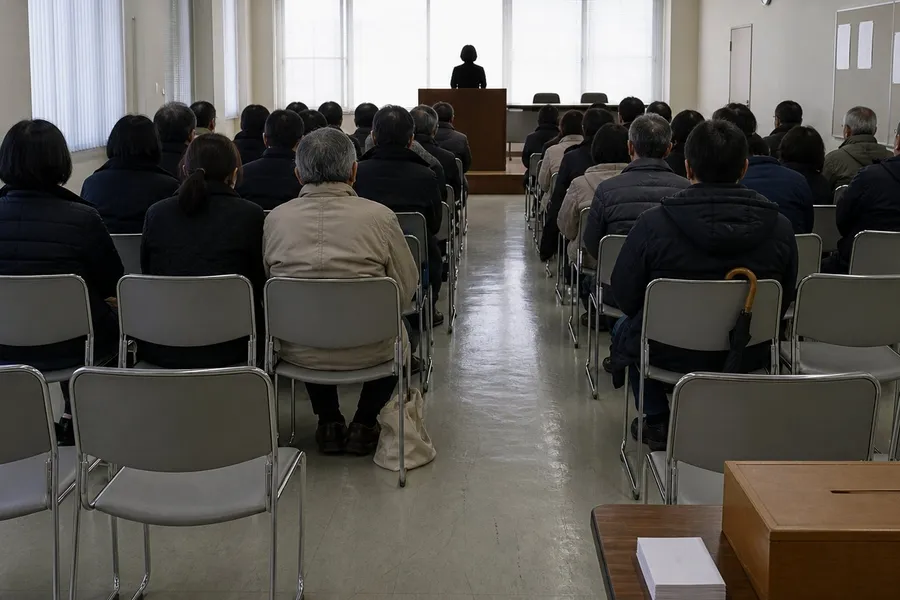
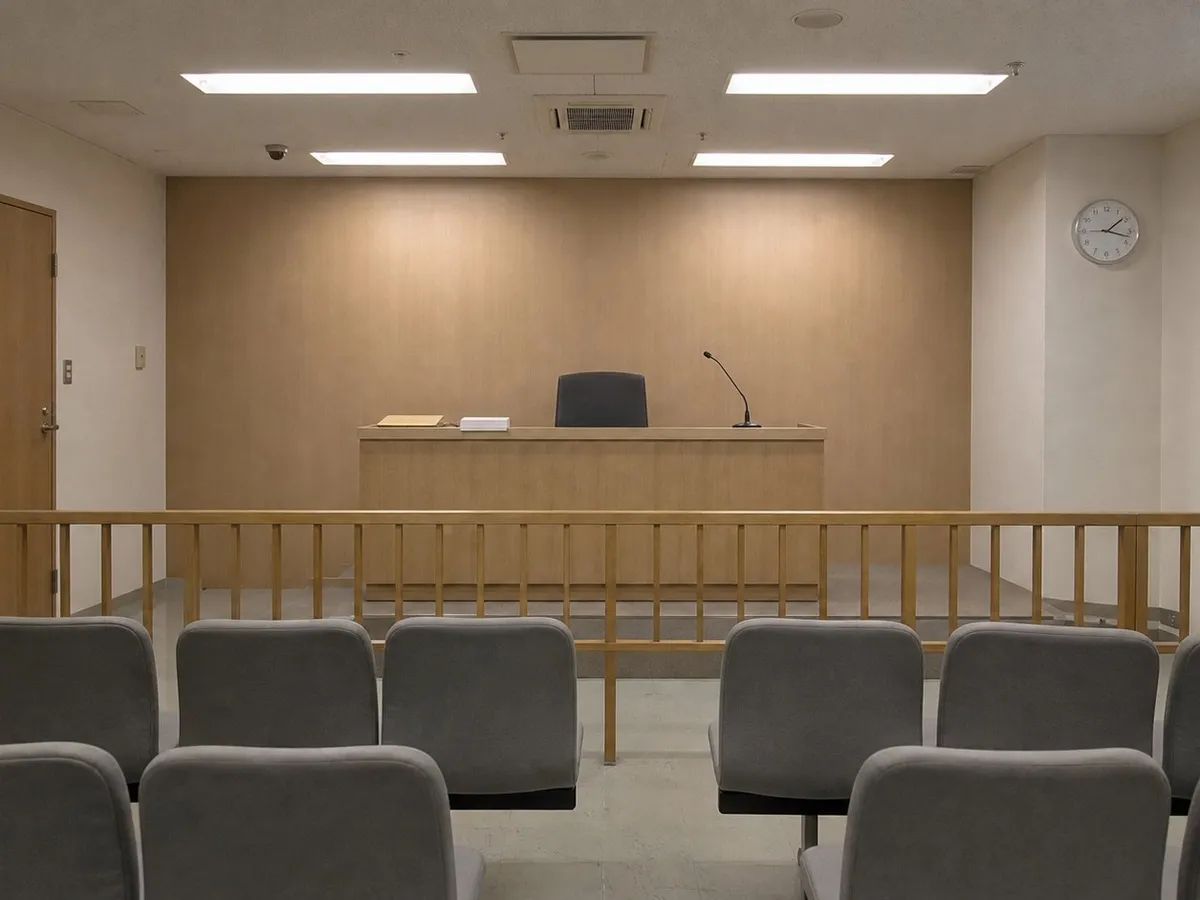
The Supreme Court’s own public explanation of what summary courts do describes the mechanics plainly: the procedure requires that the suspect has no objection, it is conducted as a documentary examination without opening a courtroom, and the judge issues the order after examining the evidence the prosecutor has submitted and finding it appropriate.
There is no hearing to attend. There is no moment at which the person being punished is looked at.
Who ends up with one
The ceiling in Article 461 does two jobs. It caps what the order can do to you (a fine or petty fine of not more than 1,000,000 yen), and it decides, in advance, which cases can travel this route at all. An offence that must draw imprisonment cannot be disposed of on paper, because the order is incapable of imposing it.
The court that issues it is the smallest one Japan has. Summary courts generally hear only criminal cases where the penalty is a fine or lighter; they may impose imprisonment for a limited set of offences carrying light statutory penalties, such as theft and embezzlement, and then only within limits fixed by law. A single judge handles each case.
Put the jurisdiction and the ceiling together and the population comes into focus: minor offences, admitted, not in dispute, punishable by money. Shoplifting. Minor assaults. Traffic cases that fall outside the fixed-penalty scheme. The kind of case where the facts were settled at the police station and everything after that is administration.
Whether that is a humane way to keep small matters out of a courtroom, or a machine for producing convictions without examining them, is the argument. The figures do not settle it. They only establish the scale: this is not a rarely used byway. It is how most Japanese prosecutions end.
You have to say yes
This is the part that gets left out of the shorter descriptions, and it changes the character of the thing.
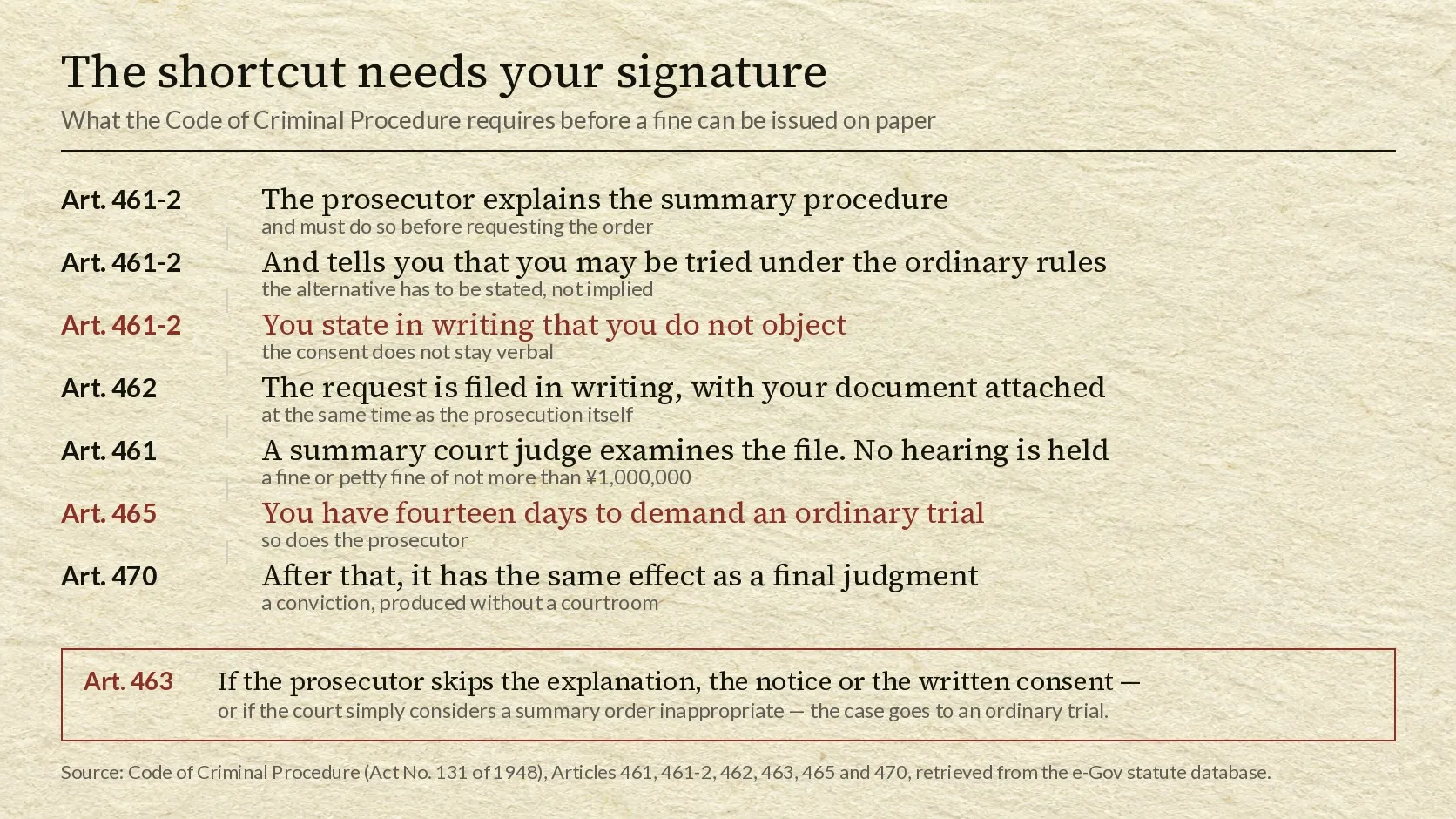
Article 461-2 does not permit the prosecutor to simply file. Before requesting a summary order, the prosecutor must explain to the suspect the matters necessary to understand the summary procedure, must tell the suspect that they may be tried under the ordinary provisions, and must confirm that the suspect has no objection to proceeding summarily.
And the suspect’s answer does not stay verbal. Where there is no objection, the suspect “must make that clear in writing.”
Article 462 then requires that the request for a summary order be made in writing, at the same time as the institution of prosecution, and that the suspect’s written statement be attached to it.
So the file that arrives on the judge’s desk contains a document in which the accused person has agreed, in writing, not to have a trial.
And the judge can refuse
A consent-based shortcut invites an obvious question: what stops it being used on a case that deserves a hearing?
Article 463 gives two answers.
The first is discretionary. If the court considers that the case is one in which a summary order cannot be issued, or that issuing one would not be appropriate, it must proceed under the ordinary provisions. The judge is not a rubber stamp for the prosecutor’s chosen route.
The second is a sanction, and it is aimed squarely at the prosecutor. If the prosecutor requested a summary order without carrying out the procedure in Article 461-2 (without the explanation, the notice, the confirmation) or in violation of the requirement to attach the written consent, the court must likewise proceed to an ordinary trial.
The explanation is not a formality that can be skipped when everyone is busy. Skipping it costs the prosecutor the shortcut.
Fourteen days
Article 465: a person who has received a summary order, or the prosecutor, may request a formal trial within fourteen days of being notified of it. The request is made in writing, to the court that issued the order.
Under Article 468, if the request is lawful, the case is heard under the ordinary provisions, and the court “is not bound by the summary order.” The Supreme Court’s public explanation puts the consequence in plainer language: where a formal trial is requested, the summary order loses its effect.
Fourteen days is not a long time to reconsider a decision you made in a police station, but the door is genuinely there, and it opens in both directions: the prosecutor can walk through it too.
The clause about not being bound deserves a second look, because it cuts both ways and the statute does not say which. A court hearing the case afresh is released from the order’s terms; the text does not restrict that release to reductions. What that means for someone deciding whether to spend the fourteen days (whether asking for a trial can leave you worse off than the order you objected to) is a question of practice rather than text, and we could not establish the practice from published material. We note the wording and stop there.
What the wording does establish is that the summary order is provisional in a way a judgment is not. For fourteen days it is an offer with a deadline attached. After that it is something else entirely.
It is still a conviction
Article 470 closes the loop. Once the period for requesting a formal trial has passed, or the request has been withdrawn, the summary order has the same effect as a final and binding judgment. The same is true if a request for formal trial is dismissed and that dismissal becomes final.
This is the sentence that should give an English-speaking reader pause. The outcome is not an administrative penalty, a citation, or a settlement. It is a conviction and a fine with the force of a judgment: produced by a process in which no evidence was contested, no witness was heard, and the defendant was never in the room.
Two thirds of the people Japan prosecutes end there.
It is worth being precise about what Article 470 does and does not say. It does not say the order resembles a judgment, or carries similar weight, or is treated as one for certain purposes. It says it has the same effect. Whatever a final judgment does in Japanese law (as a record, as a bar on being tried again for the same act, as something an authority can later look up), the summary order does, having been produced without any of the machinery that judgments are supposed to require.
This is also the sense in which the consent in Article 461-2 is doing heavy lifting. The system’s answer to the obvious objection (that a conviction should not be manufactured on paper) is that the person convicted agreed to it, in writing, after being told they could have a trial instead. Everything rests on that document being a real choice rather than a form handed over at the end of a long day in a police station. Which returns us to the fourteen days, and to the number Japan does not appear to publish.
The ticket in your hand
If you have driven in Japan, you may be wondering whether the slip a police officer once handed you was one of these. Usually, it was not, and the distinction is worth getting right, because the two systems are often collapsed into one in English.
Minor traffic offences run through a separate scheme in Chapter 9 of the Road Traffic Act. Article 125 defines the “infraction,” the “infractor,” and the sum payable. Article 126 requires the officer to give written notice of the facts constituting the infraction and the category it belongs to, and specifies that the written notice must state the matters necessary to understand the procedure.
Then Article 128(2) does the decisive thing:
A person who has paid the stipulated sum … is not prosecuted, nor referred to family court, in respect of the act that gave rise to the notice.
Payment is not a fine and produces no conviction, because there is no prosecution to convict anybody in. Article 130 approaches it from the other side: an infractor may not be prosecuted until the notice has been given and the payment period has elapsed.
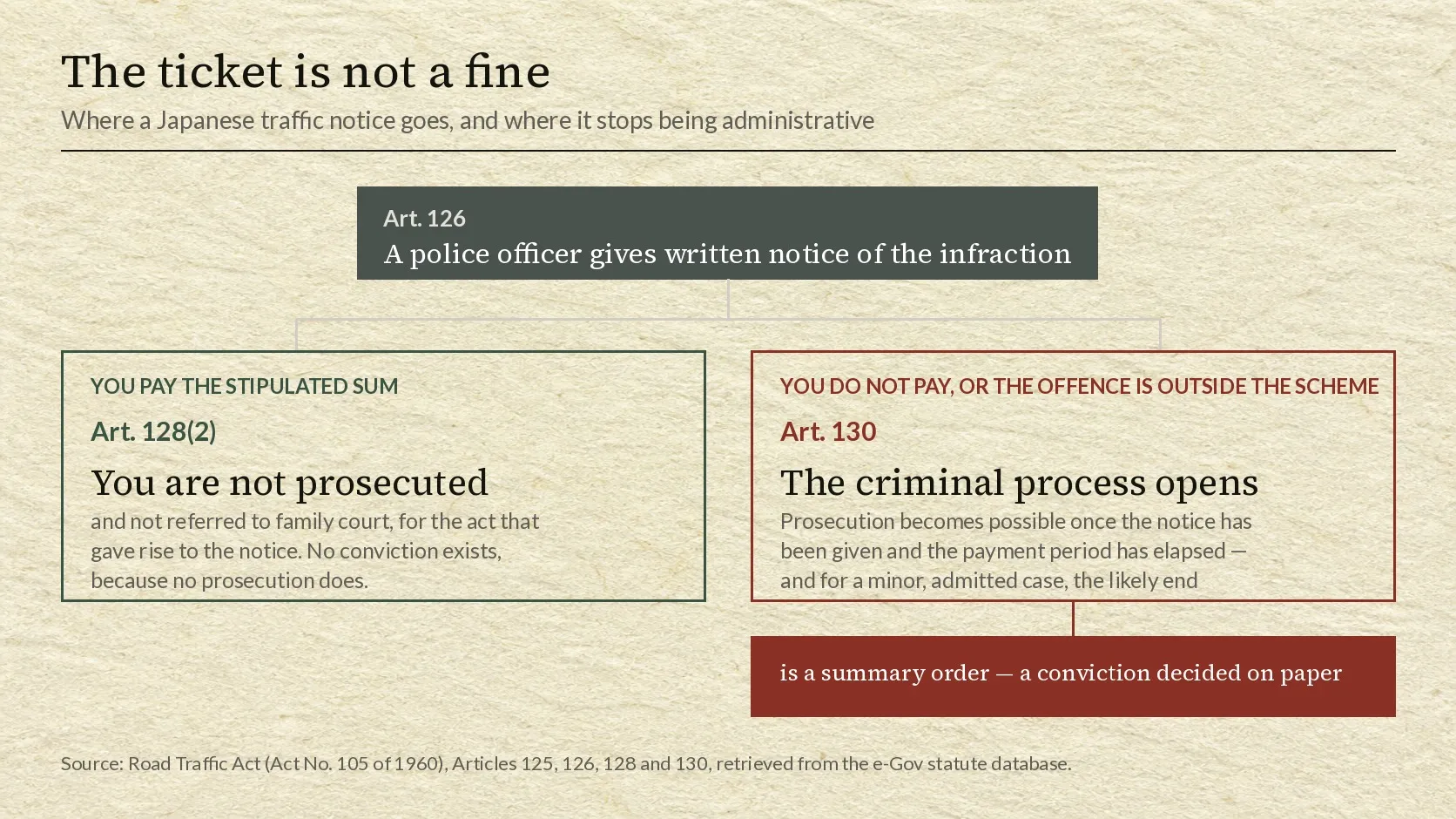
That is the fork. Pay, and the criminal process never begins. Do not pay (or commit something the scheme does not cover) and the ordinary criminal process becomes available, with the summary order sitting at the end of it as the most likely destination for a case that is minor, admitted, and undisputed.
What we could not confirm
One number would complete this article, and we could not find it published.
How many people use the fourteen days?
The right exists in the statute. Whether it is exercised a thousand times a year or a dozen is the difference between a safeguard and a formality, and it is the first thing a reader should want to know. We looked in five places:
- the White Paper on Crime (Ministry of Justice), the server refused our requests
- the Judicial Statistics search system (Supreme Court): the annual tables are behind a dynamic search that did not return the criminal-division tables to us
- e-Stat, the government statistics portal. We could not locate a direct table for applications for formal trial
- the National Diet Library’s index of the Judicial Statistics Annual Report, redirected without content
- the Supreme Court’s report on expediting trials: its criminal chapter covers ordinary first-instance cases in district courts, which is precisely the population that summary orders are not part of
Japan publishes a great deal about this system. It publishes how many summary orders prosecutors ask for, how many people are prosecuted formally, in which courts, and what the maximum penalty may be. What we could not find, in any of those places, is the number of people who read the order, looked at the fourteen-day deadline, and said no.
It is not the first time we have run into this particular edge. When we looked at Japan’s plea bargaining system, the Ministry of Justice was asked at its own review council how many agreements had been proposed and signed, and declined to answer, one of its stated reasons being that the figures might let the public identify which cases had used it. A missing number is not always a filing error. Sometimes it is the most informative thing on the page.
If you know where that figure is published, we would like to see it.