Quick answer
- No Japanese statute exempts pachinko from the gambling law by declaring it something else. The act that licenses these businesses describes them, in its own operative text, as places that let customers play games “likely to stimulate the speculative spirit.”
- The three-shop system is not a loophole the industry discovered. One article of that act closes four separate routes to cash: no cash prizes, no buying back prizes, no taking the balls outside, no receipts for balls held. The exchange booth exists in the one space those four prohibitions leave open.
- The state sets the numbers itself. A machine may not be built to fire more balls than about ¥400 a minute of play buys. A single prize may not exceed ¥9,600 plus tax. The body that tests the machines is designated by the National Public Safety Commission.
- In 2018 the state called it speculative conduct, placing “gaming at pachinko parlours” in the same statutory definition as horse and bicycle racing, inside a law about addiction.
- What the state has never done is explain the cash. Asked in 2007 whether the three-shop system amounts to the buy-back the law forbids, the Director-General of the Cabinet Legislation Bureau said his office was “not necessarily aware of the actual state” of it, and declined to answer.
The question in English, and the sentence in Japanese
English-language explanations of pachinko arrive, almost without exception, at the same word: loophole. Gambling for money is a criminal offence in Japan. Pachinko parlours pay in steel balls, the balls become prizes, the prizes become cash at a window down the street. An illegal activity, the reasoning concludes, survives inside a technicality that nobody has bothered to close.
The word does real damage, because it implies that the state was outmanoeuvred.
Open the statute and you find that it was not.
The Act on Control and Improvement of Amusement Business (the 1948 law that licenses these businesses) defines the category pachinko belongs to in Article 2, paragraph 1, item 4: mahjong parlours, pachinko parlours and other businesses that install equipment and let customers play games “likely to stimulate the speculative spirit.”
That phrase is not a critic’s characterisation borrowed for effect. Shakōshin (the speculative impulse, the urge toward windfall) is the term the legislature chose, and it sits inside the definition of the thing being licensed. Japan authorised these businesses while describing them, in the operative text of the authorising law, as equipment for stimulating the desire to gamble.
Now read the offence they are supposedly evading. Article 185 of the Penal Code: gambling is punishable by a fine of up to ¥500,000 or a petty fine. And then the sentence English discussions almost never quote: “this shall not apply when a person bets a thing which is provided for momentary entertainment.” Article 186 raises the penalty for habitual gambling to imprisonment of up to three years, and for opening a gambling place for profit to between three months and five years.
So Japan has a gambling offence with a written-in exception for trivial stakes, and a licensing statute that openly regulates businesses built around the speculative impulse. The question worth asking is not how pachinko slipped between the two. It is what the state built in the space between them, and the answer is: a great deal, in considerable detail, over seven decades.
What the law actually forbids
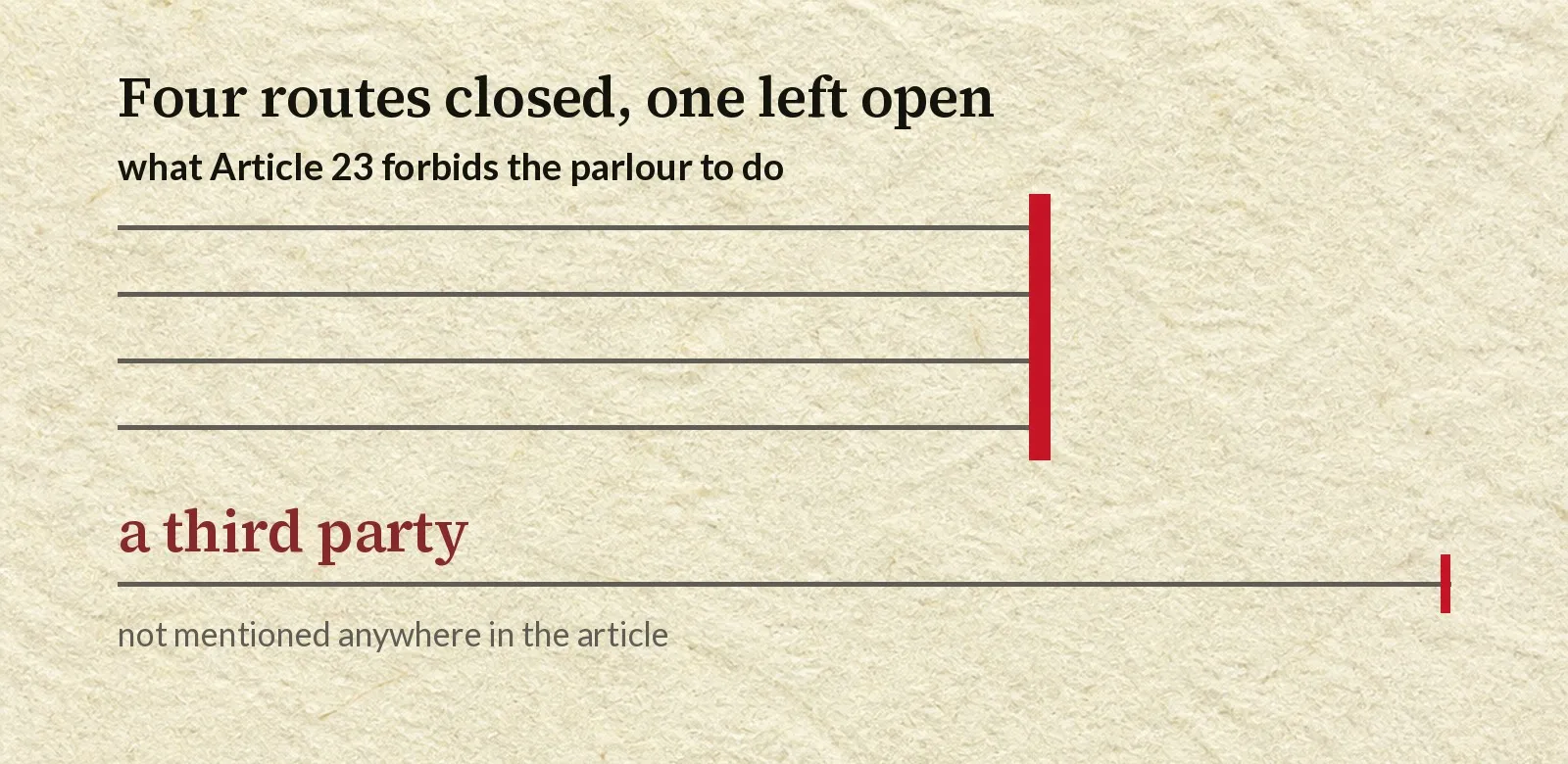
Article 23 of the same act is headed “prohibited acts of persons operating game parlour businesses.” For pachinko operators it lists four, and they should be read as a sequence:
- providing cash or securities as prizes;
- buying back prizes provided to customers;
- letting customers take the balls or medals used in play out of the premises;
- issuing customers a document showing that balls have been held on their behalf.
The first closes the direct route: no money across the counter. The second closes the obvious workaround: the parlour may not hand you a prize and then buy it back. The third closes the physical route: the balls cannot leave the building with you. The fourth closes the paper route: no receipt, no claim ticket, nothing that could function as a stored-value token.
This is not the drafting of a legislature that forgot about cash. It is the drafting of one that thought about cash four times in succession and shut each door in turn.
What Article 23 does not mention is a third party. The parlour may not buy your prize. It says nothing about anyone else buying it.
And so, in a country where the law had sealed every route between the parlour and your wallet, a window appeared in a small building nearby. You carry your prize out, a booth that is a different business buys it for cash, and a wholesaler sells the same prize back to the parlour. Three businesses, one circuit, and no single participant doing the forbidden thing.
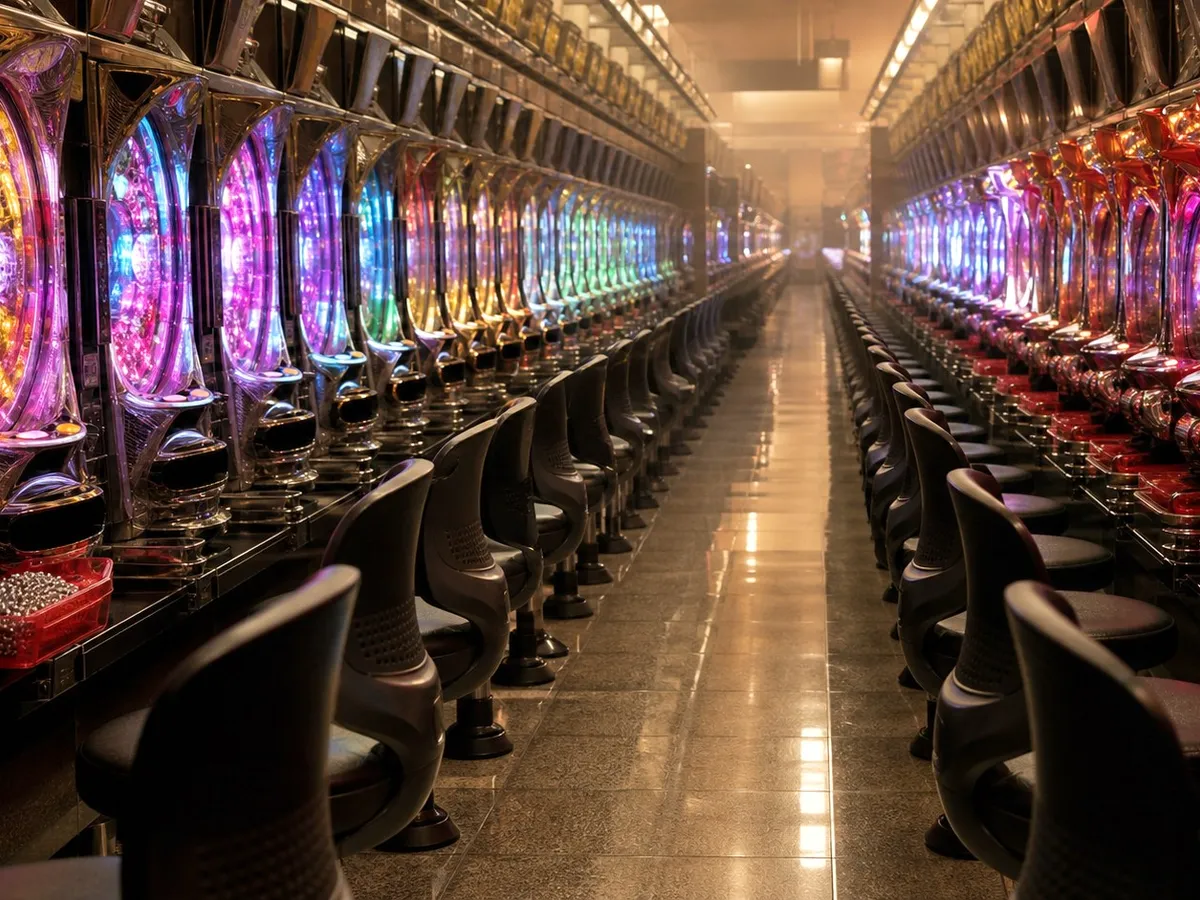
What this looks like from the floor is unremarkable, which is part of why it has lasted. The circuit was described in plain terms in a Diet committee in 2018: the customer receives prizes according to the balls won; the prizes are turned into cash, in most cases at an exchange booth close by the parlour; and the booth sells what it has bought back to the parlour. A player who finishes ahead carries their balls to a counter to be counted by machine, exchanges the count for goods from a display (confectionery, household items) and, kept apart from those, the small items known as special prizes. Those go outside, to a window in another building, and cash comes back. Nobody inside the parlour has done any of the four prohibited things.
The three-shop system is not what the industry found in the law. It is the shape the law left behind.
The answer the state declined to give
Which raises the obvious question, and in 2007 a member of the House of Representatives asked it directly.
On 15 June 2007, in the Cabinet Committee, Masahiko Yamada distributed a document setting out how prize exchange actually works and asked whether the three-shop system falls within the buy-back that Article 23 prohibits. When the responsible minister did not take it, he put the question to the government’s own authority on statutory interpretation: the Cabinet Legislation Bureau.
The Director-General, Reiichi Miyazaki, answered:
Article 23, paragraph 1 of the Entertainment Business Act prohibits pachinko operators from buying back prizes they have provided to customers. That is the rule as a norm. As to how the three-shop system you refer to should be applied to and understood under this provision, this bureau is not necessarily aware of the actual state of this so-called three-shop system, and I would therefore refrain from answering.
Yamada’s reply is in the record too. He had briefed the bureau’s staff at length the previous day, he said, and handed over the documents; the bureau had a full day; interpreting statutes is what the Cabinet Legislation Bureau exists to do. He narrowed the question to something a person can answer from ordinary observation (I have played pachinko, taken a prize, and never once had the parlour buy it back from me; so it does not fall under Article 23, does it) and asked again.
The record shows no answer.
There is a way to read this that is not cynical. A legislation bureau interprets provisions against established facts, and the facts here are commercial arrangements between private parties that no ministry has formally established. Declining to characterise them is defensible.
But it means that the single most consequential question about an industry of this size (does the mechanism by which its customers obtain money violate the article written to stop exactly that) has never been answered by the office whose function is to answer such questions.
The state has, however, quietly answered a narrower version of it. It knows precisely when a booth is illegal.
In the House of Councillors Cabinet Committee on 5 July 2018, Tomoko Tamura set out what she had been told in briefings from the police: there are prosecuted cases where the parlour and the exchange booth had the same operator, and cases where the booth was staffed by the parlour’s own employees. The reasoning she reported for those prosecutions was that such an arrangement risks amounting to gambling and harms public morals. Her point was that, seen from outside, nothing distinguishes those cases from the ordinary ones: the customer walks to the booth, the money changes hands, the prize returns to the parlour.
Fumio Yamashita, Director-General of the Community Safety Bureau of the National Police Agency, answered for the government:
The Entertainment Business Act prohibits pachinko operators from providing cash and the like as prizes and from buying back prizes provided to customers. The purchase of a prize by a third party other than the pachinko operator does not immediately constitute a violation of the Act. […] Were purchases by third parties other than the operator to be regulated, the scope of regulation would extend without limit to ordinary sales of goods, which could amount to excessive regulation. In any event, the police will continue to take strict action against unlawful conduct such as the purchase of prizes by persons recognised as substantially identical to the pachinko operator.
Put the two answers side by side and the architecture becomes visible. The line is not drawn around the transaction. It is drawn around the relationship between the parties. The identical sequence of events (prize out, cash in, prize back) is a crime when the two businesses share an owner or share staff, and lawful when they do not. Japan did not decide that exchanging prizes for money is acceptable. It decided that the parlour must not be the one doing it, and then policed that boundary while declining to describe what stands on the other side of it.
It would be wrong to read this as an oversight nobody noticed. In the same 2007 session, having failed to get an answer, Yamada put the alternative on the record himself:
Either recognise the present three-shop system as it stands, or, if it is wrong, amend the law, make a new law. This has been called for, for ten years, twenty years, thirty years, and it has been left alone.
That was said in 2007. Nearly two decades later the position is unchanged: no statute has been written to authorise pachinko as public gambling, and none has been written to close the circuit. Japan did not fail to make the choice. It has been choosing, continuously, not to make it.
The state sets the odds
The idea that pachinko is under-regulated does not survive contact with the rules.
Article 19 of the act requires operators to comply with standards set by the National Public Safety Commission covering play charges, the method of providing prizes, and the maximum price of a prize. Article 4 allows a prefectural public safety commission to refuse a licence outright where the machines to be installed meet the standard for stimulating the speculative spirit to a marked degree.
The numbers themselves are in the Enforcement Regulation, and they are startlingly specific.
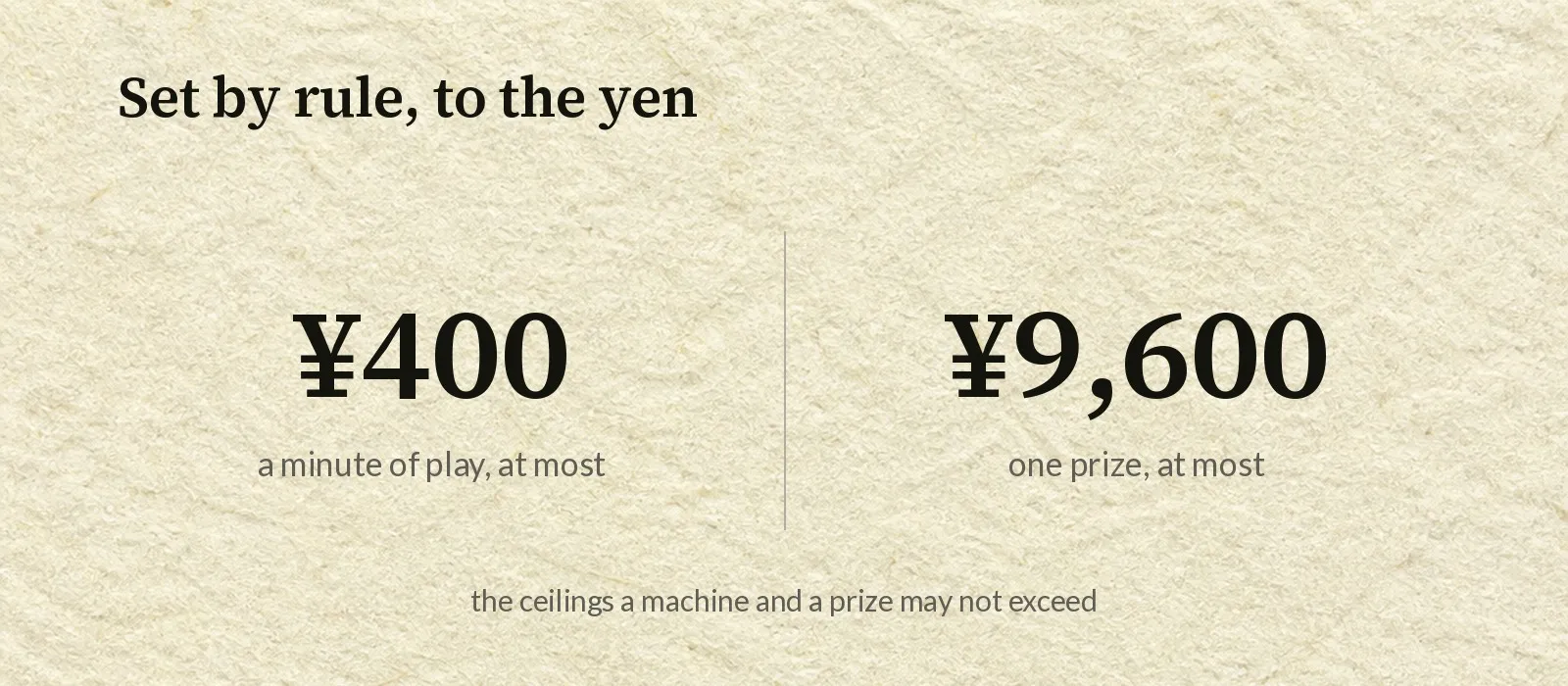
A pachinko machine may not be capable of firing more balls than a play charge of about ¥400 per minute would buy. Not “excessive payouts are prohibited”: a rate, per minute, in yen, written into a national rule. The same ceiling is set for pachislot machines, arrange-ball machines and the rest, each in its own paragraph.
And the prize: the maximum price of a single prize may not exceed ¥9,600, plus the corresponding consumption tax. That is why the special prize a winning player carries out of the door is denominated the way it is. The ceiling is not an industry convention. It is a figure in a National Public Safety Commission rule.
A state that did not wish to be responsible for this activity would not be setting the yen-per-minute rate at which a machine may consume a customer’s money.
Who tests the machines
If the state fixes the numbers, someone has to verify that each machine obeys them, and here the structure turns.
Under Article 20, type testing of gaming machines is performed by a body designated by the National Public Safety Commission. The designated body is the Security Communication Association, known in the industry as Hotsukyo. No machine reaches a parlour floor without passing its test.
On 23 February 2017, in the First Subcommittee of the House of Representatives Budget Committee, Kensuke Onishi took this apart in public. He had gone through the government’s own published records of post-retirement employment under the National Public Service Act and extracted the cases where police officials had moved into the pachinko sector, and he tabled the list. Two of his examples were about as direct as such things get: from the Wakayama prefectural police to the Wakayama prefectural amusement business cooperative; from the Yamaguchi prefectural police to the Yamaguchi prefectural amusement business cooperative.
The name that recurred in his table, he said, was Hotsukyo. He put its economics on the record: a type test costing about ¥1.44 million for a pachinko machine and ¥1.63 million for a pachislot machine; fee income of roughly ¥2.4 billion in fiscal 2015 alone; a testing monopoly without which no machine can be sold; and applications for type testing running well above the number of models actually released: which, he suggested, looks like fees being generated for the benefit of the body receiving them.
He set one more figure beside it: in the previous year, 1,329 recorded penal code offences had been committed with the raising of money for pachinko as their motive or cause.
The government’s answer, again from Fumio Yamashita, addressed the testing regime and nothing else:
Type testing of gaming machines is provided for in Article 20, paragraph 5 of the Act. Because it is necessary to secure the fairness and neutrality of the testing work, and to have the technical capacity to analyse the performance of increasingly sophisticated machines […] it is to be performed by a person whom the National Public Safety Commission recognises as meeting those conditions and designates. At present the Security Communication Association is designated as that testing body. This is not limited to one body under the Act; where other bodies meet the conditions, they too may be designated.
The reemployment figures were not addressed.
These numbers are a legislator’s assertions, tabled in committee with supporting documents; they are recorded in the Diet minutes, and the government did not dispute them, but they are not findings the state has adopted. What is not in dispute, because it comes from the statute and the government’s own answer, is the structure: the state fixes the numerical limits on how much a machine may take from a player, and the verification that each machine complies is carried out by a single body that the state designates, for a fee paid by the manufacturer.
And then the state called it gambling
For seventy years the arrangement described above ran on a distinction: pachinko is yūgi, play, and not tobaku, gambling. Then, in 2018, the Diet wrote a definition that made the distinction impossible to maintain in the ordinary sense of the words.
The Basic Act on Gambling Addiction Countermeasures, Article 2:
In this Act, “gambling addiction” means a state in which daily life or social life is impaired as a result of becoming absorbed in gambling and the like (meaning public racing conducted pursuant to the provisions of law, gaming at pachinko parlours, and other speculative conduct).
Gaming at pachinko parlours sits in the same parenthesis as horse racing, bicycle racing, boat racing and motorcycle racing, activities that are gambling in the plain sense and are exempted from the Penal Code by their own special statutes. All of it is named, collectively, speculative conduct.
Article 1 of the same law explains why the Diet was legislating at all. Gambling addiction, it states, gives rise to “serious social problems such as multiple indebtedness, poverty, abuse, suicide and crime.”
The two propositions the Japanese state maintains simultaneously are therefore these. Pachinko is not gambling for the purposes of the Penal Code, because no one at the parlour hands over money. And gaming at pachinko parlours is speculative conduct capable of producing multiple indebtedness, poverty, abuse, suicide and crime, for the purposes of the law on addiction.
Both are true statements of Japanese law. They describe the same machines.
And the second one is not decorative. Article 23 of that Act requires the state to survey the problem every three years. The survey for fiscal 2023, conducted by the Kurihama Medical and Addiction Center, estimated that 1.7 per cent of adults are people in whom gambling dependence is suspected, based on their gambling in the preceding twelve months.
What follows from that estimate is a national plan, adopted by the Cabinet on 21 March 2025, and its table of contents is the most direct answer to the question this article asks. It contains chapters devoted specifically to pachinko: advertising and promotion; the removal of ATMs and similar machines from parlours; the structure of addiction countermeasures within the industry. These are not chapters about an amusement arcade.
One programme in it is worth stating in full, because it has no counterpart in ordinary retail. Under the self-declaration and family-declaration programme, a person can ask that they themselves be restricted from entering, or a family member can ask it on their behalf. As of the end of November 2024 the programme had been adopted by 6,130 parlours, 92.2 per cent of them.
More than nine in ten of the premises where, legally speaking, no gambling takes place are equipped with a mechanism allowing a customer to have themselves barred from the door.
The line Japan redrew in 2025
The most recent movement makes the state’s actual position legible, because it shows where Japan is prepared to be blunt.
On 18 June 2025 the Diet amended the Basic Act on Gambling Addiction Countermeasures, and the amendment took effect on 25 September 2025. It inserted Article 9-2, which prohibits (as conduct, by anyone transmitting information on the internet) presenting websites for illegal online gambling, and advertising or otherwise inducing people toward them.
Read the law as a whole and the line is unmistakable. One statute now contains, in its definitions, an inventory of the speculative conduct Japan conducts lawfully (public racing, gaming at pachinko parlours) and, a few articles later, a prohibition aimed at the speculative conduct it treats as criminal. The same law that declines to call pachinko gambling has no difficulty at all in naming online casinos illegal and banning the advertising that leads to them.
Japan is not squeamish about the word. It is specific about which activities it has taken inside its own control.
The industry is disappearing anyway
While the legal architecture held, the business it governs has been contracting for years, and the National Police Agency counts it precisely.
At the end of 2020 there were 9,035 licensed pachinko businesses in Japan. At the end of 2024 there were 6,706, a fall of about a quarter in four years. Installed machines dropped over the same period from about 4.00 million to about 3.33 million.
One number moved the other way. Machines per parlour rose from 443.3 to 496.0. The parlours are disappearing; the survivors are getting bigger.
This is the same shape this site has measured elsewhere: an underworld that shrinks every year while the statute that names it stays fully operative; motorcycle gangs that dissolved as organisations while the behaviour persisted without them. The regulatory apparatus around pachinko (the per-minute ceilings, the designated testing body, the quarterly machinery of licensing) now governs an industry that has lost a quarter of its premises in four years.
So why is it legal?
Because Japan did not choose between banning and permitting. It chose a third thing, and it has used the same third thing repeatedly.
It defines the activity in its own statute, in unflattering language, games likely to stimulate the speculative spirit. It fixes the numbers: yen per minute, yen per prize, the threshold above which a licence may be refused. It designates who verifies compliance. It prohibits the parlour from touching cash, four ways in one article. And it declines to describe what happens in the building next door: while retaining, and using, the power to prosecute the moment the two buildings turn out to have the same owner.
Readers of this site will recognise the technique. Japan designates organised crime groups rather than outlawing them, and regulates their internal customs article by article, naming the ritual in the statute. It dissolves a religious corporation through the courts while creating no category for dangerous religion. It leaves the tattooed customer to a rule no statute contains. It forbids prostitution in a single sentence and attaches no penalty to it, then puts the businesses that grew around the gap on a register.
Pachinko is the same instrument applied to money. The state never granted it the dignity of a licence to gamble, and never took the risk of banning an industry that had already installed four million machines across the country. It regulated the machines to the yen, policed the boundary between the parlour and the booth, put the whole activity into a law about addiction: and, when asked in the Diet to say plainly whether the arrangement in between is lawful, replied that it was not necessarily aware of the actual state of it.
That is not a loophole. A loophole is a gap the drafters missed. This is a gap the drafters left, and the state has been standing beside it for seventy years, taking notes.