Quick answer
- Japan did not dissolve the Unification Church for what it teaches. The legal test under Article 81 of the Religious Corporations Act is documented unlawful conduct that clearly and substantially harms public welfare. What the courts examined was how money was raised, over what period, and with what degree of organization.
- The order does not ban the religion, and this is the point most often lost in translation. Dissolution removes legal personality, the ability to own property and hold assets as an entity. The same law that permits dissolution states that nothing in it may be read as restricting anyone from spreading doctrine or performing religious acts.
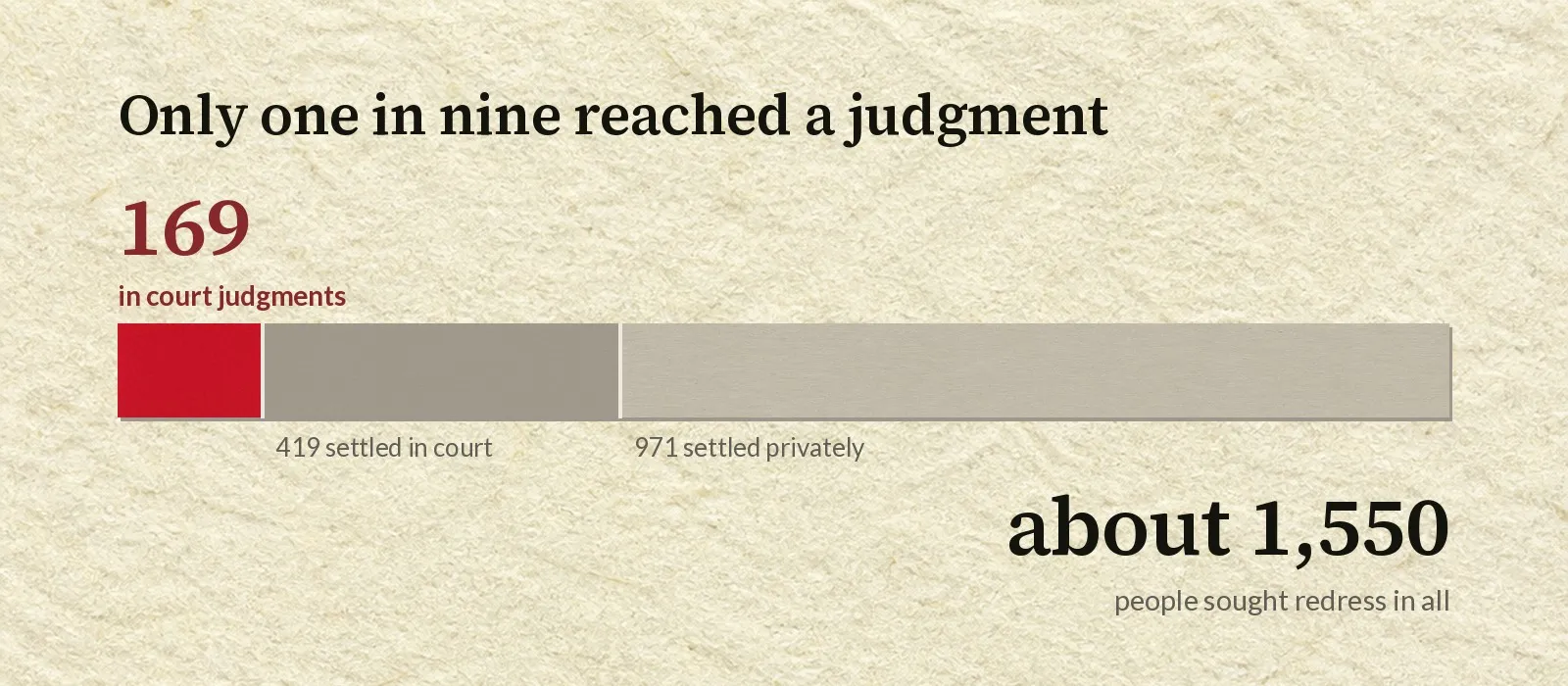
- It was a first. Japan had dissolved only two religious corporations before, and both rested on criminal convictions. This case rested on civil liability: 32 judgments, 419 court settlements, 971 private settlements, and a documented total of roughly ¥20.4 billion.
- It took half a century, and the delay is the more interesting question than the ruling. The conduct the courts described begins in 1973. The government first used its power to demand answers in November 2022, four months after a former prime minister was shot dead by a man whose family had been ruined by donations to the organization.
What the order actually does
Start with what was taken away, because almost every English-language description of this case overstates it.
A shukyo hojin (a religious corporation) is a legal container. Japan’s Religious Corporations Act of 1951 says so in its opening line: the purpose of the law is to give religious organizations legal capacity so they can own places of worship and other property, maintain them, and run the business of their own operations. The container is not the religion. It is the vehicle that lets a religion hold a deed, sign a lease, employ staff and be taxed as an entity rather than as a crowd of individuals.
Dissolution destroys the container. It does not touch what was inside.
The law says this explicitly, in the second paragraph of that same first article: freedom of religion as guaranteed by the Constitution must be respected in all state affairs, and no provision of the law may be construed as restricting any individual, group or organization from spreading doctrine, performing rites and ceremonies, or carrying out other religious acts. That sentence was written into the statute in 1951 and it has not moved. A dissolved organization’s members may still believe, still meet, still worship, still proselytize. They may re-form as an unincorporated association and continue indefinitely, as many small religious groups in Japan already do without ever seeking corporate status.
What they lose is institutional. The corporation cannot hold property or enter contracts in its own name. It loses the tax treatment that comes with religious-corporation status. And its accumulated assets stop being the organization’s to direct: on the day dissolution took effect, the estate passed to a liquidator appointed by the court.
This is why the Japanese government’s own language about the case is about money rather than belief. When the Minister of Education, Culture, Sports, Science and Technology issued a statement on 4 March 2026, he said the court had accepted the ministry’s contention that unlawful donation solicitation by the organization’s believers had inflicted financial and psychological damage on a large number of people over a long period, and that liquidation would now proceed under court supervision, with the ministry hoping the process would deliver relief to victims. Not a word about doctrine, because doctrine was never the question before the court.
Fifty-three years, in order
The dates matter here more than usual, because they show a long stretch of nothing followed by a very fast sequence.
| When | What happened |
|---|---|
| From 1973 | The period of organized financial harm later found by the Tokyo High Court |
| 8 July 2022 | Former prime minister Shinzo Abe is shot dead while campaigning in Nara |
| From November 2022 | The Agency for Cultural Affairs begins exercising its reporting-and-questioning power, seven times in total |
| 16 December 2022 | A new law on unjust solicitation of donations is promulgated |
| October 2023 | The Minister of Education, Culture, Sports, Science and Technology requests dissolution from the Tokyo District Court |
| 20 December 2023 | A second law is promulgated, adding legal-aid measures and restrictions on how the organization may dispose of property |
| 25 March 2025 | The Tokyo District Court orders dissolution |
| 4 March 2026 | The Tokyo High Court rejects the organization’s appeal; the same day, the District Court appoints a liquidator and liquidation begins |
| 22 June 2026 | The Supreme Court dismisses the final appeal; the ruling is reported the following day |
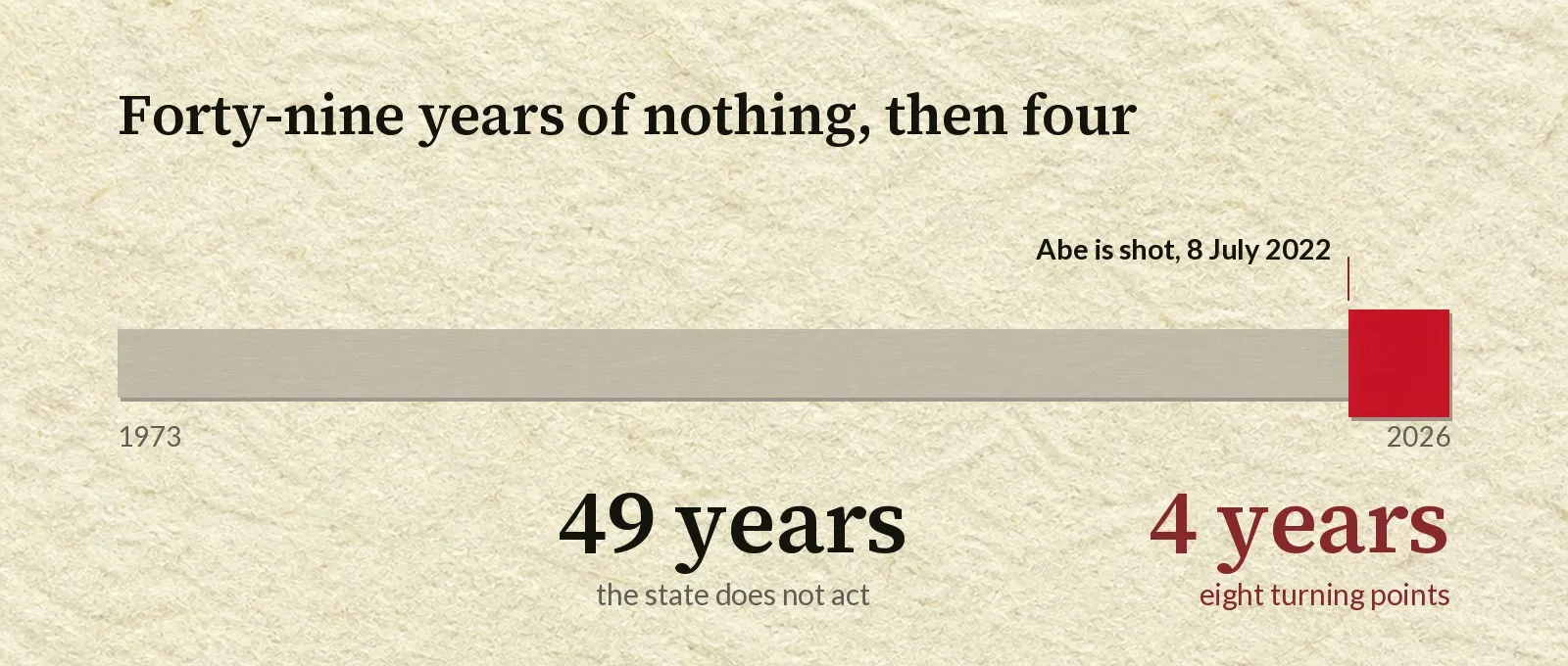
Two features of this sequence are worth pausing on.
The first is that liquidation began in March 2026, three months before the Supreme Court ruled. That is not a procedural irregularity. Article 81 gives the organization a right of immediate appeal against a dissolution order, and it specifies that such an appeal against an order of dissolution suspends execution. So the March 2025 district-court order sat inert for a year. When the High Court dismissed the appeal in March 2026, the suspension ended and the order took effect at once, which is why the court appointed a liquidator the same day. The further appeal to the Supreme Court, a tokubetsu kokoku, carries no such suspensive effect. By the time the Supreme Court spoke, the estate had been in a liquidator’s hands for three and a half months.
The second is the gap between “from 1973” and “November 2022.” Nothing was discovered in 2022 that the state could not have found earlier. The 32 civil judgments the government later relied on had been accumulating in Japanese courts for decades. What changed in 2022 was not the evidence.
The test the courts applied
Article 81 of the Religious Corporations Act lets a court dissolve a religious corporation on the request of the competent authority, an interested party or a public prosecutor, or on its own initiative. The government invoked the first two of its five grounds:
- Ground 1, that the corporation “has committed an act in violation of laws and regulations that is clearly recognized as substantially harming public welfare.”
- Ground 2, first clause, that it “has committed an act that substantially deviates from the purposes of a religious organization” as defined in Article 2.
Ground 1 is the operative one, and its wording repays attention. It is not a standard of belief, sincerity or social approval. It has three moving parts (a violation of law, harm to public welfare that is substantial, and a link between them that is clearly recognized) and it puts the burden of all three on the party asking for dissolution.
The Tokyo District Court found them met. Its 25 March 2025 decision, under presiding judge Kenya Suzuki, held that the organization’s conduct violated laws and regulations and was clearly recognized as substantially harming public welfare, describing the donation-related damage as unprecedented in both the number of people affected and the amounts involved. The Tokyo High Court upheld that a year later on the finding that the organization had inflicted large-scale losses as an organization, continuously, from 1973 to 2022.
The Supreme Court’s Third Petty Bench, presided over by Justice Eriko Watanabe, dismissed the final appeal on 22 June 2026 by unanimous decision of its four justices. It framed the question as one requiring caution (the importance of religious freedom must be borne in mind and the matter examined carefully) and concluded that dissolution was necessary and unavoidable in order to address the conduct, and therefore did not violate Article 20 of the Constitution. The organization had argued that dissolution would make religious activity impossible. The court rejected that argument on the scale and continuity of the harm.
What the evidence looked like
The most useful public document in the entire case is not a judgment. It is the briefing paper the Agency for Cultural Affairs handed to reporters when it filed the request in October 2023, because it lays out exactly what the state thought it could prove and how.
The alleged conduct was described as follows: that from around 1980 at the latest, continuously and over a long period, for the purpose of the corporation’s own financial gain, the organization drove large numbers of people into anxiety or confusion, constrained their free decision-making, and had them make donations or purchases in a state where normal judgment was impaired, inflicting substantial financial loss and psychological sacrifice on many people and harming the peaceful lives of many others, including their relatives.
Three pillars held that up.
The judgments. Thirty-two civil rulings had already found the corporation liable in damages, covering 169 plaintiffs, awarding roughly ¥2.2 billion, an average of about ¥13.2 million per person. These were not concentrated in one region or one decade. They came from courts across Japan, over more than forty years.
The pattern. Despite that dispersal, the judgments kept identifying the same three techniques, which the government listed as (1) mishoshi kanyu (proselytizing and subsequent education without disclosing that the teaching was the organization’s own doctrine; (2) innen toku) telling a target that ancestral karma would bring grave misfortune on them, their family or their descendants, thereby inducing fear; and (3) inducing donations disproportionately large relative to the person’s means. Similar facts recurring in unrelated cases across the country was, the government argued, strong evidence that the conduct was systematic rather than incidental.
The manuals. This was the decisive piece. The agency reported that the organization had produced instructional materials for proselytizing, product sales and donation solicitation, and that these materials described concealing the organization’s identity while offering guidance, exploiting a person’s misfortune to heighten anxiety, and obtaining donations disproportionate to their finances. Written procedure turns a pattern into an institution. It is the difference between many believers behaving badly and an organization instructing them to.
Around this sat a body of evidence about scale that never reached a courtroom. Beyond the 169 people covered by judgments, 419 people had reached court-mediated settlements and 971 had settled out of court after demanding restitution through counsel: about 1,550 people in total, with settlements and awards totaling roughly ¥20.4 billion, an average of about ¥13.1 million each. The agency also interviewed more than 170 victims directly, and noted that many needed time simply to be able to speak about what had happened.
The part that reads worst
The second ground (substantial deviation from the purposes of a religious organization) required the ministry to explain why this was not religion behaving imperfectly but an organization pointed at money. Six findings supported it, and they are worth stating plainly because they describe method rather than belief:
- Individuals were approached personally, actively and persistently, in a way that did not respect the voluntariness that is otherwise taken for granted in donation.
- The techniques prioritized the corporation’s financial interest.
- Believers received guidance that placed the corporation’s interest above their own conscience, in terms that discouraged judging instructions by whether they were right, lawful or moral.
- The financial damage was enormous in aggregate and substantial per person.
- Before soliciting, the organization conducted various investigations to establish a target’s assets and whether they held decision-making power over household spending.
- The consequences reached believers’ children: family relationships broken by a parent’s donations, childhoods spent in poverty, university abandoned.
The fifth item is the one that is hardest to reconcile with any account of ordinary religious fundraising. Researching whether a person can authorize a large payment without a spouse’s agreement is not a devotional practice.
Two smaller facts about how Japan built this case deserve mention, because they cut against the picture of a state bulldozing a religion.
The reporting-and-questioning power the agency used seven times, under Article 78-2, is weaker than it sounds. Before using it, the minister must consult the Religious Juridical Persons Council. Officials must respect the religious character and customs of the organization and take particular care not to impede freedom of religion. To enter the organization’s facilities in order to ask questions, they must obtain consent. And the statute states flatly that the power “shall not be construed as having been granted for the purpose of criminal investigation.”
The agency also went back to the council before filing, and asked whether requesting dissolution was appropriate. The council said it was.
The first case built without a conviction
Japan has dissolved a religious corporation under Article 81 twice before, and in both instances the criminal courts went first.
Aum Shinrikyo, which released sarin on the Tokyo subway in March 1995, was the first application of Ground 1; the Tokyo District Court ordered dissolution that October, the order became final in December 1995 when the immediate appeal was dismissed, and the Supreme Court dismissed a further appeal the following month. Myokakuji, a temple organization that extracted large sums through spiritual-healing scams, was raided by Aichi prefectural police on suspicion of fraud in October 1995, saw its leadership imprisoned, and was dissolved by order of the Wakayama District Court in January 2002 after the Agency for Cultural Affairs filed in 1999.
In both cases, the unlawful conduct had already been established by criminal judgment. The dissolution followed the conviction the way a consequence follows a cause.
The Unification Church case had no such foundation. There was no criminal conviction of the corporation for the donation practices at issue. What existed instead was a mass of civil liability (tort judgments, settlements, restitution agreements) and the government’s argument that when civil liability accumulates on this scale, with this consistency of method, over this span of time, it satisfies Article 81 on its own.
That is why Japanese coverage of the March 2025 ruling led with the phrase minpo-jo no fuho koi de hatsu, “a first, on civil tort.” The novelty was never the outcome. It was the evidentiary route to it. Every religious corporation in Japan now operates under a precedent it did not face before 2025: sustained, organized civil wrongdoing can cost you your legal existence even if no prosecutor ever charges you.
The two defenses, and why they failed
The organization did not merely deny the facts. It made two structural legal arguments, both of which would have made Article 81 inapplicable no matter how bad the conduct was. They are the intellectual core of the case, and the government’s answers to them are laid out in the briefing paper.
“Violation of laws and regulations does not include the Civil Code.” The organization’s first argument was textual. It pointed to a Tokyo High Court decision of 19 February 1995 (from the Aum Shinrikyo dissolution), which had described the ground as covering conduct that violates “prohibitory or mandatory norms established by positive law such as the Criminal Code.” Read narrowly, that phrase confines Article 81 to criminal wrongdoing, and civil tort would never be enough.
The ministry’s rebuttal had three parts. First, that the 1995 decision had also said the purpose of the dissolution scheme was to prevent a religious corporation from turning into a “criminal, anti-moral or anti-social entity”, language that contemplates more than convictions. The reference to the Criminal Code, it argued, reflected the case in front of that court, which was the deliberate, organized production of sarin for mass murder, and cannot be read as excluding the Civil Code. Second, that the word “laws and regulations” carries no textual limitation whatsoever. Third, and this is the argument that shows how the Japanese state builds these cases, that the legislative record settles it: in the House of Councillors Education Committee on 24 March 1951, the provision was understood to cover “laws and orders, all of them.” The ministry added a structural point: a religious corporation’s legal personality derives from its status as a public-benefit entity under civil law, so there is no reason to exempt from dissolution an organization that violates the very civil-law order that gave it that personality.
“The believers did it, not the corporation.” The second argument was subtler. None of the 32 civil judgments had found that the corporation’s representative officers or senior executives ordered or directed the solicitation. If the acts were not the leadership’s, the organization argued, they cannot be treated as acts “of the religious corporation.”
The ministry’s answer was that this reading would empty the statute. In a religious corporation, believers are the ones who act; if nothing counts unless the representative officer personally ordered it, no dissolution would ever be possible. The test it proposed instead was whether, on the relationship between the actors and the corporation, their position, the purpose and course of the conduct, and where its benefits landed, the acts can be regarded in ordinary social terms as the corporation’s own activity.
It then listed five findings that, in its view, made them exactly that:
- The conduct was carried out by believers in connection with the organization’s doctrine.
- Its purpose was to obtain property for the corporation, and the corporation did in fact receive the donations and acquire the property.
- Instructions concerning donations were issued from headquarters to individual churches, and those churches took part in obtaining donations and selling goods.
- Donation revenue and sales became the basis of rewards and punishments within the organization.
- The methods were uniform nationwide, indicating an organization coordinating churches across the country.
Point 4 is the one that does the most work. An organization that measures and ranks its branches by how much money they extract is not an organization whose members merely happened to behave badly. It is a structure with an incentive system pointed at the outcome the courts found unlawful.
Why it took fifty years: politics as credibility
Here is the part that a purely legal account cannot explain. If the conduct runs from 1973, and civil courts were finding the organization liable across four decades, why did the Japanese state not act until 2022?
There is no single documented answer, and we are not going to invent one. But there is a well-evidenced element, and it is not the one people usually reach for. The value the organization drew from Japanese politics was not protection from prosecution, no evidence in the public record shows politicians obstructing cases. It was something harder to litigate and more useful in a living room: credibility.
The alliance began in the Cold War. The International Federation for Victory Over Communism, a political organization founded in 1968 and still active, describes itself on its own website as a conservative political body with the slogan that communism is wrong. It was founded by the same religious movement, and it gave that movement a reason to be in the same rooms as Japanese conservatives during the decades when anti-communism was the organizing principle of the Japanese right. The relationship that grew from there has been described in Japanese reporting as reaching back to Nobusuke Kishi, prime minister from 1957 to 1960 and Shinzo Abe’s maternal grandfather. We were unable to verify the specifics of Kishi’s own involvement from primary sources, and we leave it there.
Before the next part, a note on the office involved, because Japan’s two most prominent figures are easily conflated from outside the country. Japan has both an emperor and a prime minister, and only one of them governs. The Constitution makes the emperor “the symbol of the State and of the unity of the people,” and Article 4 states that he “shall not have powers related to government.” Executive power belongs to the Cabinet, which the prime minister heads. So a Japanese prime minister lending his name to an organization is not a ceremonial monarch offering a blessing that carries no political weight. He is the elected head of government, and after leaving office he keeps whatever standing his faction and his record give him.
A former prime minister lent his face. On 12 September 2021, Abe (by then out of office, but the longest-serving prime minister in Japanese history and still the most powerful figure in the ruling party’s largest faction) sent a video message to an event held by the Universal Peace Federation, an organization founded in 2005 by Hak Ja Han, the leader of the Family Federation. In it he expressed respect for Han and for those working with the UPF toward resolving conflicts around the world and toward peaceful unification of the Korean Peninsula. The message was recorded in a Tokyo studio and played to the event from the organization’s facility in South Korea. The organization’s own affiliated outlets published it and preserved it.
Consider what a recording like that is worth at the point of solicitation. The techniques the courts identified depended on a target’s willingness to keep listening: through undisclosed proselytizing, through claims about ancestral misfortune, up to a donation beyond their means. A group that can show a former prime minister addressing its affiliate with respect is not a group a hesitant person easily dismisses as a fringe outfit. That is the mechanism the victims’ lawyers have long pointed to, and it requires no illegality by any politician to function.
The scale was measured, once, by the ruling party itself. On 8 September 2022 (two months after Abe was killed) the Liberal Democratic Party published the results of an internal review, and it remains the single most precise public document on the relationship. Secretary-General Toshimitsu Motegi told reporters that all 379 LDP members of both houses of the Diet had responded, and that 179 had answered yes to at least one of eight questions. The breakdown:
| Contact | Members |
|---|---|
| Sent congratulatory telegrams or messages to events (328 instances, of which 20 were video messages) | 97 |
| Appeared in interviews or dialogues in the organization’s publications (48 instances) | 24 |
| Sent a secretary to an affiliated organization’s event (245 instances) | 76 |
| Attended in person without speaking (98 instances) | 48 |
| Attended in person and gave greetings | 96 |
| Attended in person and delivered a lecture | 20 |
| Attended an event hosted by the organization itself | 10 |
| Paid membership or similar fees (24 required to disclose; average total across all members ¥250,000 a year over five years) | 49 |
| Received donations or fundraising-party income (4 required to disclose; average about ¥39,000 per instance) | 29 |
| Received volunteer support in elections | 17 |
| Requested electoral support, or accepted organized support and mobilization | 2 |
Read that table carefully, because it is more interesting than the headline number. The heavy columns are the cheap ones: telegrams, greetings, a secretary in a seat. Only two members admitted to the deepest form of the relationship. The party noted that most of those who attended or spoke said they had not known at the time that the host was affiliated with the organization.
Which is precisely the point. This was not, on the available evidence, a machine of quid-pro-quo corruption. It was an ecosystem in which the endorsement of respectable politics could be obtained cheaply, at scale, and often carelessly, and in which the organization then held something no amount of its own advertising could buy.
What we are not saying. No court has found that any politician directed, assisted or shielded the unlawful solicitation, and neither the dissolution request nor the judgments rest on any such finding. The documented claim is narrower and still substantial: Japanese politics supplied social legitimacy to an organization that was, in the same years, being found liable in court after court for how it took money from people.
Why 2022 was different
The killing changed the politics of inaction, not the law.
On 8 July 2022, Abe was shot dead with a homemade gun while giving a campaign speech on a street in Nara. The man arrested at the scene, Tetsuya Yamagami, was found by the Nara District Court on 21 January 2026 to have committed a contemptible and extremely heinous crime, and was sentenced to life imprisonment. His defense had argued that his upbringing (his mother’s donations to the organization and the collapse of the family that followed) amounted to religious abuse warranting no more than twenty years; the court held that his upbringing had not greatly influenced the decision to kill. The defense appealed to the Osaka High Court on 4 February 2026, and that appeal has not been resolved.
We treat that case on its own terms in a separate article, because it raises questions that have nothing to do with religious corporations: why lethal political violence is so rare in Japan, how a man built a firearm in a country where guns are almost unobtainable, and why the grievance travelled from a religious organization to a politician.
For this story, the relevant sequence is narrow and factual. The shooting was in July 2022. The reporting-and-questioning power was used from November 2022. The dissolution request came in October 2023. Two laws (one restricting unjust solicitation of donations, promulgated 16 December 2022, and one adding legal-aid measures and property-disposal controls, promulgated 20 December 2023) were made in the interval.
And the legal case rested on none of it. The conduct in the dissolution request predates the shooting by four decades. The courts did not treat the killing as evidence of anything. An honest description of the causal chain is that a political assassination made a government willing to use a power it already had, against conduct that had already been documented, on behalf of victims who had already been counted.
Why Soka Gakkai has not been dissolved
The comparison English-language readers reach for immediately is Soka Gakkai: Japan’s largest lay religious organization, the founder of a political party that governed in coalition for 26 years, and the subject of decades of cult allegations. If Japan will dissolve one large religious organization, why not the other?
Because the test is not size, doctrine, political reach or unpopularity. It is documented unlawful conduct causing substantial harm to public welfare, at a scale a court will call clear. Soka Gakkai has never been the subject of a dissolution request, let alone an order. Allegations against it exist and are serious; the organization denies them; no court has adjudicated them into the kind of record that Article 81 requires. We examined that question at length in Is Soka Gakkai a Cult?, including the constitutional question of whether a religious organization may run a political party in Japan. It may.
The two cases together describe the actual shape of Japanese religious regulation better than either does alone. One organization had extraordinary political access and no dissolution order. The other had political access and forty years of accumulating civil liability with written manuals behind it. Only the second combination reached Article 81.
Widen the frame and the rarity is the point: in seventy years, only three religious corporations have been dissolved for wrongdoing, against 95 requests in a single decade aimed at corporations that had simply stopped functioning.
What is settled, and what is not
The constitutional question is now answered at the highest level available: the Supreme Court has held that dissolution on these facts does not violate Article 20. That is binding, and it is narrow. It says that where harm is this large, this organized and this sustained, dissolution is a necessary and unavoidable response. It does not say where the line falls in a smaller case.
The organization rejects the result. Its public-relations bureau issued a statement the day the ruling was reported, expressing regret that its arguments about the High Court’s decision had not been accepted. Its affiliated newspaper editorialized that the dissolution violates the human rights of believers. Those are the arguments of a party that lost, and they are also the arguments that will be made in Japanese religious-freedom scholarship for years: that a civil-liability route to dissolution lowers a threshold that was meant to be extremely high, and that the members who continue to believe bear a cost the courts treated as acceptable.
What is unresolved is the part that matters most to the people the case was about. Liquidation is being administered by a court-appointed liquidator, and the government has said it hopes the proceeds reach victims. Under Article 50, remaining assets are distributed according to the corporation’s own rules; where the rules are silent they may go to another religious organization or to public-benefit purposes, and whatever is not disposed of in those ways reverts to the national treasury. How much money exists, how much reaches the roughly 1,550 people already counted, and how many more come forward now that a liquidator and a public inquiry line exist, none of that is known yet.
Fifty-three years of conduct produced a two-line legal conclusion. The accounting has not been done.
That gap between a power the state possesses and the record it keeps of using it is not confined to religious corporations. It recurs, in a sharper form, in the criminal-procedure reform of the same era: a cooperation regime built with signed documents, mandatory defence counsel and compulsory disclosure to the court, whose own ministry will not say how many times it has been used. We take that apart in our article on whether Japan has plea bargaining.
In this article
- Quick answer
- What the order actually does
- Fifty-three years, in order
- The test the courts applied
- What the evidence looked like
- The first case built without a conviction
- The two defenses, and why they failed
- Why it took fifty years: politics as credibility
- Why 2022 was different
- Why Soka Gakkai has not been dissolved
- What is settled, and what is not