Quick answer
There is no official record of what Shoko Asahara said on the morning he was hanged. Japan does not release what happens inside an execution. It began disclosing even the fact that executions had occurred only in 1998.
Two published accounts of that morning contradict each other. In one he shouts and has to be pulled from his cell. In the other he sits quietly, names a daughter, and clears his throat. Neither comes from the state.
What Japan did document, exhaustively, is everything that came before: a yoga teacher who was fined for selling unlicensed medicine, ran twenty-five candidates for parliament, lost every seat, and then built sarin. Thirty-one years after the attack, the group he founded still has around 1,600 members.
What Aum Shinrikyo did
At about eight in the morning on 20 March 1995, members of a religious organization boarded five trains on three Tokyo subway lines during rush hour, set down plastic bags wrapped in newspaper, punctured them with sharpened umbrella tips, and walked out.
Fourteen people died. Around 6,300 were injured. The Tokyo Fire Department sent 131 ambulance teams and carried 688 people to hospital that morning. One survivor lived with hypoxic brain damage from sarin poisoning for twenty-five years before dying in March 2020, which means the death toll was still moving a quarter of a century later.
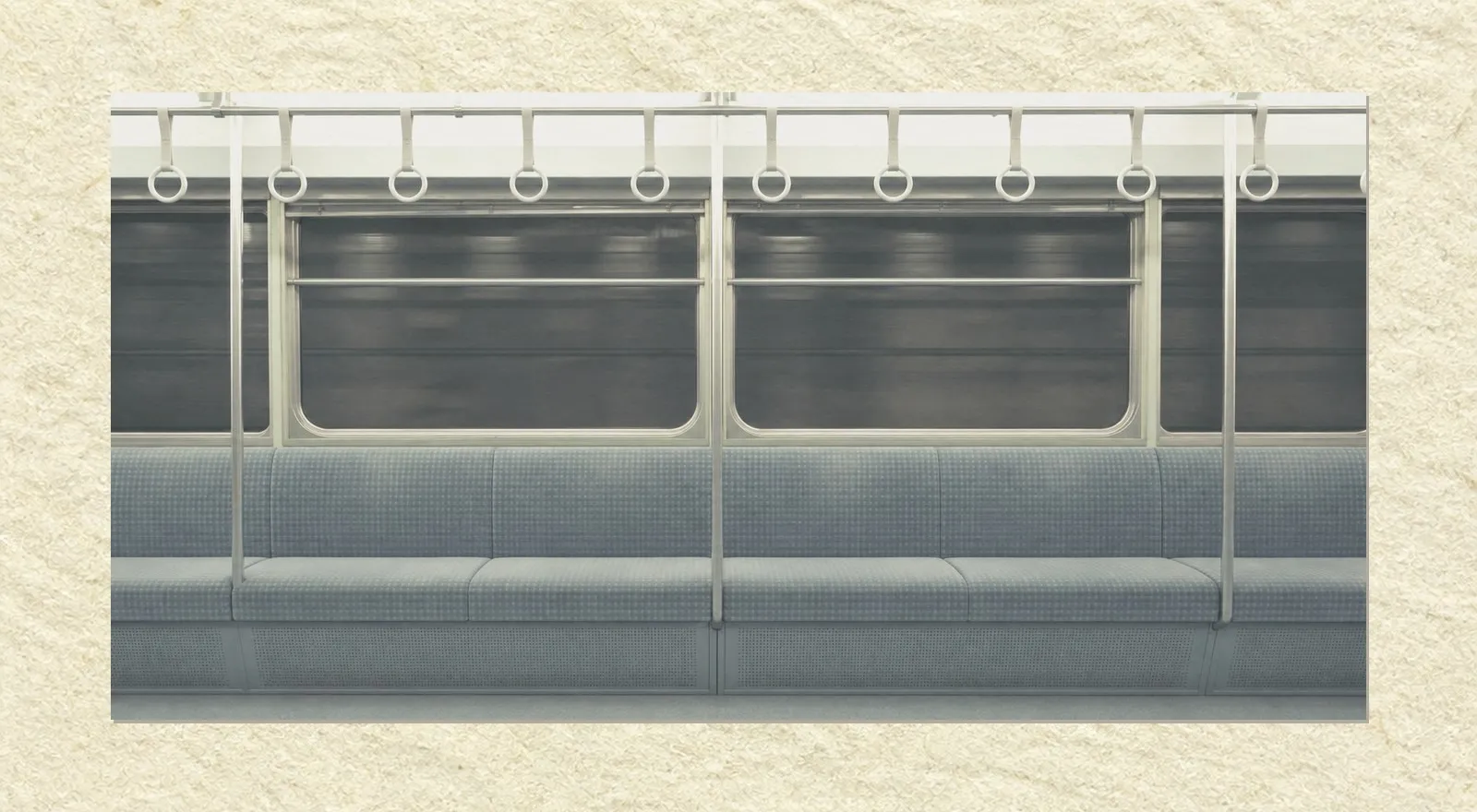
Nerve gas had never been used against a civilian population in a major city before. It was released by a group holding legal status as a religious corporation, granted by the Tokyo metropolitan government six years earlier, the same status Japanese law offers any religious group, since it recognises no separate category for a cult.
Police arrested the group’s founder, Chizuo Matsumoto (who called himself Shoko Asahara) on 16 May 1995. Prosecutors charged him in seventeen separate cases. As the trial dragged on they withdrew four of them, and on 27 February 2004 the Tokyo District Court convicted him in the remaining thirteen. Presiding judge Masamochi Ogawa described what he had read as “a truly heinous and grave series of crimes, of a kind we have never known.” Across those thirteen cases the court counted 27 people dead and 21 injured, a smaller number than the subway attack alone produced, because it counts only the victims named in the charges that survived to judgment.
His death sentence became final in September 2006. He was hanged on 6 July 2018, eleven years and ten months later, alongside six others. Six more were hanged on 26 July. Thirteen executions in one month.
That is the part of the record that is complete. The morning of 6 July is not.
The morning of 6 July 2018
Two books describe it. They cannot both be right.
The journalist Fumiya Ichihashi reconstructs the morning from what he describes as accounts from people connected to the detention centre. In his telling, Asahara finished his breakfast, was told at around 7:40 that the sentence would be carried out, and then had to be moved by force. Two officers took him by the arms. He shouted, “Damn it. Stop”, as he came out of his cell. Four officers pushed him up the stairs while he muttered something too quietly to hear. Cold air came under a curtain and he shivered.
The other account, published by Bessatsu Takarajima in a collection of last statements by condemned prisoners, describes a man who did nothing at all. Asked whether he wanted a chaplain, he said nothing. Asked whether he had anything to say, he said nothing. Asked who should receive his body, he said nothing, until an officer began reading out the names of his relatives. Then: “wait a moment.” Then: “fourth daughter.” Then a sound like clearing his throat, and it was over. He did not resist.
One man is dragged out shouting. The other sits still and names a daughter. The accounts share a time of day and nothing else.
Both are built on the same kind of material: someone inside the detention centre, talking afterwards, to an author. Neither is a government document. And the second account carries a warning from the outlet that reprinted it, which noted that it is genuinely doubtful whether Asahara was in any condition to hold that conversation at all.
That warning is not a throwaway line. It points at the longest unresolved argument of the whole case.
Why nobody can check
The obvious move is to go and read the official record. There isn’t one.
Japan’s Ministry of Justice publishes that an execution has taken place and how many people were executed. It began doing even that only in 1998. The location of the gallows is treated as non-public; ministers have said the execution chamber is by its nature unsuitable for disclosure. No rule requires the state to record what a condemned person says, and no rule requires it to release anything if it does.
So the last words of the man who ordered a chemical attack on a capital city exist only as hearsay, in books, attributed to unnamed staff. That is not a gap in the reporting. It is the designed output of the system.
Which produces a strange asymmetry. Japan documented Asahara’s crimes across thirteen court cases and a judgment that runs to hundreds of pages, quoting his sermons back to him by date. It documented the group’s finances, its rank structure, its constitution draft. Then, at the one moment the state had him entirely to itself, it recorded nothing that the public may see.
Could he even speak?
Here is the argument the warning was pointing at.
By the end of his trial Asahara had stopped communicating in any way the court could use. Whether that was illness or performance was the central question, and the answer depended on which psychiatrist you asked.
Seven psychiatrists engaged by his defence examined him. All seven denied or questioned his capacity to stand trial. The Tokyo High Court commissioned its own examination from a single psychiatrist, who concluded that Asahara showed a detention reaction but that it had not reached the level of detention psychosis, and that he had not lost the capacity to continue. The High Court received that report in February 2006. The sentence became final the same year.
Seven against one, and the one decided it.
There is a document from earlier in the proceedings that makes the problem tangible. On 22 September 1999, Asahara appeared as a witness at the seventieth hearing in the trial of two of the men who carried out the subway attack. To testify he had to sign an oath: the standard Japanese form, promising to tell the truth according to his conscience, to conceal nothing and state no falsehood. He wrote it out. Then he added a line of his own:
Invalid except in my own handwriting, that of Chizuo Matsumoto.
Nobody has explained what it means. It is in the court record, which is more than can be said for anything he is supposed to have said nineteen years later.
The one thing that can be checked
There is exactly one channel through which a claim about that morning has been tested in public, and it is still running.
The state says Asahara asked, before he was hanged, that his remains go to his fourth daughter. That is the government’s own position, argued in court: which makes “fourth daughter,” alone among the words attributed to him that day, a matter of legal record rather than book publishing.
His second daughter disputed it. In 2021 the Supreme Court confirmed her as the lawful owner of the remains. The state kept them anyway, arguing that Aum’s successor groups might put them to use, a fear the government has never treated as hypothetical. In March 2024 the Tokyo District Court ordered the state to hand them over. The state appealed within five days. On 5 February 2026 the Tokyo High Court upheld the lower court and ordered the state to release them.
Eight years after the execution, the ashes have still not moved.
Local government has taken a position too. Adachi City, which contains former Aum facilities, has publicly asked the national government to handle the remains in a way that does not turn into a wider public disturbance, noting that residents near those facilities live with considerable anxiety and fear.
A country that will not say what a man said will litigate for eight years over where to put his ashes. Both facts follow from the same official instinct, and to see where that instinct comes from you have to go back to a yoga class in 1984.
How it started, and how it grew
Before any of this, Asahara sold medicine.
The 2004 judgment sets out his working life plainly. After marrying he made a living as an acupuncturist, then obtained a licence to open a pharmacy in Funabashi, Chiba, and sold pharmaceutical products. The Tokyo Summary Court fined him ¥200,000 for violating the Pharmaceutical Affairs Act: he had manufactured two preparations without the health minister’s approval, called fushitsusei and seiryūtan, and sold them commercially as treatments for illness.
A man convicted of manufacturing unapproved drugs would, twelve years later, run a laboratory producing nerve gas.
He opened a yoga school in Tokyo and around 1984 founded a group called Aum Shinsen no Kai. Then came the marketing. In October 1985 he had an occult magazine publish a photograph of himself sitting in the lotus position, apparently floating in the air, together with the training method said to lead to levitation. He published a book titled The Secret Method for Developing Supernatural Powers. He began running seminars offering shaktipat: a ritual said to awaken a spiritual energy called kundalini and, through it, to confer supernatural abilities. In June 1987 the group changed its name to Aum Shinrikyo.
On 1 March 1989 he applied to the governor of Tokyo for certification as a religious corporation. On 25 August 1989 the certificate was issued. Branches opened in Osaka, Fukuoka, Nagoya, Sapporo, and New York. The court’s phrase for what happened next is that the group “rapidly expanded its influence.”
The money worked in two stages. Donations first: give ¥300,000 or more, the group advertised, and you could receive various special initiations. Then renunciation. Members who took holy orders signed an undertaking whose terms the judgment quotes:
While ordained, do not cause trouble for the organization. Sever ties with relatives. … All inheritance and property shall be donated to the organization.
Police have stated that members holding substantial assets were pressured into ordination so that their property would pass to the group. Renunciants were then housed together in Aum facilities and fed meals the group called “offerings.” The court’s assessment of the result is blunt: Aum built “a closed society of its own, cut off from general society.”
Inside it, everyone had a rank. Aum assigned members a “stage” said to measure spiritual attainment, with the saishū gedatsusha (final liberated one, Asahara’s own title of sonshi) at the top, then seidaishi, seigoshi, shi, each tied to a yoga practice the holder was certified to have mastered. The court described the structure as one in which those of higher rank controlled and managed those below, and orders travelled downward only. At the time of the subway attack, the rank immediately below Asahara’s was held by two people, one of whom was his wife.
The judgment records the scale Aum reached in those years: 100 to 200 ordained members and 3,000 to 4,000 lay followers. Published estimates of the peak run far higher (into the tens of thousands, in Japan and in Russia both) but they come from books rather than official counts and they do not agree with one another, so no figure for the peak appears here. What the state does confirm is that Aum reached Russia, and that it never left: the Public Security Intelligence Agency records members in the Russian Federation today.
Why a religion tried to take the state
Aum’s turn toward weapons has a date, and it is not what most accounts assume.
In August 1989 Asahara founded a political party, Shinri-tō, the Party of Truth. On 18 February 1990, twenty-five Aum members including Asahara stood in the general election for the House of Representatives.
Every one of them lost.
The 2017 judgment (the ruling that kept the successor group under observation, and the fullest official account of Aum’s aims that exists) treats that defeat as the hinge. Combined with residents’ movements opposing Aum’s expansion around the country, the losses hardened the group’s hostility toward society. The court’s finding is that Asahara concluded it was impossible to build political power inside the existing democratic system, and that achieving his aim therefore required destroying the existing state structure by force, and eliminating those who opposed the organization.
That aim has a name in the judgment. The court calls it the group’s “political principle”: to establish a theocratic autocracy with Matsumoto as dictator.
He said it out loud, and the court quotes him:
Aum Shinrikyo will, in the end, come to possess military force. … The Aum organization is not merely a religious body; it is prophesied that a time will come when it changes into a mechanism of world governance. — sermon, 31 January 1993
In 1997 I will become the king of Japan; by 2003 most of the world will be under Aum’s power. And those who work against the truth must be killed as early as possible. — recorded remarks, late February 1994, as testified in open court
Then the timetable of what was actually built:
| From | What |
|---|---|
| March 1990 | Development of biological weapons including botulinum and anthrax |
| February 1994 | Synthesis of sarin |
| June 1994 | Manufacture of copies of Russian automatic rifles |
| December 1994 | Construction of a plant for mass-producing sarin |
And alongside the weapons, the paperwork of a state. On Asahara’s instructions Aum renamed its internal divisions to imitate government structure (a ministry system), and had a member draft a constitution for a theocratic state with Matsumoto as sovereign. The judgment gives its title: the First Draft of the Basic Law of the Land of Solar Stillness.
A group of a few thousand people, mostly in their twenties, had a cabinet, a rifle programme, and a constitution.
The chemistry served the religion as well as the war. Between 1994 and 1995 Aum members manufactured 115g of LSD, 227g of methamphetamine, at least 1,700g of the anaesthetic thiopental and about 6kg of mescaline, according to contemporaneous reporting by Yomiuri Shimbun and Tokyo Shimbun. The hallucinogens were used in the rituals the group called initiations. The anaesthetics were used to put members into a half-waking state and check whether they were spies. Precursor material for the LSD was brought from Russia by a senior member; a fifteen-year-old was among those weighing and mixing.
One point of precision, because it is easy to get wrong: none of the drug offences appear in Asahara’s own thirteen convictions. Those covered murder, attempted murder, preparation for murder, mutilation of corpses, unlawful confinement resulting in death, and weapons manufacturing. The drug charges were proven against the members who ran the laboratory.
The doctrine that made killing a service
The weapons arrived in 1994. The justification was in place seven years earlier.
Asahara taught a hierarchy of doctrines with Tantra Vajrayana at the top, and within it a set of rules called the five buddha principles. Two of them do the work. The Akshobhya principle holds that a soul accumulating bad karma should have its life ended early. The Amoghasiddhi principle holds that for one who practises the truth, the result is what counts, and the means may be chosen freely.
From that, killing becomes a favour to the person killed. The court quotes the sermon:
For example, when the guru says to kill someone, it means that person has already reached the time to die. And by having a disciple kill them, that person is made to attain poa. You have them killed at the best possible time. — sermon, 4 January 1987
January 1987. Eight years and two months before the subway.
Six years later he had generalised it:
We wish to save all souls. … But when there is no time, it is not unreasonable that there should be a wise soul, or a virtuous soul, who selects among them and kills the souls that are not needed. — sermon, 18 April 1993
The dead, in this teaching, were poa’d, transferred to a higher spiritual world. The court’s summary is that Asahara taught that killing was permitted for the sake of the truth, and permitted on his instruction. Not tolerated. Permitted, and beneficial to the victim.
This is the doctrine, according to the 2017 judgment, that the successor organizations have never renounced in substance. Absolute devotion to Matsumoto remains their requirement; the court found that the core of the teaching places him as the single absolute thing that governs everything.
Japan had to write a new law
Here is the measure of how far outside the ordinary Aum fell: the existing law could not touch it.
Japan has had a Subversive Activities Prevention Act since 1952. It contains a power to dissolve an organization. In its four decades on the books, that power had never once been used. On 11 July 1996, the Director-General of the Public Security Intelligence Agency asked the Public Security Examination Commission to apply it to Aum Shinrikyo, the first such request in the law’s history.
On 31 January 1997 the Commission refused. Its reasoning is worth reading twice: the danger posed by the group could not be said to have disappeared, but it could not be found that there was a clear risk of the group carrying out violent subversive activity within some reasonably near period.
Aum had gassed the Tokyo subway twenty-two months earlier, and the state’s strongest instrument had just been found not to reach it.
The Japan Federation of Bar Associations had opposed the application, and later published a report examining the rejection. The legal profession’s own objection is part of the record here, not a footnote to it. But the practical conclusion the government drew was that a group could commit indiscriminate mass murder, survive, and remain beyond the reach of the statute book.
So the statute book changed. The Act on the Control of Organizations Which Have Committed Acts of Indiscriminate Mass Murder was promulgated on 7 December 1999 and took effect on 27 December. It created the observation disposition and the recurrence-prevention disposition (reporting duties, inspections, restrictions on facilities and donations) aimed squarely at a group that had already killed and had not gone away.
A law written for one organization, because the general law had failed against it. Compare the Unification Church, dissolved by court order in 2026 under Article 81 of the Religious Corporations Act: an ordinary instrument, applied to an ordinary religious corporation. Aum required a bespoke one. Japan has done this before: when it decided not to ban the yakuza, it built a designation system around them instead, statutes shaped to fit an organisation the state would not outlaw.
It has not ended
Aum’s leadership is dead. Aum is not.
The Public Security Intelligence Agency reports that the organization has roughly 1,600 members in Japan and 30 facilities across 15 prefectures, operating mainly through Aleph and the Yamada group in the mainstream faction and Hikari no Wa in another, with members in the Russian Federation as well. The observation disposition was renewed in January 2024 for three years and runs until 31 January 2027.
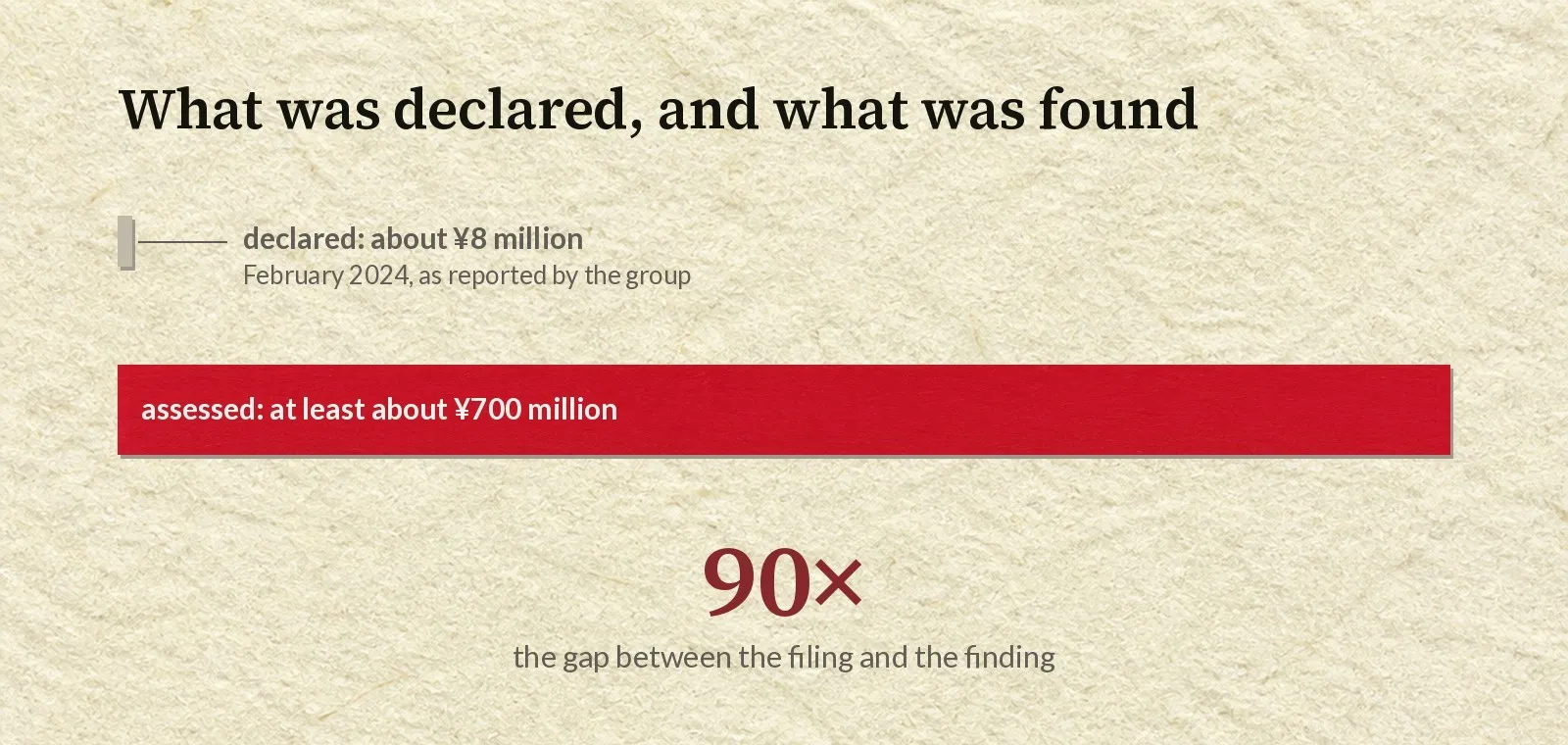
The reported assets tell you what kind of compliance the state is dealing with. In February 2024 the group reported holdings of about ¥8 million. Investigators assessed the real figure at at least around ¥700 million, roughly ninety times what was declared.
On 9 March 2026 Aleph was placed under a further recurrence-prevention disposition, following a request in January that cited its failure to meet the asset-reporting obligation. The measures ban use of four facilities entirely, restrict offices at eleven more, and continue prohibitions on receiving donations and financial benefits.
And on the day Asahara was hanged, the state did not simply carry out a sentence. The Public Security Intelligence Agency stood up a special investigation headquarters under its deputy director-general, and with police support conducted inspections of 24 Aum facilities across 13 prefectures, on 6 July 2018, the same day.
That is what the fear over a box of ashes is made of. Not superstition. An organization the government still counts, still inspects, and still finds under-reporting its money by two orders of magnitude.
The counting is itself the anomaly. Japan does not know the size of any other religious body within its borders. The state’s own register of believers runs to more than the population, because each corporation reports its own figure and nobody checks. The groups whose membership the state tracks to the nearest hundred, quarter by quarter, are the ones whose corporate status it took away.
What the record does and does not hold
Japan knows the names of the two unapproved preparations Asahara was fined for selling. It knows the title of the constitution he had drafted for the country he meant to rule. It has his sermons transcribed with the day and month attached, including the one from January 1987 in which he explained that a disciple killing on command is doing the victim a service.
It does not know (or will not say) whether he shouted on the way to the gallows.
The second daughter is still waiting for the ashes. The observation disposition runs to January 2027, and the agency will decide again whether to extend it. The Basic Law of the Land of Solar Stillness never took effect, which is the one sentence here that needs no citation.
In this article
- Quick answer
- What Aum Shinrikyo did
- The morning of 6 July 2018
- Why nobody can check
- Could he even speak?
- The one thing that can be checked
- How it started, and how it grew
- Why a religion tried to take the state
- The doctrine that made killing a service
- Japan had to write a new law
- It has not ended
- What the record does and does not hold