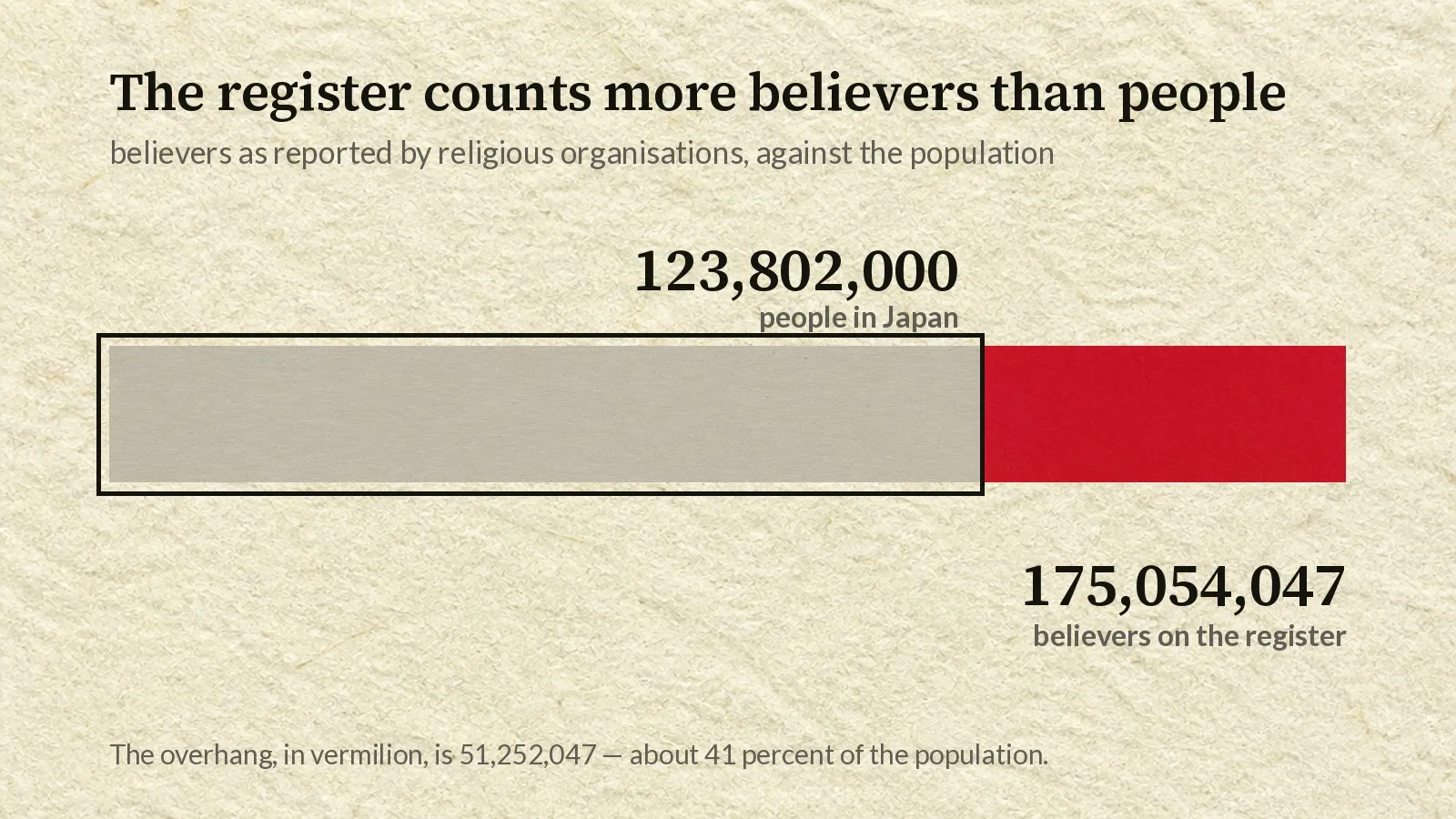
The Japanese government publishes a figure for how many believers the country contains. As of 31 December 2024 it was 175,054,047.
Japan’s population on 1 October 2024 was 123,802,000.
The register counts 141 percent of the country as religious. A different arm of the same state, asking individuals directly, has never found more than 35 percent saying they hold a faith, not once in twelve surveys since 1958. In the most recent published round the figure was 28 percent.
Neither number is wrong. They measure different things, and the gap between them is the most honest description of religion in Japan that either one offers.
Quick answer
- The state’s own count is 175,054,047 believers, against a population of 123,802,000. Shinto organisations report 86.4 million and Buddhist organisations 80.5 million, together 135 percent of the population by themselves.
- Asked directly, 28 percent say they hold a faith. That share has moved only between 25 and 35 percent in every round since 1958.
- Asked whether a religious mind matters, 66 percent of the same respondents say yes. Change the wording and the number multiplies by 2.4.
- Belief in an afterlife has doubled, from 20 percent in 1958 to 40 percent in 2013, while reported faith drifted down. The standard story of secularisation does not fit the data.
- The register is a sum of self-reported returns. Nobody reconciles it against individuals, and the yearbook contains no column for members anywhere in its list of corporations.
- Christianity is 1.1 percent. Islam has no category at all: the yearbook sorts every organisation into Shinto, Buddhist, Christian or Other.
- What Japan registers is legal personality, not belief. Article 1(2) of the governing statute forbids reading any part of it as a restriction on religious acts.
- Dissolution is mostly janitorial. Ninety-six requests in ten years, 95 of them filed by prefectural governors against corporations that had stopped functioning. Only three groups have ever been dissolved for wrongdoing.
- Three organisations have been dissolved for what they did. All three still exist.
The number the state publishes
The Agency for Cultural Affairs issues a volume every year called the Religious Yearbook. The 2025 edition reports the position as of 31 December 2024, and its headline table divides the country’s believers into four families.
| Family | Believers | Share |
|---|---|---|
| Shinto | 86,359,612 | 49.3% |
| Buddhist | 80,463,918 | 46.0% |
| Other | 6,358,197 | 3.6% |
| Christian | 1,872,320 | 1.1% |
| Total | 175,054,047 | 100% |
The same volume counts 210,007 religious organisations and 641,567 clergy. Those two figures are plausible on their face. A country with 210,007 shrines, temples, churches and halls is a country with a lot of religious infrastructure, and Japan visibly is.
The believer count is the one that breaks. Shinto and Buddhist organisations between them report 166.8 million people in a country of 123.8 million. Adding the other two families takes the total to 141 percent of the population.
This is not a scandal, and the Agency does not hide it. The figure is the sum of what organisations file. Each religious corporation reports its own numbers under the statistical survey that feeds the yearbook, the returns are added up, and nothing in the process reconciles one organisation’s list against another’s.
A household whose funerals are conducted by the Buddhist temple it is registered with, and whose new year begins at the Shinto shrine that treats the neighbourhood as its parish, is on two lists. Both organisations are reporting accurately. The arithmetic simply has no mechanism for noticing that the same people are in both.
The number people give when you ask them
Since 1953 the Institute of Statistical Mathematics, a national research institute, has run a survey called the Japanese National Character Survey. It asks a stable set of questions of a fresh national sample every five years, which makes it one of the longest continuous social datasets in the world.
Item 3.1 is put like this: We would like to ask about religion. For example, do you have any faith or belief?
| Round | Year | Hold a faith | Do not | (n) |
|---|---|---|---|---|
| XIII | 2013 | 28 | 72 | 1,591 |
| XII | 2008 | 27 | 73 | 1,729 |
| XI | 2003 | 30 | 70 | 1,192 |
| X | 1998 | 29 | 71 | 1,339 |
| IX | 1993 | 33 | 67 | 1,833 |
| VIII | 1988 | 31 | 69 | 1,858 |
| VII | 1983 | 32 | 68 | 2,256 |
| VI | 1978 | 34 | 66 | 2,032 |
| V | 1973 | 25 | 75 | 3,055 |
| IV | 1968 | 30 | 70 | 3,033 |
| III | 1963 | 31 | 69 | 2,698 |
| II | 1958 | 35 | 65 | 920 |
Fifty-five years, twelve national samples, and the answer never leaves a ten-point band. It was 35 percent in 1958, when the war generation still ran the country. It was 28 percent in 2013.
Nothing that happened in between moved it much. Not the economic miracle, not the collapse of the bubble, not the sarin attack on the Tokyo subway in 1995, which produced the most intense public scrutiny of religion in postwar Japanese history. The 1998 round, taken three years after that attack, came in at 29 percent, one point above 1993.
This is the figure most foreign coverage reaches for when it calls Japan a secular or irreligious country. Taken alone it supports that reading. It is also the point at which most accounts stop asking questions.
The same survey, asked differently
The institute follows item 3.1 with item 3.2b, put to the same respondents in the same sitting:
Setting aside religion as such, do you think a religious mind is important, or do you not think so?
| Round | Year | Important | Not important | Other | Don’t know | (n) |
|---|---|---|---|---|---|---|
| XIII | 2013 | 66 | 21 | 3 | 10 | 1,591 |
| XII | 2008 | 69 | 19 | 2 | 11 | 1,729 |
| XI | 2003 | 70 | 15 | 3 | 12 | 1,192 |
| X | 1998 | 68 | 20 | 2 | 10 | 1,339 |
| IX | 1993 | 72 | 14 | 3 | 11 | 1,833 |
| VIII | 1988 | 72 | 15 | 8 | 5 | 1,858 |
| VII | 1983 | 80 | 11 | 5 | 4 | 2,256 |
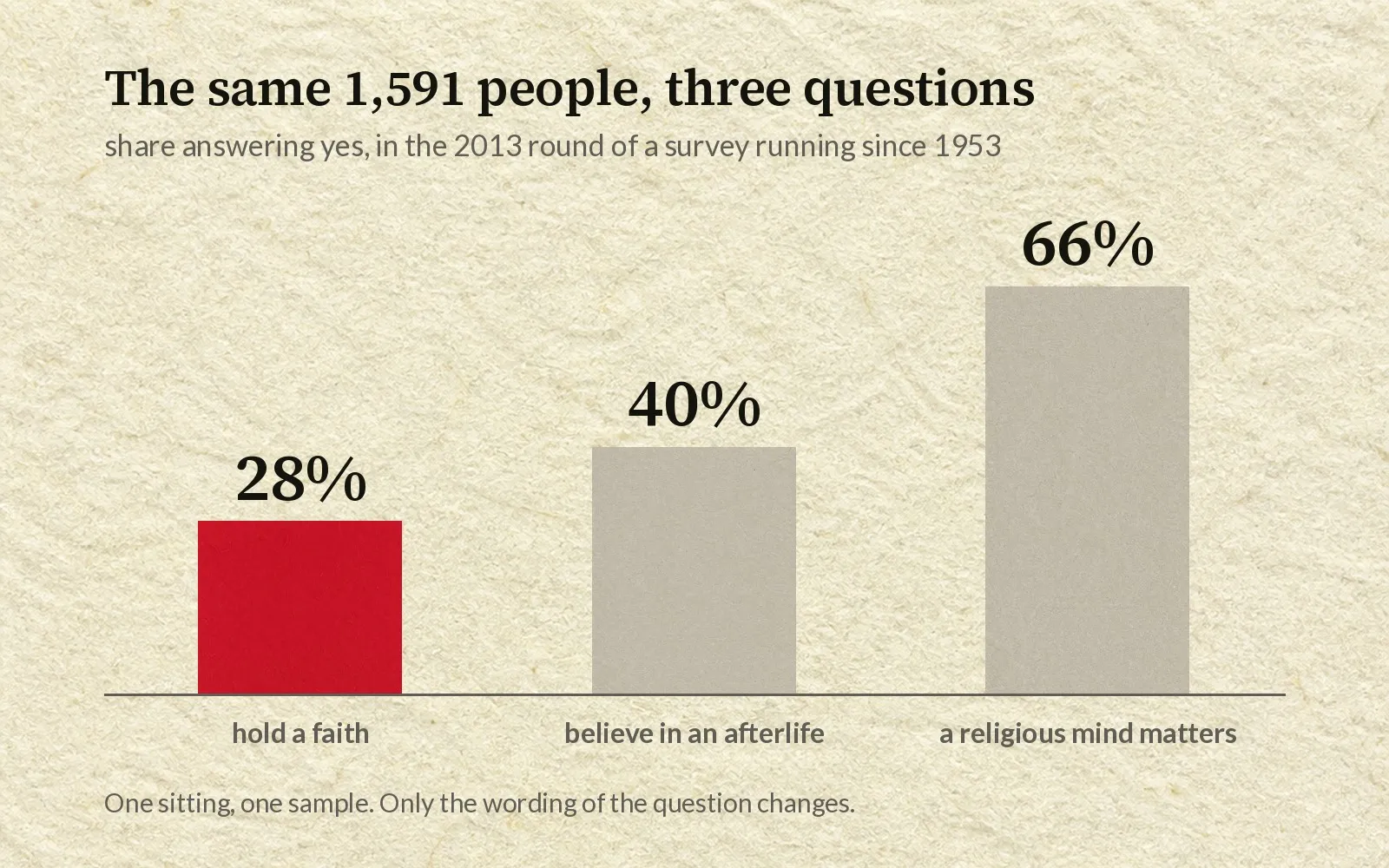
The same 1,591 people who produced a 28 percent faith rate in 2013 produced a 66 percent rate here. Not a different sample, not a different year, the next question on the same form.
Whatever the 28 percent is measuring, it is not the presence or absence of religious sensibility. It is measuring whether a person is willing to attach the word faith to themselves. In Japanese, the word used in item 3.1 (shinkō) carries a weight closer to devotion or adherence than to the loose English religious. Saying yes to it implies a commitment to a particular body of doctrine, and to an organisation that teaches it.
Most Japanese people will not make that claim. Two-thirds of them will nonetheless say the religious mind matters.
Then there is item 3.5, which asks whether the respondent believes in an afterlife.
| Round | Year | Believe | Undecided | Do not believe | (n) |
|---|---|---|---|---|---|
| XIII | 2013 | 40 | 19 | 33 | 1,591 |
| XII | 2008 | 38 | 23 | 33 | 1,729 |
| II | 1958 | 20 | 12 | 59 | 920 |
Belief in an afterlife doubled between 1958 and 2013, from 20 percent to 40. Over precisely the same period, reported faith fell from 35 percent to 28.
The two lines cross. In 1958 far more people claimed a faith than believed in an afterlife. By 2013 the position had reversed, and the gap was twelve points the other way. Whatever has been happening to religion in Japan over the last half-century, “decline” is not an adequate description of it. What has fallen is affiliation. What has risen is unaffiliated belief.
Why the register can say 141 percent
The register and the survey are not competing estimates of the same quantity. They are counts of different objects.
The survey counts people, one at a time, and asks each of them a question about themselves. The register counts relationships between organisations and the people they consider theirs, and one person can stand in several such relationships at once without experiencing any contradiction.
This is the ordinary shape of Japanese religious life rather than an aberration. A family maintains a grave at a Buddhist temple and pays for its upkeep. The same family belongs to the parish of a Shinto shrine because the neighbourhood does. The children may be married in a Christian-style ceremony by a hotel chapel that no denomination recognises. None of this involves a conversion, and none of it requires the household to describe itself as holding a faith.
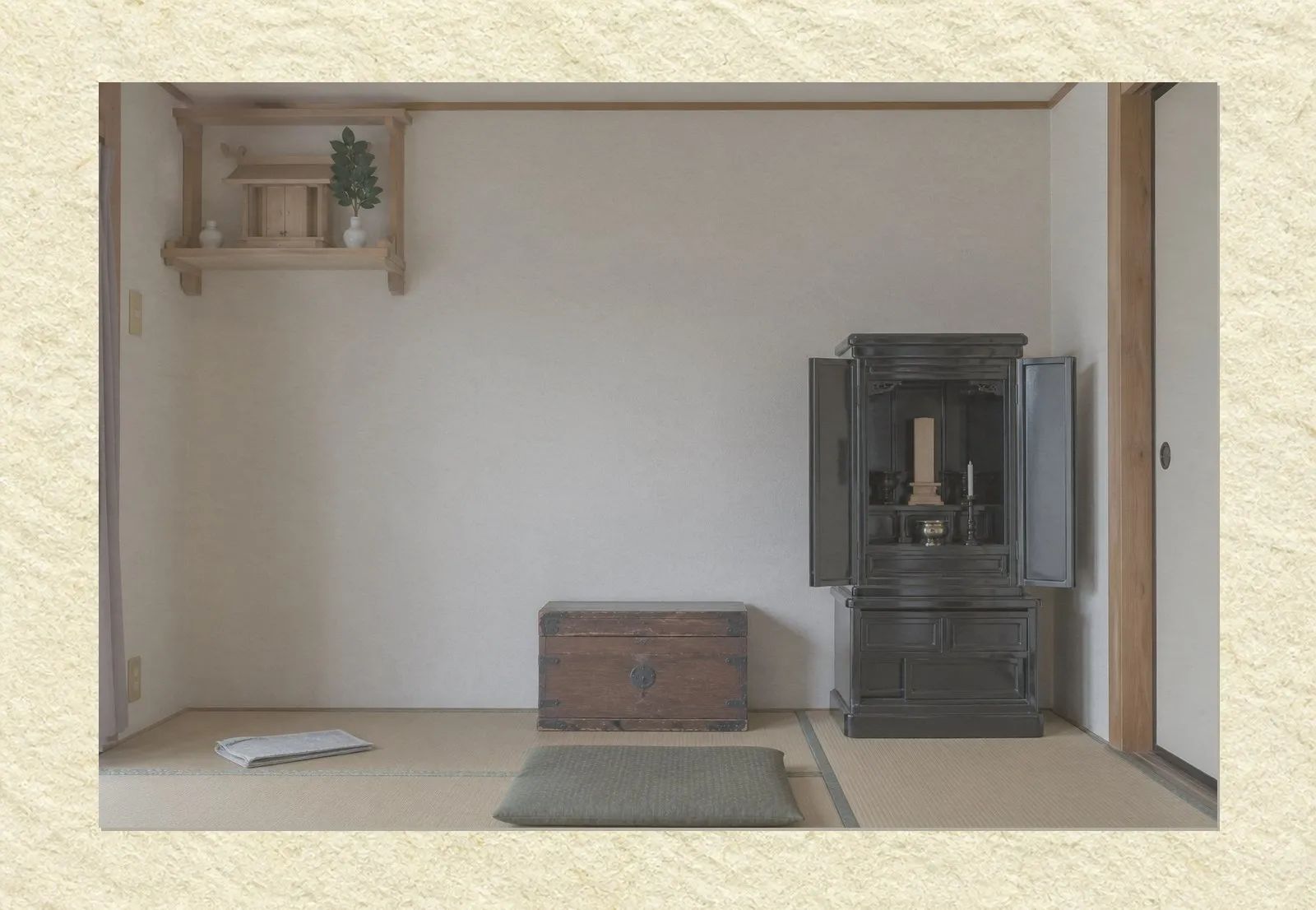
The register faithfully records the first two of those relationships and produces two believers where there is one household. The survey asks that household a direct question and records one no.
Three further features of the register are worth stating plainly, because they bound what the 175 million can be used for:
- The returns are self-reported. Organisations file their own figures. There is no audit and no obligation to define believer consistently across organisations. A temple may count registered parishioner households; a new religious movement may count everyone who has ever registered.
- The yearbook has no member column. Its Part 3 lists every corporation under the Minister of Education’s jurisdiction with name, corporate number, representative officer, address and telephone number. That is all. The 175 million total is published, but its breakdown by organisation is not.
- The two dates do not match. The believer figures are as of 31 December 2024. The list of corporations is as of 30 September 2025, updated where later changes were notified. The yearbook says so explicitly in its front matter.
What the register does not contain
The absence of a member column has a consequence that is easy to miss. The Japanese state publishes a total for religious believers that exceeds its population, and cannot tell you how many members any individual organisation has.
Nor, in most cases, can the organisations be relied on to fill the gap. Soka Gakkai states 8.27 million households in Japan and about 3 million members overseas on its own website. Tenrikyo states 1.2 million believers and about 14,000 churches. No membership figure appears on the Happy Science pages that describe the organisation. For the Family Federation for World Peace and Unification, the organisation Japan spent three years dissolving, no figure could be found either: its own site could not be read, and none appears in the Diet record.
The four-family taxonomy has its own blind spot. Every organisation is sorted into Shinto, Buddhist, Christian or Other, and Islam has no category. Japanese mosques that hold corporate status are folded into the residual 6.36 million of Other, alongside Tenrikyo and dozens of unrelated movements. No official figure exists for the number of Muslims in Japan.
Christianity, which does have a category, accounts for 1,872,320 people: 1.1 percent, in a country where the Christian wedding ceremony is the default form of the wedding industry, and where mission schools educate a visible slice of the professional class. The gap between Christianity’s cultural footprint and its 1.1 percent is a small version of the same lesson: in Japan the practice and the affiliation come apart. That figure has its own history, and its own instability. We have taken the 1 percent apart separately.
What Japan actually registers
The state’s real instrument is not the yearbook. It is the Religious Corporations Act of 1951, and what it hands out is not recognition of a religion. It is legal personality.
A religious organisation in Japan may exist without any of this. It may hold services, collect offerings, publish doctrine and ordain clergy with no involvement of the state whatsoever. What it cannot do without corporate status is own its own building, hold a bank account in the organisation’s name, sign a contract as an entity, or receive the tax treatment attached to religious corporations.
The certification that confers this status is administered by one of two authorities, under Article 5: the prefectural governor where the organisation sits, or the Minister of Education where it operates across prefectural lines or has affiliated bodies in more than one prefecture. This is a jurisdictional test, not a ranking. It has one visible consequence in the yearbook. Organisations under the Minister’s jurisdiction are listed in Part 3, and organisations under a governor’s are not.
The statute is emphatic about what it is not doing. Article 1(2) reads:
Nothing in this Act shall be construed as restricting an individual, a group or an organisation from spreading doctrine, performing rites and ceremonies, or carrying out other religious acts, on the basis of the freedom guaranteed to them.
That sentence is what makes the rest of this article possible. The state is not in the business of licensing beliefs. It is in the business of maintaining a register of legal persons, and everything it can do to a religious organisation, it does to the legal person.
Including ending it. Article 81 lists five grounds on which a court may order a religious corporation dissolved, on the application of the competent authority, an interested party or a public prosecutor, or on the court’s own motion:
| Ground | Article 81(1) | What it is for |
|---|---|---|
| (i) | Acts violating laws and regulations, clearly recognised as substantially harming public welfare | Wrongdoing |
| (ii) | Substantially deviating from the purposes of a religious organisation, or failing to act for those purposes for one year or more | Wrongdoing, or dormancy |
| (iii) | Loss of the place of worship, with no replacement for two years and no unavoidable reason | Dormancy |
| (iv) | Absence of a representative officer and any deputy for one year or more | Dormancy |
| (v) | Discovery, more than a year after certification, that the requirements for certification were not met | Defective registration |
Read the right-hand column. Only one and a half of the five grounds concern misconduct. The rest describe an organisation that has stopped working: no priest, no building, no activity, nobody in charge. The Agency for Cultural Affairs has a term for corporations in that condition: inactive religious corporations.
What dissolution is really used for
In April 2023 the Agency’s Religious Affairs Division circulated a briefing to prefectural authorities on dealing with inactive religious corporations. It contains the numbers that make the dissolution power legible.
Over the ten years to 2022, dissolution requests filed came to:
- 1 by the Minister of Education, plus one filed by an interested party in 2022
- 95 by prefectural governors
Ninety-six requests, of which 95 were prefectural officials clearing dead corporations off their books. This is the ordinary business of the dissolution power. It is closer to striking off a defunct company than to putting a faith on trial.
And it barely moves the pile:
| 2012 | 2013 | 2014 | 2015 | 2016 | 2017 | 2018 | 2019 | 2020 | 2021 | 2022 |
|---|---|---|---|---|---|---|---|---|---|---|
| 3,837 | 3,732 | 3,694 | 3,647 | 3,582 | 3,543 | 3,527 | 3,473 | 3,398 | 3,348 | 3,329 |
Eleven years of effort, a decline of 508, and the Agency’s own briefing describes the count as flat over the past decade. About nine-tenths of the 3,329 remaining are affiliated to a parent organisation.
The reason the state cares is not tidiness. A dormant religious corporation is an asset with a tax status and no one watching it, which makes it worth buying. The Agency has a live workstream on transactions resembling the sale of religious corporations, and in July 2026 sent out a survey on the fraudulent use of religious corporate status. An empty corporation is a vehicle, and the register is where vehicles are stored.
The three exceptions
Against 96 requests in a decade, the number of religious corporations Japan has ever dissolved under Article 81(1)(i) (the wrongdoing ground) is three.
| Aum Shinrikyo | Myokakuji | Family Federation | |
|---|---|---|---|
| Ordered | 30 October 1995, Tokyo District Court | 24 January 2002, Wakayama District Court | 25 March 2025, Tokyo District Court |
| Became final | 19 December 1995, on dismissal of the immediate appeal | , | 4 March 2026, Tokyo High Court |
| Supreme Court | Special appeal dismissed 30 January 1996 | , | Special appeal dismissed 22 June 2026 |
| Case rested on | Criminal convictions for mass murder by chemical weapon | Criminal conviction for fraud, fake spiritual readings sold from a script | 32 civil judgments covering 169 people; no criminal conviction |
| Money at issue | Not a financial case | Memorial fees obtained by deception | ¥2.2bn awarded in judgments; about ¥20.4bn in settlements covering some 1,550 people |
| Group today | Continues unincorporated as Aleph and two other factions | Continues to exist as an unincorporated body | In liquidation under a court-appointed liquidator |
The sequence in the first three rows repays attention, because it is where most accounts of these cases go wrong.
Under Article 81(5) an immediate appeal against a dissolution order suspends its effect, so the corporation survives while the appeal runs. A special appeal to the Supreme Court carries no such suspension. The order therefore becomes final when the High Court dismisses the immediate appeal, and the Supreme Court’s decision, whenever it comes, confirms rather than creates the dissolution.
For Aum this was stated in the Diet by the Director-General of the Ministry of Justice’s Litigation Bureau in April 1998: the Tokyo Metropolitan Governor and the Tokyo District Public Prosecutor applied on 30 June 1995, the Tokyo District Court ordered dissolution on 30 October, the immediate appeal was dismissed on 19 December, and the dissolution order became final. The Supreme Court’s decision of 30 January 1996 came six weeks after the corporation had already ceased to exist.
The same structure produced the Family Federation timetable. The Tokyo High Court upheld the dissolution on 4 March 2026, and a liquidator was appointed by the Tokyo District Court the same day, the practical end of the corporation. The Supreme Court dismissed the organisation’s special appeal on 22 June 2026, three and a half months into a liquidation that was already running.
What separates the third case from the first two is the evidence. Aum and Myokakuji were dissolved on the back of criminal convictions; in Myokakuji’s case a fraud in which a religious corporation was found to be the actor, worked from a manual of scripts for extracting memorial fees from people convinced they were spiritually endangered. A 2022 review of the case law in the Kyorin Journal of Social Sciences recorded that dissolution had been granted under Article 81(1)(i) in two cases only.
The Family Federation had no criminal conviction. The Agency built its request on 32 civil judgments covering 169 people, awarding about ¥2.2 billion, and on settlements with roughly 1,550 people worth about ¥20.4 billion, accumulated over four decades from about 1980. Its case identified three recurring methods across the judgments: approaching people without disclosing that the approach was religious, telling them their ancestors’ misdeeds would visit ruin on their families, and taking donations disproportionate to any conceivable service. The whole dispute turned on whether the laws and regulations in Article 81(1)(i) included the Civil Code, or only the criminal statutes an earlier High Court decision had mentioned. It does, three courts have now held.
The full account of that case (what was found, what was argued, and why it took fifty years) is set out in why Japan ordered the Unification Church to dissolve.
There is a detail in the register worth putting beside it. The 2025 Religious Yearbook, current to the end of 2024, lists the Family Federation for World Peace and Unification in the ordinary run of standalone corporations under the Minister of Education: corporate number, representative officer, an address in Shibuya, a telephone number. Fifteen months before the state finished dissolving it, it sat on the same page as convents and Bible societies, in the same typeface, with no annotation of any kind.
What dissolution does not do
Here is what the state takes when a court dissolves a religious corporation: the ability to hold property, to contract, to bank and to be taxed as a religious corporation. The assets enter liquidation under court supervision.
Here is what it does not take.
When Aum’s believers challenged the dissolution as a violation of the constitutional guarantee of religious freedom, the Supreme Court held on 30 January 1996 that dissolving the corporation places no restriction whatever on believers continuing the religious body without legal personality, and has no legal effect prohibiting or restricting their religious acts. That is the constitutional basis on which the power survives. It is also an accurate description of what happens next.
Aum’s successors are the proof. Thirty years after the corporation ceased to exist, the Public Security Intelligence Agency reported at the end of February 2026 that the organisation it still treats as continuous with Aum (the mainstream faction using the name Aleph, a group around a figure named Yamada that keeps its distance from Aleph, and the Joyu faction operating as Hikari no Wa) numbers about 1,600 people, of whom roughly 250 are ordained and 1,350 lay. It holds 30 sites across 15 prefectures and reported about ¥78 million in cash and deposits.
None of that requires a religious corporation. The buildings are held some other way; the money sits somewhere; the teaching continues: including, thirty years after the attack and eight years after the founder was hanged, instruction in absolute devotion to him. What the group lost in 1995 was a legal wrapper, and thirty years of surveillance have established that a religious movement does not need one.
The surveillance is its own point. Because Aum’s successors fall under the Act on the Control of Organisations Which Have Committed Indiscriminate Mass Murder, they file reports on their members’ names and addresses every three months (105 filings to date) and submit to inspections, 43 site visits across 15 prefectures in 2025 alone. The observation order has been renewed eight times, most recently in January 2024, and a supplementary order barring the group from using specified property and from receiving gifts of money or goods has been imposed six times since March 2023, the latest on 9 March 2026.
Which produces the sharpest fact in the whole register. The Japanese state does not know how many members Soka Gakkai has, or Happy Science, or any of the 210,007 organisations whose self-reported believers add up to 141 percent of the population. It knows, to the individual name and address, how many people belong to the one organisation it stripped of legal personality thirty years ago.
Counting begins where the corporation ends. It is the same pattern the state uses on organised crime, which it has never outlawed and instead designates and lists group by group: Japan reaches for registration, and reserves enumeration for what it has decided to watch.
So is Japan a religious country?
Both official numbers are correct, and the honest answer is that they are answers to different questions.
If the question is whether Japanese people belong to religions, the answer is no, and has been no for as long as anyone has measured it. Between a quarter and a third claim a faith, and that band has held through prosperity, collapse, and the worst religious atrocity in the country’s modern history.
Measurement only begins in 1958. Before that the state’s relationship with belief ran through machinery of an entirely different kind: a ban on Christianity, an island in Nagasaki harbour, and an annual written report on the outside world delivered by the one European trading partner willing to promise it would not proselytise.
If the question is whether religion is present in Japanese life, the register is closer to the truth than the survey. Two hundred and ten thousand organisations and 641,567 clergy do not sustain themselves on the devotion of 28 percent of the population. They are sustained by the far larger group who visit shrines at new year, bury their parents through a temple, keep a household altar, and would decline, if asked directly, to describe themselves as believers.
The 141 percent is an artefact of double counting. It is also the most accurate portrait the statistics contain, because double counting is precisely what Japanese religious practice does. The same household really is on the temple’s list and the shrine’s list. The error in the arithmetic is a faithful record of the behaviour.
And what the state does with all of this is narrower than it looks from outside. It maintains a register of legal persons. It cleans dormant entries out of that register, 95 requests in a decade, and still cannot get the pile below three thousand. Three times in seventy-five years it has taken the register away from an organisation for what the organisation did, and each time, the organisation continued, because the law it acted under says in its first article that nothing in it may be read as touching what people believe.
Japan does not ask its citizens what they believe, and does not check what its organisations report. It records who has legal personality, and watches whoever it has taken it from. Everything else (whether 28 percent is the real figure, or 66, or 141), the state has decided is not its business to know.
In this article
- Quick answer
- The number the state publishes
- The number people give when you ask them
- The same survey, asked differently
- Why the register can say 141 percent
- What the register does not contain
- What Japan actually registers
- What dissolution is really used for
- The three exceptions
- What dissolution does not do
- So is Japan a religious country?