Ask how many yakuza groups exist in Japan and you can be answered with a list rather than an estimate. Japan does not outlaw its crime syndicates. It registers them. Prefectural public safety commissions designate them one by one under the Anti-Organized Crime Act, publish the designation in the official gazette, and record in a single table each group’s name, the address of its head office, the name of the man who represents it, the prefectures it operates in, and how many members it has.
There are twenty-five of them.
The largest has about 3,100 members and operates in 44 of Japan’s 47 prefectures. The smallest has about ten, and its territory is one city ward. They occupy the same row structure in the same table, under the same designation, subject to the same law. That is not an oversight. The test Japan applies is not a size. It is a probability, and the government has written the arithmetic into an ordinance.
Quick answer
- Twenty-five groups are currently designated. Membership figures are as of the end of 2025; names, head offices and representatives are as gazetted up to 12 March 2026.
- Size is not the test. The Rokudaime Yamaguchi-gumi (about 3,100 members) and the Judaime Sakaume-gumi (about ten) hold the same designation.
- A row is not a single organization. The Act defines these groups as hierarchically composed, and counts the members of their constituent groups; each row is a stack of subordinate organizations, each with its own name, office and boss.
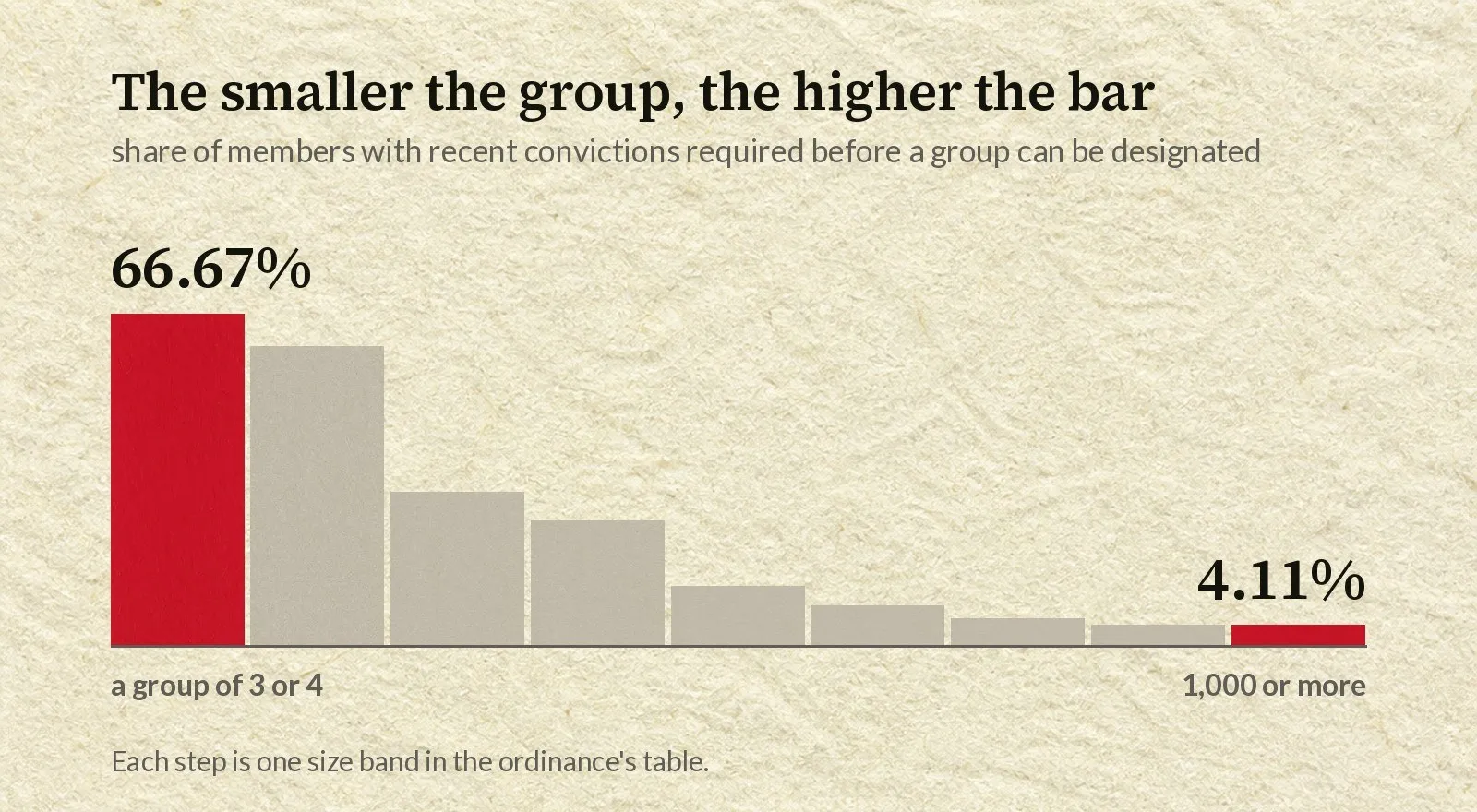
- The threshold is statistical. An ordinance sets, for each size band, the proportion of members with recent criminal records at which the probability of a randomly drawn group matching it is one in 100,000 or less. Small groups need 30.77 percent; groups of a thousand or more need 4.11 percent.
- Three-quarters of the membership sits in six groups. The police count 7,000 of Japan’s 9,400 full members (74.5 percent) inside the six organizations they call the main groups.
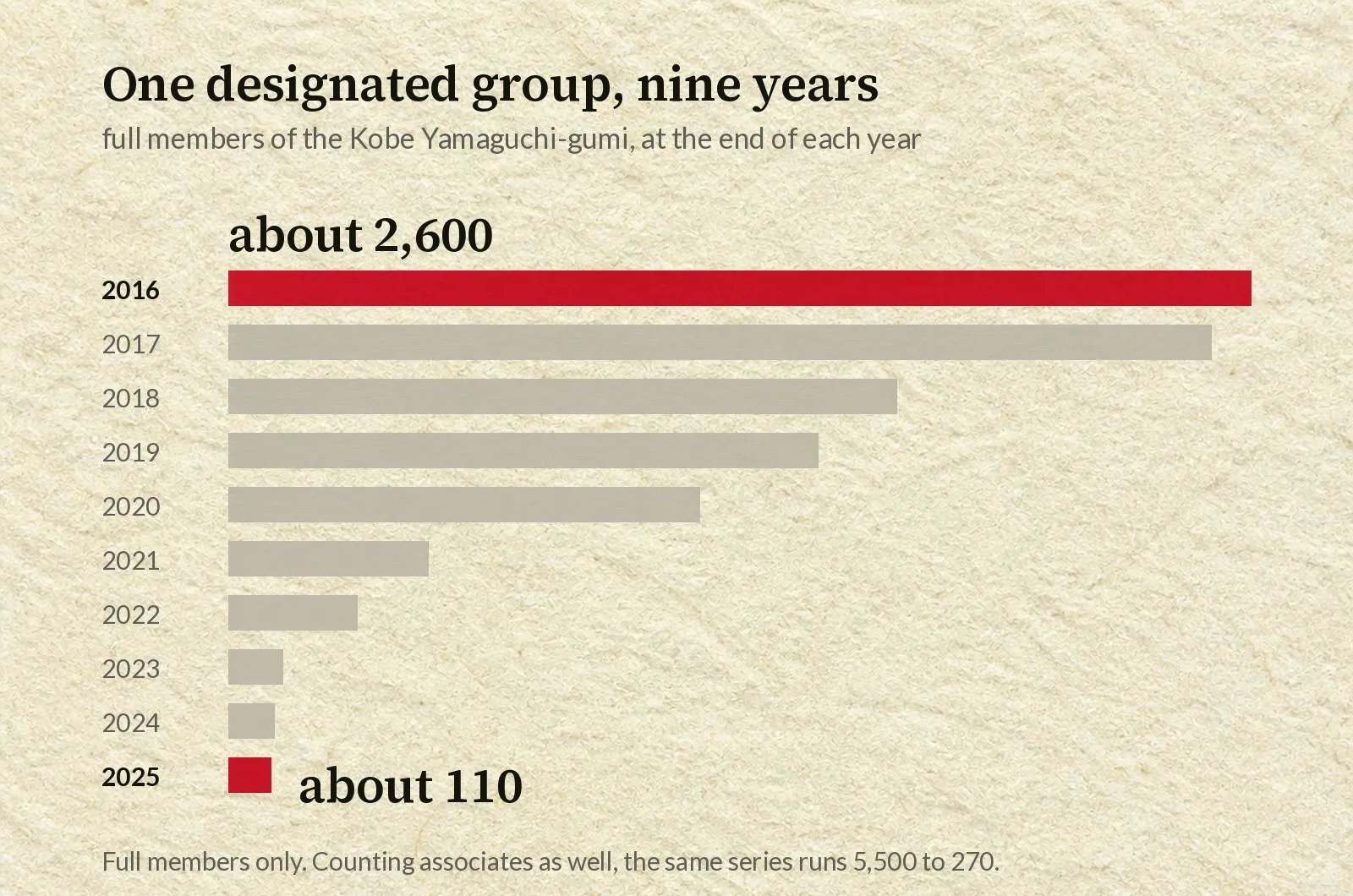
- The list is a record of contraction. Total membership has fallen every year since 2005, and one group on the list, the Kobe Yamaguchi-gumi, has gone from about 2,600 full members at the end of 2016 to about 110.
The twenty-five
This is the register the National Police Agency publishes. Membership is as of 31 December 2025 and every figure is approximate; the names, head offices and representatives are those gazetted as of 12 March 2026. It is sorted here by membership, which the published table is not, the police list carries its own numbering and no ranking. Head offices are given to ward or municipality; the register itself prints the full street address. Representatives’ names appear as they do in the Japanese original, with a romanization added only where the reading is confirmed by established reporting, because the reading of a Japanese name cannot be deduced from its characters.
| Group | Head office | Represented by | Territory | Members | |
|---|---|---|---|---|---|
| 1 | Rokudaime Yamaguchi-gumi 六代目山口組 | Nada Ward, Kobe, Hyogo | 篠田 建市 (Kenichi Shinoda) | 44 prefectures | ~3,100 |
| 2 | Sumiyoshi-kai 住吉会 | Minato Ward, Tokyo | 小川 修 | 16 prefectures | ~2,100 |
| 3 | Inagawa-kai 稲川会 | Minato Ward, Tokyo | 内堀 和雄 | 17 prefectures | ~1,600 |
| 4 | Dojin-kai 道仁会 | Kurume, Fukuoka | 福田 憲一 | 4 prefectures | ~300 |
| 5 | Kyokuto-kai 極東会 | Shinjuku Ward, Tokyo | 髙橋 仁 | 13 prefectures | ~290 |
| 6 | Matsuba-kai 松葉会 | Kashima, Ibaraki | 伊藤 義克 | 8 prefectures | ~260 |
| 7 | Kyokuryu-kai 旭琉會 | Kitanakagusuku, Okinawa | 糸数 真 | 1 prefecture | ~200 |
| 8 | Godaime Kudo-kai 五代目工藤會 | Kokurakita Ward, Kitakyushu, Fukuoka | 野村 悟 (Satoru Nomura) | 3 prefectures | ~190 |
| 9 | Rokudaime Kyosei-kai 六代目共政会 | Minami Ward, Hiroshima | 荒瀬 進 | 1 prefecture | ~140 |
| 10 | Nidaime Namikawa-kai 二代目浪川会 | Omuta, Fukuoka | 梅木 一馬 | 6 prefectures | ~130 |
| 11 | Kobe Yamaguchi-gumi 神戸山口組 | Inami, Hyogo | 井上 邦雄 (Kunio Inoue) | 8 prefectures | ~110 |
| 12 | Kanto Sekine-gumi 関東関根組 | Tsuchiura, Ibaraki | 大塚 逸男 | 5 prefectures | ~80 |
| 13 | Soai-kai 双愛会 | Ichihara, Chiba | 椎塚 宣 | 2 prefectures | ~70 |
| 14 | Taishu-kai 太州会 | Tagawa, Fukuoka | 日高 博 | 1 prefecture | ~60 |
| 15 | Yondaime Fukuhaku-kai 四代目福博会 | Hakata Ward, Fukuoka | 金 國泰 | 2 prefectures | ~60 |
| 16 | Sandaime Kyodo-kai 三代目俠道会 | Onomichi, Hiroshima | 池澤 望 | 5 prefectures | ~50 |
| 17 | Nidaime Azuma-gumi 二代目東組 | Nishinari Ward, Osaka | 滝本 博司 | 1 prefecture | ~50 |
| 18 | Kizuna-kai 絆會 | Neyagawa, Osaka | 金 禎紀 | 11 prefectures | ~50 |
| 19 | Hachidaime Aizu Kotetsu 八代目会津小鉃 | Sakyo Ward, Kyoto | 髙山 義友希 | 4 prefectures | ~40 |
| 20 | Godaime Asano-gumi 五代目浅野組 | Kasaoka, Okayama | 中岡 豊 | 2 prefectures | ~40 |
| 21 | Nidaime Shinwa-kai 二代目親和会 | Takamatsu, Kagawa | 吉良 博文 | 1 prefecture | ~40 |
| 22 | Hachidaime Goda-ikka 八代目合田一家 | Shimonoseki, Yamaguchi | 朴 鐘吉 | 2 prefectures | ~30 |
| 23 | Yondaime Kozakura-ikka 四代目小桜一家 | Kagoshima, Kagoshima | 平岡 喜榮 | 1 prefecture | ~30 |
| 24 | Ikeda-gumi 池田組 | Kita Ward, Okayama | 金 孝志 | 4 prefectures | ~30 |
| 25 | Judaime Sakaume-gumi 十代目酒梅組 | Nishinari Ward, Osaka | 李 正秀 | 1 prefecture | ~10 |
Two things about this table are worth saying out loud before going further.
The first is that it exists at all. No equivalent register is published for organized crime in most countries, because most countries prohibit the organizations outright and therefore have nothing to register. Japan’s approach (measuring the organizations instead of banning them) produces an annual document in which the state names the head of each syndicate and the ward its office stands in.
The second is the bottom row. About ten men, in one ward of Osaka, carrying the same legal label as an organization three hundred times their size.
(One clarification on the count of twenty-five. The Act provides for a second kind of entry: under Article 4 a public safety commission may designate a federation of already-designated groups, an umbrella body whose members are themselves designated syndicates, existing to coordinate between them. The list above is the Article 3 register, and the 2025 volume’s statement that twenty-five groups are designated refers to it.)
What a single row contains
The table has twenty-five rows. It does not have twenty-five organizations in any ordinary sense, and the statute is explicit about why.
Article 2 defines a bōryokudan as a group meeting two conditions, and the second is structural: it must be hierarchically composed under the control of the person who represents it or who holds the position of controlling its operation: a person the Act calls the representative etc. The same article counts, among the group’s members, the members of its constituent groups. Hierarchy is not an observation the police make about these organizations. It is part of the legal definition of what they are.
Article 9 then names the relationship. It prohibits a designated member from using the power of his own group or of any group above it, and defines that chain as upward linkage: the relationship in which one designated group becomes a constituent group of another, or in which the representative of one designated group is himself an ordinary member of another. Follow the linkages upward and you have what the Act calls the superior affiliated designated group.
That second clause is the whole architecture in a sentence. The boss of a subordinate organization is, one level up, simply one of the men. A syndicate of 3,100 is not 3,100 individuals reporting to one office; it is a stack of organizations, each with its own name, office and boss, connected by the fact that each boss is a rank-and-file member of the organization above.
The police name these layers when they enforce against them. The 2025 volume devotes a section to concentrated enforcement against the Kōdō-kai, the Nagoya-based organization it describes flatly as effectively controlling the Rokudaime Yamaguchi-gumi, a subordinate body inside row one of the table, targeted in its own right because weakening it is how the police intend to weaken the parent. In 2025 they arrested five direct-affiliate bosses and others of the Rokudaime Yamaguchi-gumi, four direct-affiliate bosses and others of the Kōdō-kai, and thirteen executives of Kōdō-kai direct-affiliate organizations. Three tiers, counted separately, all inside one row of the register.
Elsewhere in the same volume the case reports read the same way: bosses of a Yamaguchi-gumi subordinate organization prosecuted for running a baseball gambling operation, plainly criminal, in a country where the permitted form of gambling is licensed and metered by the state; members of a Kyokuryu-kai subordinate organization over concealment of criminal proceeds; members of a Sumiyoshi-kai subordinate organization over subsidy fraud. Almost nobody is arrested as a member of the entity named in the table. They are arrested as members of something inside it.
The names on the register, and the names in use
Two more things the table does not show, both of which say something about what kind of document it is.
The register carries legal names. Row one gives the representative of the Rokudaime Yamaguchi-gumi as Kenichi Shinoda, because that is the name gazetted. In Japanese reporting, in the organization, and in most English writing about it, the same man is known by another name entirely: Shinobu Tsukasa. Both refer to one person. The state’s document does not use the name the world uses, because the state is not describing a figure. It is recording who is legally answerable for an entity. That distinction runs through Chapter 5 of the Act, which makes the representative liable in damages for harm done by the organization’s members.
The bonds inside a row are family bonds, formally conferred. The police record them as organizational events. In October 2025 the Sumiyoshi-kai held a parent-child sake ceremony with chairman Osamu Ogawa as the parent; the police note it strengthened the organization. In the same month the Inagawa-kai, having promoted men to direct-affiliate status, held a parent-child bonding sake ceremony for them, and a succession sake ceremony for men newly made heads of subordinate organizations. These are not folklore. They are the mechanism by which a man becomes a direct affiliate (which is to say, by which the upward linkage of Article 9 is actually created) and the National Police Agency lists them in an annual report to the state alongside membership statistics.
Which leaves the question of who is eligible to be somebody’s child. The Act itself is silent: it speaks of the representative etc. and of members, and imposes no condition of sex anywhere. Japan’s published crime statistics break down arrests by sex in other categories, but no sex breakdown is published for organized crime group members, so the composition of the 9,400 cannot be stated from the primary sources. What the record does show is the vocabulary the institution uses about itself and that the state reproduces without comment: parent and child, the parent-child cup, succession. The kinship being simulated is a male line, and it is simulated through a ceremony the police count as a corporate event.
What “designated” actually does
Designation does not make a group illegal, and it does not dissolve it. Membership of a designated group remains lawful in Japan. What designation does is switch on a set of prohibitions that apply to that group’s members: they may not use the organization’s power to make demands, may not use it to collect debts or force contracts, and (once further designations are added) may not do a range of things inside geographically defined zones.
The procedure to get there is a formal administrative one, and it reads less like a police action than like a licensing decision run in reverse.
Under Article 5 the commission must hold a public hearing before designating. It must notify the group’s representative, or someone standing in for him, of the reasons for the proposed designation and of the date and place of the hearing, with adequate notice, and must publish the date and place. At the hearing the representative or his lawyer may state an opinion and submit evidence in his favour. Only if the representative fails to appear without proper reason, or cannot be located for thirty days after publication, may the commission proceed without a hearing.
Under Article 6 the commission must then ask the National Public Safety Commission to confirm that the group meets the requirements, attaching the documentary proof and the record of the hearing.
Under Article 7 the designation must be published in the official gazette, and (this is the operative sentence) the designation takes effect by that publication. Where a published detail changes, the change must be gazetted too. That is why the 2025 volume records that the Sumiyoshi-kai’s head office moved from Shinjuku Ward to Minato Ward in June 2025 and was gazetted; that the Kizuna-kai’s head office moved from Osaka City to Neyagawa in July 2025 and was gazetted; and that when the Inagawa-kai’s sōsai (the ceremonial head who stands above the chairman) died in May 2025, the commission gazetted the chairman as the group’s representative in his place.
Under Article 8 the designation lasts three years, and must be revoked when the group is extinguished by dissolution or otherwise, or when it clearly no longer meets the requirements.
Read together, those four articles describe a register. The state does not pursue an outlawed enemy; it maintains an entry, hears objections to it, publishes amendments to it, and lets it expire unless it is renewed.
Twelve times, one group at a time
The three-year clock is not a formality, and the 2025 volume shows what running it looks like. Fourteen of the twenty-five entries came up for renewal that year, on four separate dates, each handled by the public safety commission of the prefecture where the group has its head office:
- 8 April 2025, the Kobe Yamaguchi-gumi, by the Hyogo commission: its fourth designation.
- 17 June 2025: the Rokudaime Yamaguchi-gumi (Hyogo), the Inagawa-kai and the Sumiyoshi-kai (Tokyo), the Godaime Kudo-kai (Fukuoka) and the Kyokuryu-kai (Okinawa): the twelfth for each.
- 25 July 2025: the Hachidaime Aizu Kotetsu (Kyoto), the Rokudaime Kyosei-kai (Hiroshima), the Hachidaime Goda-ikka (Yamaguchi) and the Yondaime Kozakura-ikka (Kagoshima): the twelfth for each.
- 9 December 2025: the Dojin-kai (Fukuoka), the Godaime Asano-gumi (Okayama), the Nidaime Shinwa-kai (Kagawa) and the Soai-kai (Chiba): the twelfth for each.
Twelve designations at three years apiece span thirty-four years, which places the first of them in 1992, the year the Anti-Organized Crime Act took effect. Thirteen of the organizations on this list have therefore been designated, re-examined and designated again, without a gap, for the entire life of the statute. The Kobe Yamaguchi-gumi, which did not exist until 2015, is on its fourth.
Nothing about this is dramatic, and that is the point. A designation is not a raid. It is a file that a prefectural commission opens every three years, hears argument on, sends to Tokyo for confirmation, and publishes in the gazette: for the fourth time, or the twelfth, depending on how long the organization has been there to be counted.
The arithmetic the state wrote down
Article 3 sets two requirements, and both must be met.
The first is about purpose: the group must be one whose substantive purpose, whatever it claims its nominal purpose to be, is to let its members use the organization’s power to obtain money.
The second is where the law becomes unusual. It requires that the proportion of members holding a “criminal record” (defined precisely, with time limits) exceed a proportion set by government ordinance. And it constrains what that ordinance may set. The proportion must be limited to one at which, in a group of the same size drawn at random from the general population, the probability of the same or a higher proportion of record-holders appearing is
one in 100,000 or less
That is a significance threshold, written into a criminal-justice statute. Japan is not asserting that a designated group looks dangerous. It is asserting that the concentration of criminal records inside it is too extreme to have happened by chance, at odds of one in a hundred thousand.
“Criminal record” is then defined without discretion. It means a person who, for a violent unlawful act, has been sentenced to imprisonment and has not completed ten years since the sentence ended; or fined, with five years not yet elapsed; or given a suspended sentence of imprisonment that has run its course, with ten years not yet elapsed since the judgment became final; or a suspended fine, with five years not yet elapsed. A conviction ages out. The register is meant to move.
The ordinance that carries the actual figures is short, and it is a table. Here is a part of it:
| Size of the group | Required proportion with criminal records |
|---|---|
| 3 or 4 | 66.67% |
| 5 or 6 | 60.01% |
| 10 to 14 | 30.77% |
| 20 to 24 | 25.01% |
| 50 to 54 | 12.01% |
| 100 to 109 | 8.01% |
| 200 to 209 | 5.51% |
| 500 to 549 | 4.21% |
| 1,000 or more | 4.11% |
The curve runs the opposite way to intuition. The smaller the organization, the higher the proportion of convicts it must contain before Japan will designate it. A group of three or four must be two-thirds ex-offenders. A group of ten to fourteen must be nearly a third. A group of a thousand or more clears the bar at 4.11 percent.
This is what one in 100,000 does to a small sample. In a group of four, a high proportion of record-holders can easily arise by accident, so the law demands an extreme figure before it will call the pattern meaningful. In a group of three thousand, 4.11 percent is already far outside anything chance produces. The ordinance is not being lenient toward small groups. It is refusing to designate an organization on evidence that would not survive a statistician.
About 3,100, and about ten
Which brings us back to the bottom row.
The Judaime Sakaume-gumi holds its head office in Nishinari Ward, Osaka, operates in one prefecture, and had about ten full members at the end of 2025. To be designated, a group of ten to fourteen must show 30.77 percent, four of ten men carrying a recent conviction for a violent unlawful act. The Rokudaime Yamaguchi-gumi, with about 3,100, needed 4.11 percent.
Both were designated. Both went through a public hearing. Both were confirmed by the National Public Safety Commission and published in the gazette. Both hold an entry that expires in three years unless renewed. The law that governs the ten men and the law that governs the 3,100 are, in every particular the statute cares about, the same law.
English-language writing about the yakuza tends to sort the groups by power: which is the biggest, who is at war with whom, which one appears in the films. Japan’s own document sorts them by nothing of the kind. It is a register of entities that have cleared a probability threshold, and having cleared it, they are all simply on it.
Where the members actually are
The flatness of the register should not be mistaken for flatness on the ground. The police publish that calculation too, and it is stark.
Of Japan’s 9,400 full members at the end of 2025, 7,000 (74.5 percent) belong to six organizations that the National Police Agency groups together as the “main groups”: the Rokudaime Yamaguchi-gumi, the Kobe Yamaguchi-gumi, the Kizuna-kai, the Ikeda-gumi, the Sumiyoshi-kai and the Inagawa-kai. Counting members and associates together, the same six hold 12,500 of 17,600, or 71.0 percent.
Note which groups those are. Three of the six (the Kobe Yamaguchi-gumi (about 110 full members), the Kizuna-kai (about 50) and the Ikeda-gumi (about 30)) are smaller than a dozen groups that are not on the list of six. They are there because of what they broke away from. The police category tracks the Yamaguchi-gumi’s fracture lines, not the membership rankings, which means even the police shorthand for “the big ones” is not really about size either.
The concentration itself has barely moved in a decade. The main groups held 73.5 percent of full members at the end of 2016 and 74.5 percent at the end of 2025, while the absolute numbers inside that share collapsed from 13,300 to 7,000. The pyramid did not redistribute. It shrank while holding its shape.
The list is a record of a collapse
One row on the table tells that story on its own.
In August 2015 thirteen direct-affiliate bosses walked out of the Yamaguchi-gumi and founded the Kobe Yamaguchi-gumi. The war that followed ran for a decade and produced the harshest designations Japanese law can impose. Here is what the annual counts of full members did to the breakaway group afterwards:
| End of year | Kobe Yamaguchi-gumi, full members |
|---|---|
| 2016 | ~2,600 |
| 2017 | ~2,500 |
| 2018 | ~1,700 |
| 2019 | ~1,500 |
| 2020 | ~1,200 |
| 2021 | ~510 |
| 2022 | ~330 |
| 2023 | ~140 |
| 2024 | ~120 |
| 2025 | ~110 |
About 96 percent of the membership is gone in nine years. The organization is still designated; it still has a gazetted head office in Inami, Hyogo, and a gazetted representative. On the register it looks like an entity. In the count it is a hundred and ten men.
The parent organization declined over the same period too, from about 5,200 full members at the end of 2016 to about 3,100 at the end of 2025, a fall of 40 percent, which would be the headline number in any other decade. And the national total fell from 18,100 to 9,400. Nothing on this list is growing.
A caution about comparing these figures with numbers you may have read elsewhere, including in our own earlier reporting: Japan counts full members and associate members separately, and reports both. The 110 above is full members only. Counting members and associates together, the Kobe Yamaguchi-gumi stood at about 270 at the end of 2025 and about 5,500 at the end of 2016. Both series show the same collapse; they are simply not the same series, and mixing them exaggerates or flattens the fall depending on which end you take from which.
Two labels the list does not show
The register records the designation. Two further designations sit on top of it, and they are the ones that change what happens on a street.
Specified conflict designation applies when two designated groups are at war. The commission draws warning zones, and inside them members may not open new offices, may not follow or loiter near a rival member’s home or office, may not gather in numbers, and may not enter either organization’s premises. At the end of 2025 three pairings were designated, and all three are the Rokudaime Yamaguchi-gumi against a group that split from it:
| Pairing | Designated | Warning zones at end of 2025 |
|---|---|---|
| Rokudaime Yamaguchi-gumi ⇄ Kobe Yamaguchi-gumi | January 2020 | 9 prefectures, 17 municipalities |
| Rokudaime Yamaguchi-gumi ⇄ Ikeda-gumi | December 2022 | 7 prefectures, 8 cities |
| Rokudaime Yamaguchi-gumi ⇄ Kizuna-kai | June 2024 | 8 prefectures, 11 cities |
Specified danger designation is rarer and is currently held by one organization. The Godaime Kudo-kai in Kitakyushu was designated in December 2012, and the designation has been extended annually ever since; December 2025 was the thirteenth extension. The 2025 volume records what enforcement of it looks like in practice: a Kudo-kai member who, between June and August 2024, told a resident inside a warning zone “I’m the top man in Moji” and “pay it back properly”, demanding interest above the legal rate, was arrested in August 2025 for a violent demand made inside a warning zone.
The most telling detail, though, is in the police account of what the designated organizations did in 2025. For the Rokudaime Yamaguchi-gumi, the Kobe Yamaguchi-gumi, the Kizuna-kai and the Ikeda-gumi alike, the entry is the same: following the extension of the specified conflict designations, they held their executive meetings and block meetings outside the warning zones.
The state drew lines on a map. The organizations read the map and met on the other side of the line. Neither the meetings nor the reading of the map is illegal. This is the whole shape of Japanese policy in one sentence: the law does not remove these organizations, it constrains where they may stand, and they comply with the geography while remaining exactly what they were.
What the 9,400 does not count
Three cautions about the numbers on this page, because they are easy to misread.
Full members and associates are different counts. At the end of 2025 there were 9,400 full members and 8,200 associate members and others, totalling 17,600, the lowest since the Act took effect in 1992. Associates are people connected to a group who may act on its power, or who supply it with money or weapons. A figure of 17,600 and a figure of 9,400 are both correct and describe different populations.
Every figure is rounded. The police state explicitly that these are approximations and that the components need not sum to the totals. Do not build a total by adding the twenty-five rows; the published total for designated-group members is about 9,000, which is 95.7 percent of all full members.
Arrests do not track membership. In 2025, 7,335 members and associates were arrested, down 11.1 percent on the previous year. But only 1,474 of those were full members; 5,861 were associates and other peripheral figures. The people the police catch are mostly not the people the register names, a pattern that has held for years, and one reason the falling membership figure cannot be read as a falling crime figure. The 2025 volume also notes members of designated groups acting as leaders of the anonymous, fluid crime groups now absorbing much of this work, and money flowing from those groups back to the syndicates. Those groups are where the country’s fastest-growing crime now lives: fraud, up 26.5 percent in a single year, with the largest single method being callers who claim to be police officers.
So what does the list show?
That Japan has chosen, for more than thirty years, to know rather than to prohibit.
The register does not ask whether an organization is powerful, or feared, or famous, or whether the men in it are dangerous in any sense a novelist would recognize. It asks whether an organization exists to let its members trade on its power, and whether the density of convictions inside it is beyond what chance explains at one in 100,000. If both are true, the group receives an entry, a three-year clock, and a public hearing at which it may argue against all of it.
Twenty-five organizations currently hold that entry. One has about ten men in it. One has about 3,100, has held its entry twelve consecutive times since 1992, and is smaller than it was last year, and the year before, and every year since 2005.
The register that names them is also, read down its columns and back through its editions, the most precise record anyone has of their disappearance: kept, every three years, by the state that never made them illegal in the first place.
In this article
- Quick answer
- The twenty-five
- What a single row contains
- The names on the register, and the names in use
- What “designated” actually does
- Twelve times, one group at a time
- The arithmetic the state wrote down
- About 3,100, and about ten
- Where the members actually are
- The list is a record of a collapse
- Two labels the list does not show
- What the 9,400 does not count
- So what does the list show?