Quick answer
Ask why a visitor with a small rose on one shoulder is turned away from a Japanese hot spring, and you will not find the answer in any statute. No Japanese law prohibits tattooed customers from bathing, and since 2020 not even the tattooist’s needle is illegal. What operates instead is an unwritten rule with a 150-year supply chain behind it: a mark the state once inked onto criminals as punishment; a syndicate that adopted the mark as its uniform; a film industry (from the yakuza pictures of the 1960s to the straight-to-video V-cinema boom of the 1990s) that printed the association onto every screen in the country; and a public that, surveys show, still reads ink of any style, Japanese or Western, as a warning label. This article traces each link in that chain, because the bathhouse sign at the end of it cannot be understood without the rest.
The question every visitor asks
Start with the numbers. In 2015, as foreign arrivals climbed toward their record years, the Japan Tourism Agency surveyed roughly 3,800 hotels and inns with bathing facilities (the first survey of its kind) and of the roughly 600 that responded, 56 percent refused tattooed bathers outright, 31 percent accepted them, and 13 percent accepted them conditionally, most commonly if the tattoo could be covered with a sticker. The refusals apply to a full-back dragon and to a two-centimeter initial with equal force, and they apply to foreign tourists whose tattoos carry religious or cultural meaning at home.

Note what this is not. It is not law. Each facility decides its own rule, which is why the answer to “can I enter an onsen with a tattoo” is always “it depends on the onsen.” The state’s only intervention has been the Tourism Agency asking facilities, gently, to consider flexibility toward foreign guests. A private rule this widespread, enforced this uniformly, with no statute behind it, is the more interesting phenomenon: several thousand businesses independently reading the same mark the same way. Something taught them to.
The mark the state wrote on criminals
Tattooing in Japan is old enough that its earliest history is contested, but the modern story begins in the Edo period, when the practice split into two opposite meanings at once. Among firemen, construction workers and couriers, elaborate pictorial tattoos flourished as iki (the plebeian ideal of style and nerve) and the craft developed the composition, palette and technique that the world now recognizes as Japanese tattooing. At the same time, the shogunate’s courts were applying irezumi-kei, the tattoo penalty: simple marks inked onto the arms or foreheads of convicted criminals as a permanent, public criminal record. One art, two registers, pride and stigma written in the same medium on different bodies. We have traced this pattern before: Japan has a long institutional habit of using the body itself as a document.
In 1872, the Meiji government banned tattooing altogether. The new state was renegotiating treaties with Western powers and auditing its own customs through imagined foreign eyes; tattoos were classified as a barbarism unbecoming a civilizing nation. The craft went underground for three-quarters of a century (tattooists working quietly, moving often) until 1948, when the prohibition was lifted during the Allied occupation and tattooists in port towns found an unexpected new clientele: American servicemen. Legal for the first time in 76 years, the craft resurfaced into a country that had been taught, by three generations of criminalization, that ink was something criminals had.
The syndicate that made the mark a uniform
Into that vacancy stepped the organization best equipped to use it. In the postwar decades the full-body tattoo became an emblem of the yakuza, and it worked for the same reason yubitsume worked: it was a costly, irreversible, verifiable signal. A back that takes a hundred hours of pain to complete, cannot be undone, and forecloses ordinary employment is a commitment device. It binds the wearer to the organization by closing the doors behind him, the same one-way mechanics we documented for severed fingers, and for membership itself.
The Oricon News retrospective on Japanese tattoo history makes an easily forgotten point about this period: for a time, the association was not entirely dark. Mid-century yakuza retained a residue of the old iki (outlaw glamour, open ties to the entertainment world) and the tattoo carried that ambiguity with it. Two forces burned the ambiguity away. One was legal: the Anti-Boryokudan Act, promulgated in 1991, made the syndicates formally designated adversaries of the state (the regime whose machinery we have examined across this series) and as the organizations became officially “anti-social forces,” the mark they wore inherited the classification. The other force was cultural, and it had a distribution network.
The image factory: yakuza films and V-cinema
The 1960s yakuza film boom put the tattooed body at the center of the frame, the ink shot lovingly, as the visual signature of masculine resolve. That association was already strong when, in 1989, Toei launched V-Cinema: feature films produced directly for the rental-video shelf, beginning with the action title Crime Hunter. The label name became the generic term for an entire industry, and through the 1990s and 2000s (precisely the years when theatrical yakuza films had faded) straight-to-video crime pictures were produced in enormous volume, with stars like Sho Aikawa crowned “emperor of V-cinema” for a filmography running to hundreds of titles.
This is the piece the bathhouse sign cannot be explained without. The theatrical yakuza classics were events; V-cinema was wallpaper. Every rental shop in every suburb carried shelves of it, jacket after jacket of scowling men whose defining visual attribute (on the packaging itself, engineered to communicate at a glance) was the tattooed torso. For two decades, the rental shelf performed a nationwide educational function no government campaign could have matched: it taught every Japanese household, weekly, that the tattoo means yakuza. By the time the genre receded, the lesson had detached from its referent. The syndicates shrank (we have measured the collapse) but the shorthand stayed taught. A signal mass-produced for fiction went on being read as fact, by bathhouse owners, gym managers, employers, and the public at large, applied to ink of any style on anyone.
So is the tattooist a criminal or not?
For most of the postwar period, the question never needed answering: tattooing was lawful and simply unregulated. Then, in the 2010s, the state stumbled into a test case. Prosecutors charged an Osaka tattooist under Article 17 of the Medical Practitioners Act (the provision reserving the practice of medicine to licensed physicians) on the theory that puncturing skin with a needle is a medical act. The implication was extraordinary: since no medical school teaches tattooing, the theory would have made the entire craft illegal in practice, ending in Japan a trade with centuries of continuous history.
The courts split, and the progression is worth watching. The Osaka District Court convicted in September 2017, accepting the medical-act theory. The Osaka High Court reversed in November 2018 and acquitted. And on 16 September 2020, the Supreme Court’s Second Petty Bench rejected the prosecutors’ final appeal, settling the law: tattooing, the court reasoned, is a practice with decorative and symbolic elements and artistic significance, long received in society as a custom; it requires knowledge and skill of an artistic character entirely distinct from medicine; and it has historically been performed by tattooists, not doctors. It is therefore not a medical act, and no medical license is required.
So the answer to the question in this section’s title is: not a criminal, and never was, in the customer’s case. But note the shape of the resolution, because it is the same shape we keep finding in this series. Japan did not license the tattooist, regulate the studio, or legislate the bathhouse. The craft is lawful; the refusal is lawful; the state stands aside from both. Legality and acceptance run on entirely separate tracks, exactly as they do for an organization that is designated but never banned.
What the public actually thinks
Which leaves the question of where the line really lives: in the surveys. Two are worth reading side by side.
Oricon News polled 1,000 working adults aged from their teens to their fifties in 2018. Asked about the act of putting a tattoo on one’s own body, 38.4 percent said it was “not good,” 16.5 percent said it was “good,” and 45.1 percent could not say either way, a plurality suspended between a fading norm and an unarrived one. The stated reasons for disapproval were revealing in their vagueness: “it does not suit Japanese culture,” “it damages the body.” Not “it signals crime”. The criminal reading has softened into something more diffuse and therefore harder to argue with: unease.
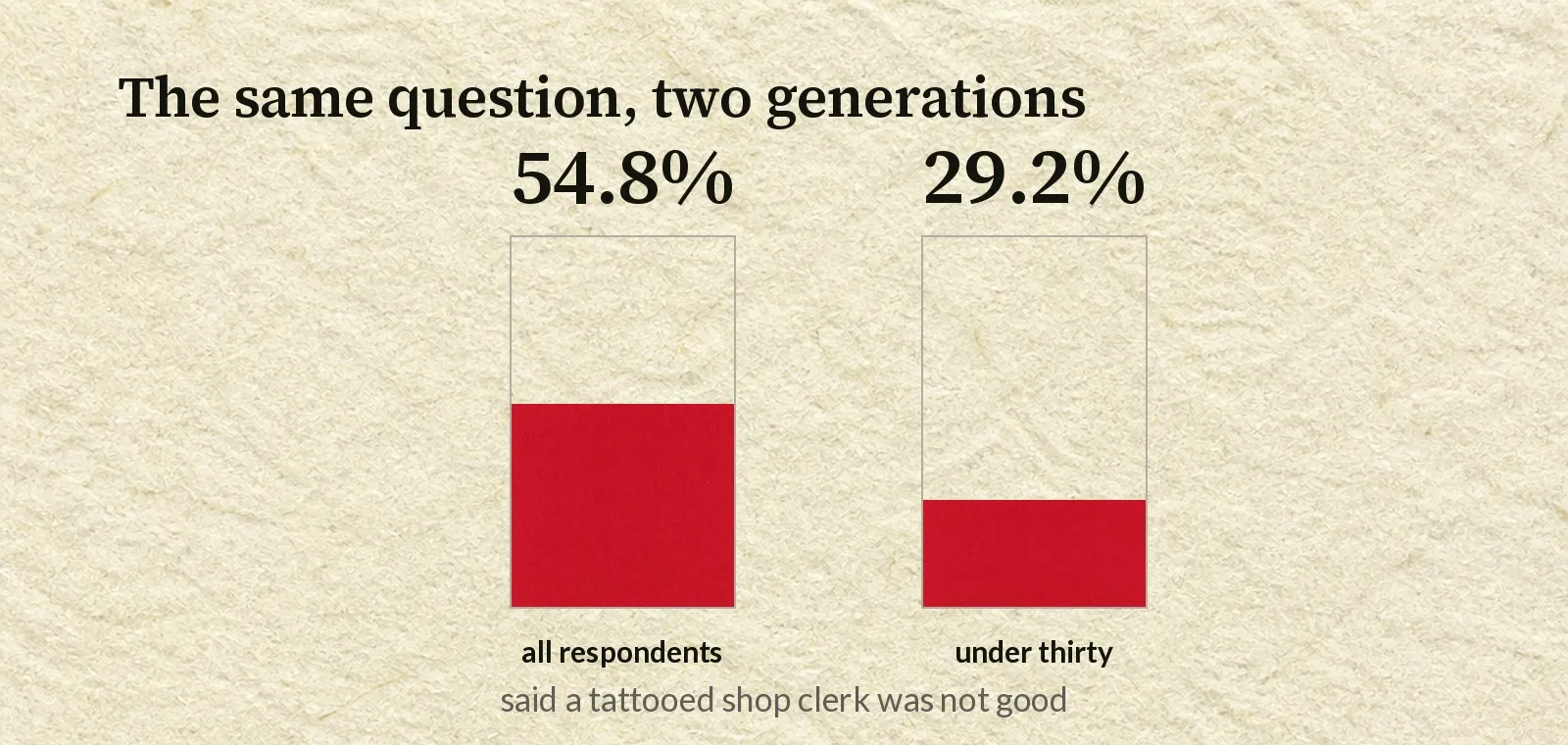
The Nihon Trend Research survey of 2021 measured the same unease with a sharper instrument. 54.8 percent of respondents said a tattooed store clerk was “not good”, but among respondents in their twenties and younger, the figure fell to 29.2 percent. On whether tattoos should become more accepted as fashion, a majority of those in their thirties and older said no; about 60 percent of the youngest cohort said yes. And the crucial detail, confirmed across both surveys: the respondents draw no distinction between Japanese-style irezumi and Western-style fashion tattoos. The wariness attaches to ink as such. A century and a half of state punishment marks, syndicate uniforms and rental-shelf iconography compressed into a single reflex (the tattooed person is frightening) applied indiscriminately to a full-back dragon and a wrist butterfly.
That indiscriminacy is the tell. A judgment that cannot distinguish a yakuza pledge from a fashion choice is not tracking crime; it is tracking a taught image. The image was taught by the history above, and it now outlives its own referent, an organization in numerical collapse, the way light outlives a star.
The mark that outlasts everything
There are signs of movement. Tattoo-friendly bathhouses advertise themselves and are celebrated for it, a screenshot of one Chiba onsen’s “tattooed guests welcome” policy drew tens of thousands of retweets. Television now jokes about celebrities’ tattoos rather than concealing them. The generational gradient in every survey points one direction.
But the deeper pattern of this article is the one this site keeps returning to. Japan writes durable meanings on the body and then leaves them there: the Edo criminal’s forehead, the missing finger joint that blocks a bank account decades later, the tattoo that reads as a warning label regardless of what it depicts or who wears it. In each case the mark was designed (by a court, a syndicate, or a film industry) to communicate instantly and irreversibly. It still does. The men the mark originally described are vanishing. The reading persists, because the reading was never really about them: it was about a country that, for 150 years, has been taught what ink means, and has not yet finished unlearning it.