The English-language version of this subject has been stable for about thirty years. Japan is a wealthy democracy that hangs people. Executions are announced after they happen. Polls show around eighty percent public support. The conclusion writes itself: a modern country with a pre-modern punishment, sustained by an unusually punitive public.
Every sentence in that paragraph is defensible. Together they describe the wrong decade.
In 2026 the Japanese state did move on capital punishment, but not where anyone outside Japan was watching. On 17 July the Diet passed a law that says nothing about hanging, sentencing, or abolition. It changed the rules for reopening a closed case. Prosecutors can no longer appeal, as a matter of course, against a court’s decision to grant a retrial. Courts can now order prosecutors to hand over evidence they would rather keep.
Nobody abolished anything. What was abolished was a delay.
Quick answer
- The law tells the justice minister to sign an execution order within six months of a sentence becoming final, and then tells him when the clock stops. Time spent on a retrial request or a pardon petition does not count. The exception has swallowed the rule.
- Executions have nearly stopped without anyone deciding to stop them. One hanging in June 2025 ended a silence of two years and eleven months. No policy changed. The signature simply was not given.
- The man whose case drove the reform is the fifth, not the first. Four condemned men were exonerated at retrial between 1983 and 1989, each after roughly thirty-four years inside. The rules that delayed the fifth case survived all four.
- What Japan changed in July 2026 was the retrial system, not the death penalty. Prosecutors lost the power to appeal a decision to reopen a case; courts gained the power to order disclosure.
- The famous 83 percent is not 83 percent. In the government’s own survey, that figure means “capital punishment is unavoidable.” A third of the people who chose it also said the country could abolish it if circumstances changed. Offer respondents life without parole and support for retention falls to 61.8 percent.
What the law actually says
Two sentences hold up the entire structure, and both are short.
The Penal Code, Article 11: death is executed by hanging, inside a penal institution. The Code of Criminal Procedure, Article 475, paragraph 1: execution is carried out by order of the Minister of Justice. Not by a court, not by a warden. A politician signs.
Paragraph 2 of the same article is where the interesting part hides. It reads like a deadline:
The order under the preceding paragraph must be issued within six months of the day the judgment becomes final.
Then, without a paragraph break, it dismantles itself:
provided, however, that the period until the conclusion of proceedings for the restoration of the right to appeal, a request for retrial, an extraordinary appeal, or a petition or request for pardon, and the period until the judgment against a person who was a co-defendant becomes final, shall not be included in that period.
Read those two clauses together and the design becomes visible. The state wrote itself a deadline and, in the same breath, wrote the conditions under which the deadline does not run. A condemned person who files for retrial stops the six-month clock. Filing again after a denial stops it again. Article 442 confirms the shape of the arrangement from the other direction: a retrial request does not suspend execution: the prosecutor may suspend it, at his discretion, but nothing compels him to. Meanwhile Article 476 gives the order itself a brutal tempo: once signed, the hanging must occur within five days.
So the architecture is: years of stopped clocks, then five days.
This matters more than any abolition debate, because it explains a fact that confuses foreign observers. When Japan goes years without an execution, no moratorium has been declared. When it suddenly hangs someone, no policy has hardened. The machinery does not require a decision to keep running, and it does not require one to stop. It requires a signature, and signatures are discretionary. We have watched the same mechanism operate elsewhere in Japanese law: a power the state clearly holds, and does not use, for reasons that never have to be stated.
The silence nobody declared
On 27 June 2025 one man was hanged at the Tokyo Detention House. The Japan Federation of Bar Associations, protesting the same day, recorded the interval plainly: it came after two years and eleven months in which no execution had been carried out.
Three calendar years in that stretch (2020, 2023, 2024) passed without a single hanging. That is not a country carrying out capital punishment in any ordinary sense. It is a country holding it.
And yet the sentence is still handed down, still finalized, still carried on the books. Japan is running an institution that almost never acts, which is a different thing from an institution being dismantled. It is a recognisable habit: the state also declines to ban organised crime, preferring to designate it and leave the power on the shelf. The last time it acted at scale, in July 2018, it hanged thirteen people from a single organization in a matter of weeks, an operation we have examined in detail elsewhere, and one that stands in the record as a reminder of what the machinery can still do when a minister decides to use it.
Ten more years, after the court had already said yes
Every argument about irreversibility in Japan now runs through one name.
Iwao Hakamada, a former professional boxer working at a miso company, was arrested on 18 August 1966 over the killing of four members of one family (a company executive, his wife, their seventeen-year-old daughter and their fourteen-year-old son) found in the burned-out house where they lived. In September 1968 the district court sentenced him to death. On 19 November 1980 the sentence became final, and the six-month clock in Article 475 began, the clock that never ran out.
His sister Hideko filed a second retrial request in 2008. On 27 March 2014 the Shizuoka District Court granted it and ordered him released.
That should be the end of the story. It was not the end of the story. The acquittal did not arrive until 26 September 2024, and became final on 9 October 2024, when prosecutors gave up the right to appeal it.
Set those two dates beside each other, because the gap between them is the subject of this article:
| Stage | Date | Elapsed |
|---|---|---|
| Killings at the executive’s house | 30 June 1966 | , |
| Death sentence handed down | 11 September 1968 | 2 years |
| Sentence becomes final | 19 November 1980 | 14 years |
| Court grants a retrial | 27 March 2014 | 33 years after the sentence became final |
| Acquittal becomes final | 9 October 2024 | 10 years and 6 months after the retrial was granted |
A court decided in 2014 that this case had to be looked at again. It then took another decade and a half of a man’s remaining life to look at it. The delay had a cause, and the cause was procedural: prosecutors could appeal the decision to reopen, and did, and the appeals had to be exhausted before the retrial itself could begin. The retrial proceedings did not open until October 2023, nine and a half years after the court said they should.
When the verdict finally came, the Shizuoka District Court did not merely find the evidence insufficient. It found that the central items used to convict him (including the five pieces of clothing that anchored the original verdict) had been fabricated by investigators. Fifty-eight years after the killings, the state’s own court described the state’s own case as manufactured.
The four who came before him
Here is the part that gets left out of the international coverage, and it is the reason the 2026 reform is late rather than sudden.
Hakamada is not the first person Japan condemned to death and then found innocent. He is the fifth. And the first four did not arrive slowly. They arrived in a cluster, inside a single decade, while the current retrial rules were already in place.
| Case | Crime | Sentence became final | Retrial acquittal | Time in custody |
|---|---|---|---|---|
| Menda | December 1948 | December 1951 | 15 July 1983, Kumamoto District Court (Yatsushiro branch) | about 35 years |
| Saitagawa | February 1950 | January 1957 | 12 March 1984, Takamatsu District Court | about 34 years |
| Matsuyama | October 1955 | November 1960 | 11 July 1984, Sendai District Court | about 34 years |
| Shimada | March 1954 | December 1960 | 31 January 1989, Shizuoka District Court | about 34 years |
| Hakamada | June 1966 | November 1980 | 26 September 2024, Shizuoka District Court | about 58 years |
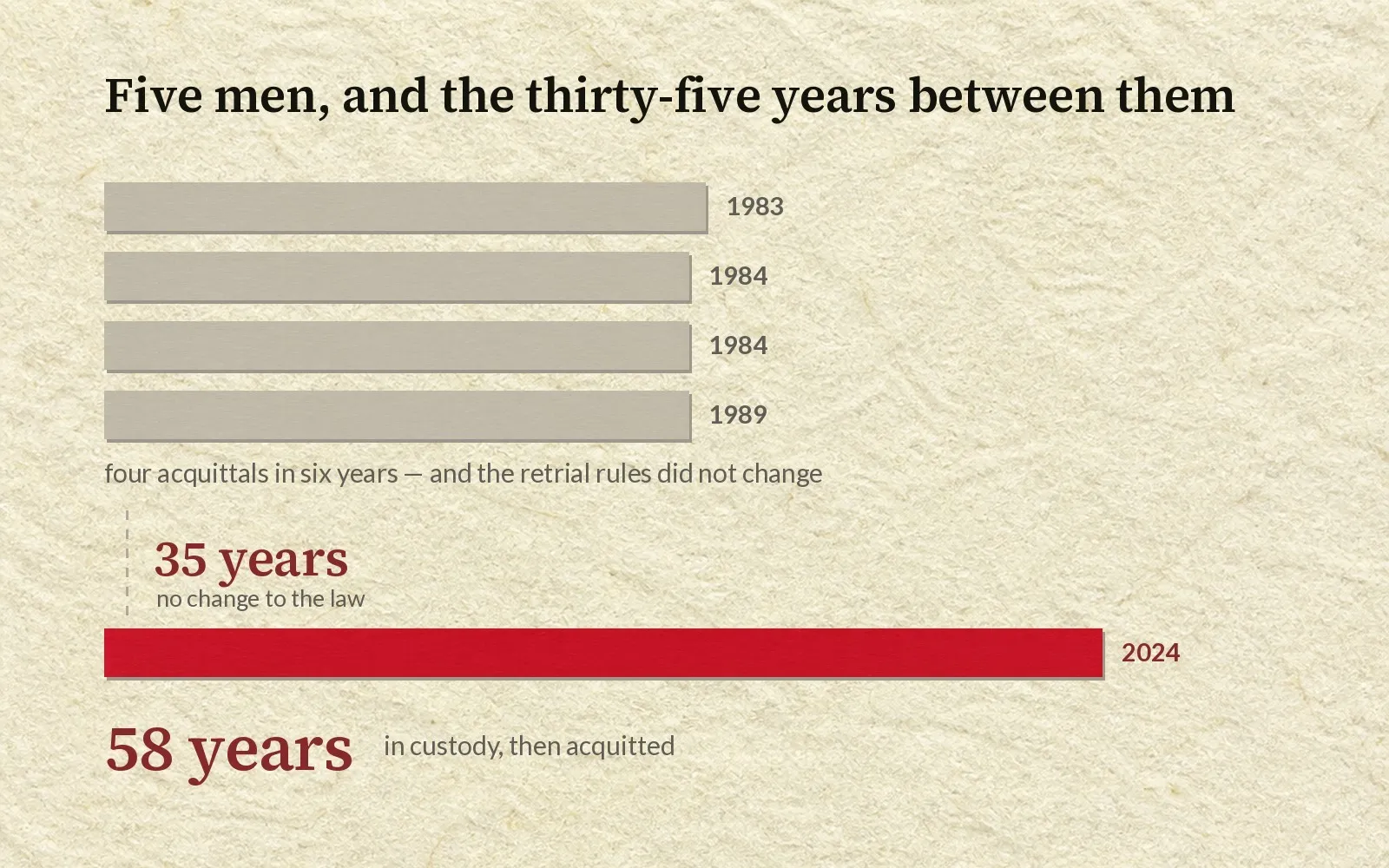
Read the fourth and fifth rows together. The same district court, in the same prefecture, acquitted a condemned man in 1989 and did it again in 2024. Shizuoka has now twice told the country that a death sentence it upheld was wrong.
The 1980s cluster is the more damning fact. Between July 1983 and January 1989 (five and a half years) four men walked out of Japanese death rows innocent, each of them after roughly a third of a century inside. The country was not short of evidence that its system produced irreversible errors. It had four demonstrations in six years.
And the retrial rules did not change. Not in 1983, not after the fourth acquittal in 1989, not in the thirty-five years that followed. The provision that let prosecutors appeal a decision to reopen a case (the provision that would later cost Hakamada a decade) survived every one of those exonerations intact.
This is why “Japan reformed its retrial system in 2026” is a thinner sentence than it looks. The reform did not follow the discovery that wrongful death sentences happen. That discovery was complete by 1989. It followed the fifth case, thirty-five years later, in a country where the man at the center had become too old and too famous to argue with.
What Japan changed in July 2026
The bill that passed the House of Councillors on 17 July 2026 does two things, and the Japan Federation of Bar Associations summarized both in its statement the same day.
First, it prohibits, as a general rule, appeals by prosecutors against a decision to commence a retrial. The specific mechanism that consumed ten and a half years of Hakamada’s life is closed.
Second, where certain conditions are met, it obliges the court to order prosecutors to produce evidence. Japanese retrial practice has long turned on material sitting in prosecutors’ files that the defense could not see and could not compel; the new law converts a matter of goodwill into a matter of obligation.
The federation, which had campaigned for the reform, still filed its objections on the day of victory. Its statement lists what did not make it in: no system requiring a list of all held evidence to be produced, so the defense must still guess at what exists; restrictions on using disclosed evidence for other purposes that it calls an excessive constraint; and no clear mechanism to make prosecutors refrain from the appeals that remain available to them where “sufficient grounds” are claimed.
Note what is absent from all of this. Not one clause concerns hanging, sentencing standards, the six-month rule, the discretion of the justice minister, or abolition. Japan did not soften its punishment. It shortened the distance between a wrongful conviction and its correction, which is the reform you build when you intend to keep the punishment.
Told on the morning
One feature of the Japanese system is not in any statute, and is currently being argued about in court.
The Code of Criminal Procedure says nothing about when a condemned person must be told that today is the day. Article 476 sets the deadline for the state (five days from the minister’s order), and is silent on notice to the prisoner. What filled that silence is administrative practice: notification on the morning of the execution itself.
Two men on death row sued over it, arguing that same-day notice is unconstitutional and asking the courts to confirm they were under no obligation to submit to an execution carried out that way. In April 2024 the Osaka District Court dismissed the claim without reaching the merits, reasoning that granting it would put the court in conflict with a final criminal judgment.
On 17 March 2025 the Osaka High Court set part of that aside and sent the case back for a proper hearing. Its reasoning is the interesting part, because it treats the practice as something the state could simply choose to do differently: if the same-day operation were unconstitutional or unlawful, the court observed, it could be corrected by giving notice at an appropriate time on the previous day rather than on the day itself.
That is a court pointing at a dial and noting that it turns. The five-day window in Article 476 does not require the prisoner to learn of it in the final hours; that part was never law. It was habit, and habit is now on trial.
The 83 percent that is not 83 percent
Every English-language account of this subject cites the same number, and the number is real. It is also the answer to a question most people have never read.
The Cabinet Office’s Survey on Basic Legal Systems, conducted in October 2024 with 1,815 valid responses, put it this way: Regarding the death penalty system, there are the following opinions; which do you agree with? The two choices were:
| Option | Share |
|---|---|
| Capital punishment should be abolished | 16.5% |
| Capital punishment is unavoidable (shikei mo yamu o enai) | 83.1% |
The Japanese phrase does not mean support. It means the thing cannot be helped. And the survey, to its credit, asked the follow-up that most citations omit. Of the 1,508 people who chose “unavoidable”:
| Follow-up question | Share of the 1,508 |
|---|---|
| Japan should not abolish capital punishment in the future either | 64.2% |
| If circumstances change, it would be acceptable to abolish it in the future | 34.4% |
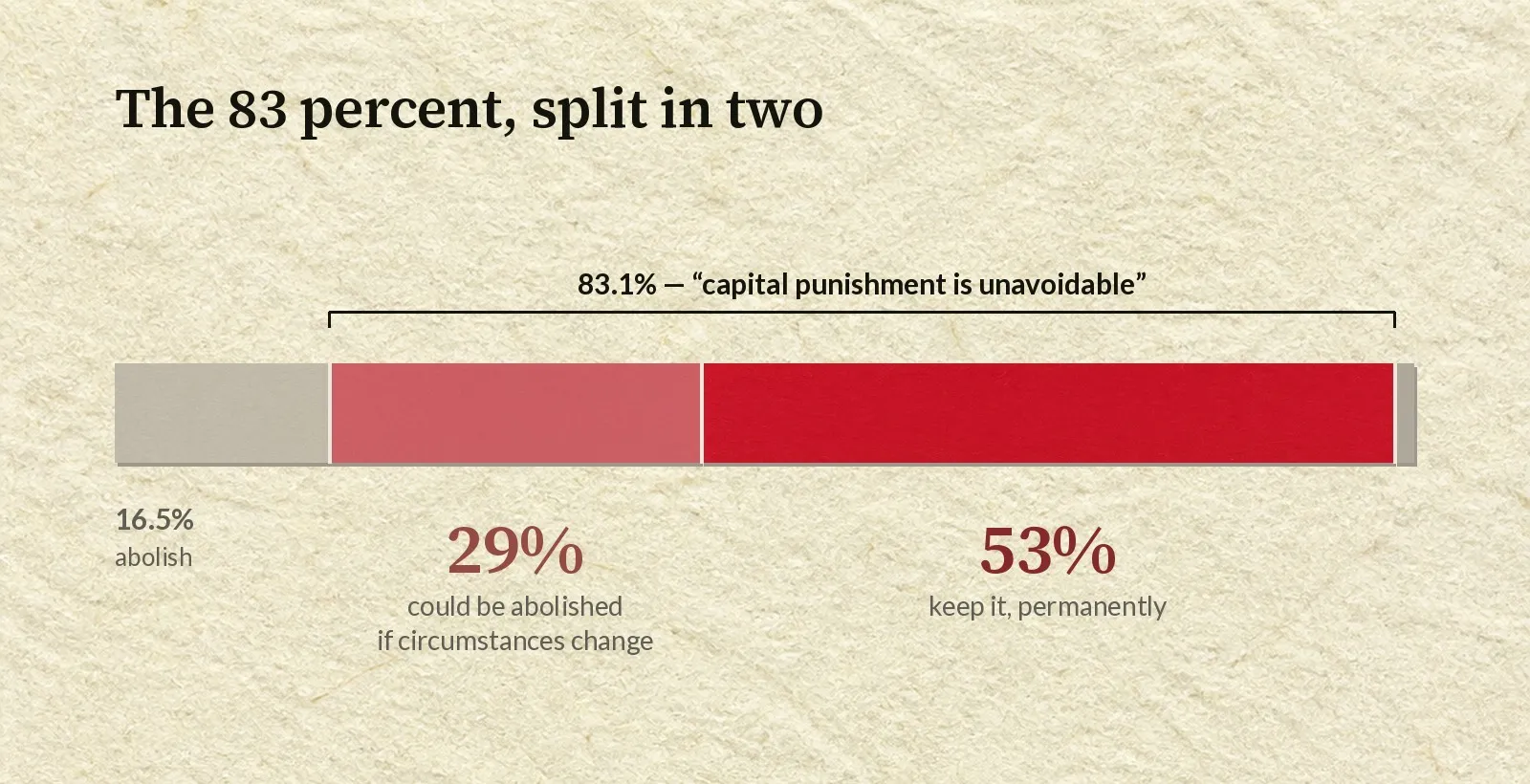
Run that through the whole sample and the headline dissolves. The share of all respondents who told their government that the death penalty should remain, permanently and unconditionally, is about 53 percent, roughly 968 people out of 1,815. Another 29 percent of the sample said it could go if things changed. The 83 percent is a coalition of the certain and the conditional, and citing it as settled opposition to abolition misreports the country’s own data.
The survey then tested exactly what “if circumstances change” might mean. Respondents were told that Japan’s next-heaviest penalty, life imprisonment, permits parole, and that a true life sentence without parole does not exist here. Asked whether they would abolish capital punishment if such a sentence were introduced:
| Option | Share |
|---|---|
| It would be better to abolish capital punishment | 37.5% |
| It would be better not to abolish it | 61.8% |
Retention still wins. But it drops more than twenty points the moment an alternative is named, which tells you that a meaningful part of that 83 percent is not attached to execution so much as unwilling to accept the release of the worst offenders.
The survey also asked everyone, regardless of their position, whether violent crime would increase if capital punishment disappeared. 71.2 percent said it would; 27.7 percent said it would not. The questionnaire supplied no evidence either way before asking, unlike the life-without-parole question, which came with an explanatory note. So the figure records a belief rather than a judgment about data, and it tells you what a large part of that 83 percent thinks it is buying: not retribution, but protection.
And then there is the answer that connects this survey to everything above it. Among the minority who want abolition, the government asked why. The most-selected reason was not cruelty, not the sanctity of life, not deterrence:
When there is an error in the trial, an execution cannot be undone — 71.0%.
Seventy-one percent of abolitionists named irreversibility as their reason. That is the largest single response in the entire death-penalty section of the survey. It is also, word for word, the problem the Diet legislated against in July 2026.
What is settled, and what is not
Settled: Japan retains capital punishment, executes by hanging, and requires a minister’s signature to do it. Executions have become rare without becoming impossible. The public, asked plainly, prefers to keep the penalty: by 83 percent when the alternative is nothing, by 62 percent when the alternative is life without parole, and by about 53 percent when the question is whether it should stay forever. And as of 17 July 2026, prosecutors can no longer routinely appeal a court’s decision to reopen a case.
Not settled: whether the reform reaches the people it was written for. A retrial system is only as fast as the disclosure that feeds it, and the law that passed contains no requirement to tell the defense what evidence exists. The justice minister’s discretion over execution orders is untouched, which means the two-year, eleven-month silence could end tomorrow or extend for another decade, with no explanation required either way. Nothing in the new law prevents an execution while a retrial request is pending; Article 442 still says a request does not suspend the sentence.
The honest summary is narrower than the headlines on either side. Japan did not move toward abolition in 2026. It moved toward correction, a state that intends to go on condemning people, quietly rebuilding the mechanism by which it admits it was wrong.
And it is worth being exact about how long that took. The country learned that it sentences innocent people to death in the 1980s, four times, in six years. It learned it again in 2024, from the same district court that had delivered one of those four. Between the fourth lesson and the law, thirty-five years passed. Hakamada was born in 1936; a court agreed to look at his case again in 2014 and told him he was innocent in 2024. The reform exists because that arithmetic finally became impossible to defend, not because the arithmetic was new.
The gallows are unchanged. The clock beside them is not.
There is one more clock the death penalty controls, and it runs in the opposite direction. Because a killing punishable by death is the one category of crime with no limitation period at all, those cases can be pursued for ever, a rule Japan created in 2010 by deleting the category from the list of offences that expire. We trace what that did to the country’s oldest open files in our article on how many murders go unsolved in Japan.