Quick answer
Yes, since 1 June 2018. And almost nothing an English-speaking reader assumes about the phrase applies to it.
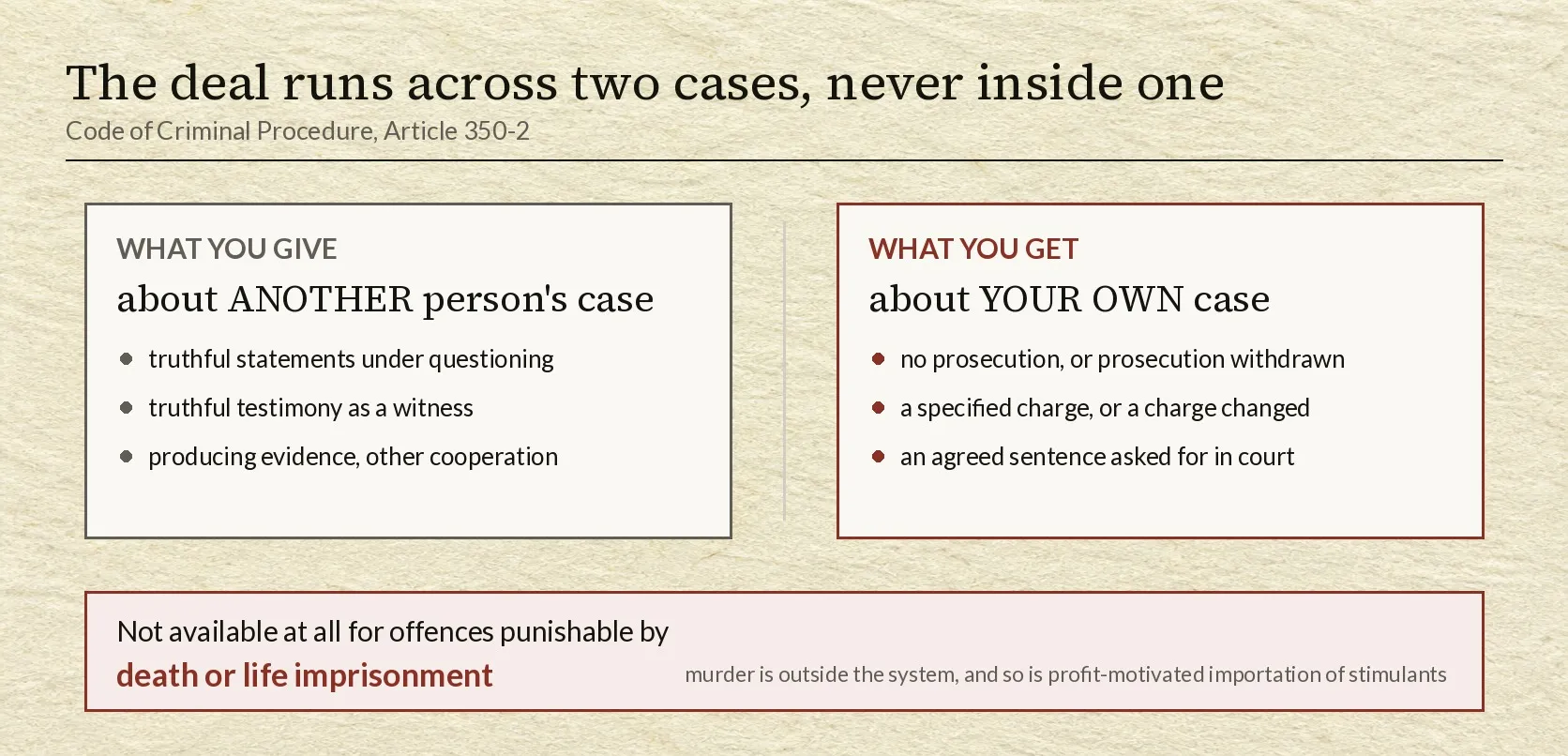
You cannot plead guilty in exchange for a lighter sentence. The Japanese system buys only one thing: evidence about somebody else. Article 350-2 of the Code of Criminal Procedure lets a prosecutor reward a suspect who gives truthful statements, testifies, or hands over evidence in another person’s case. Your own guilt is not on the table.
It is also closed to the gravest offences. The list of crimes it can be used for expressly excludes anything punishable by death or life imprisonment, so murder is out, and so is the top tier of drug importation the system was partly designed to reach.
Then there is the part that is hard to write down without it sounding like an accusation. In April 2025, at the Ministry of Justice’s own review council, a member asked how many agreements had been proposed, refused, and signed. The ministry declined. Its reasons, in order: the figures are internal case material; the secretariat does not itself hold them; and releasing them could let the public work out which cases used the system, by comparing the numbers against what has already been reported in the press.
That last reason only works if the number is very small.
The public record supports it. When the same council published its final report in July 2025, the section titled “operational status of the agreement system” was not a table. It was a list of court judgments in which the system’s use happened to become visible. There are two.
What the law actually permits
The provisions sit in their own chapter of the Code, Articles 350-2 to 350-15, and the operative sentence is Article 350-2(1). A prosecutor may agree with a suspect or defendant that the suspect will do one or more of the following in another person’s criminal case:
- give truthful statements when questioned by a prosecutor, prosecutor’s assistant officer or judicial police official;
- give truthful statements when examined as a witness;
- otherwise cooperate in the collection of evidence, including by producing it.
In exchange, the prosecutor may agree to do one or more of these:
- not institute prosecution;
- withdraw a prosecution already brought;
- charge, or maintain the charge, under a specified count and penal provision;
- apply to add, withdraw or change a count or penal provision;
- state an opinion that a specified sentence should be imposed. That is, ask the court for an agreed sentence;
- apply for the speedy trial procedure;
- apply for a summary order.
The last item on that list is worth noticing, because it is the only one that is ordinary. Applying for a summary order is not a concession invented for this system: it is how two thirds of all Japanese prosecutions already end, on paper, without a hearing. What the agreement adds is a promise to take that route.
Read the two lists side by side and the design is plain. Everything the suspect gives concerns a different person. Everything the prosecutor gives concerns the suspect’s own case. The transaction runs across two files, never within one. The ministry’s own design paper called the model “investigation and trial cooperation type”, and the bill summary put before the Diet described it as covering “certain fiscal and economic crimes and drug and firearms crimes.”
The alternative (letting a defendant trade an admission about himself for leniency) has a name in the Japanese debate, jiko-fuzai-gata, the self-incrimination type. It was not enacted. The 2025 report treats it as a question for another day: it lists the legal problems, the risk of inducing false confessions, and the doubt about whether the public would accept a system where admitting guilt lightens the punishment, then concludes that the time for serious study “will eventually come” and that basic research should begin while the cooperation model is watched.
The crimes it cannot touch
Article 350-2(2) defines the “specified crimes” the system may be used for, and it opens with an exclusion that decides the character of the whole scheme: “the following offences (excluding those punishable by death or life imprisonment).”
What remains is a list:
| Group | Examples in the statute |
|---|---|
| Penal Code, economic and official | obstruction of business and public duty, forgery of documents, fraud, extortion, embezzlement, bribery |
| Organised crime | offences under the Act on Punishment of Organized Crimes, including money laundering |
| Fiscal and economic | tax laws, the Antimonopoly Act, the Financial Instruments and Exchange Act, and others designated by cabinet order |
| Contraband | explosives, cannabis, stimulants, narcotics and psychotropics, weapons manufacture, opium, firearms and swords, the drug special provisions law |
| Obstruction | harbouring criminals, destroying evidence, and related organised-crime offences |
The 2020 White Paper on Crime, discussing drug cases, spells out what the exclusion costs. The system looks tailor-made for drug offences, it says, because they are secretive, organised, and involve many people, exactly the situation where you need someone inside to describe the ringleader. Then it notes the limit: because offences punishable by death or life imprisonment are outside the system, profit-motivated importation of stimulants, profit-motivated importation of heroin, and importation as a business are not eligible, since they carry life imprisonment.
So the instrument built to reach the top of a drug organisation stops working at precisely the charge the top of the organisation would face. The same logic runs through the rest of the list. We have written elsewhere about the killings that have no time limit at all, offences punishable by death, which Japan removed from the list of crimes that expire. Those are the same offences the agreement system may not be used on. The state will pursue them for ever, and it may not buy help doing it.
The safeguards are unusually heavy
The Japanese system is often described as cautious. It is more specific than that: the caution is written into the machinery, and some of it was added by the Diet rather than the government.
Defence counsel must consent. Article 350-3 provides that the agreement cannot be made without the defence lawyer’s consent, and that it must be made by a document signed by the prosecutor, the suspect or defendant, and counsel. Article 350-4 puts counsel in the negotiations themselves. This was not in the bill as submitted: the House of Representatives amended it to require counsel’s continuous involvement in the talks before passing it on.
The state then built the plumbing to pay for that role. The Japan Legal Support Center, the public legal aid body, issued a Q&A creating a fee supplement for defence lawyers who sit in on agreement negotiations and co-sign the document, a small administrative fact that says the system was expected to be used.
The deal goes into evidence. Articles 350-7 to 350-9 require that when a cooperator’s statement or testimony is used, the prosecutor must apply for the document recording the agreement to be examined as evidence, without delay. The court and the defence see the terms of the bargain that produced the words.
Either side can walk away. Article 350-10 allows withdrawal on breach, and allows the prosecutor to withdraw when it becomes clear that the cooperator’s account was untrue or the evidence he produced was forged.
Citizens can override the prosecutor. Under Article 350-11, if a prosecution review commission (the lay panels that review decisions not to charge) votes for indictment in a case the prosecutor promised to drop, the agreement loses its effect. Article 350-12 then bars the cooperator’s own statements from being used against him in that prosecution, with narrow exceptions.
Both sides face consequences. A prosecutor who breaches the agreement and charges anyway has the prosecution dismissed by judgment under Article 350-13. A cooperator who lies to investigators or produces forged evidence in breach of the agreement faces up to five years’ imprisonment under Article 350-15, reduced or waived if he confesses before either trial concludes.
That is a considerable amount of law. It has been visibly applied twice.
What the review actually found
The 2016 statute obliged the government to review how the new provisions were working three years after they came into force. The Ministry of Justice convened a council of academics, the three branches of the legal profession, the National Police Agency and the ministry itself. It ran from July 2022 to July 2025 and met 21 times, including a visit to the Tokyo District Public Prosecutors Office and the Metropolitan Police headquarters.
On the agreement system, the report’s finding is one sentence:
The agreement system cannot be said to be in wide use at present, and the reasons for this are not necessarily clear. However, because the agreement system can be an effective method of reducing the weight of interrogation in evidence collection, more active use should be explored in cases where its use is considered effective and appropriate.
“The reasons are not necessarily clear” is a remarkable thing for a ministry to write about its own eight-year-old statute. It is the sentence of an institution that has looked and cannot say.
For “operational status,” the report points to an appendix. That appendix is titled “Judgments and other decisions in which use of the agreement system was disclosed.” It contains two entries. The same appendix, circulated to the council’s fifth meeting years earlier, contained the same two. Between the two documents, no further case surfaced.
The one explanation anybody put on the record
The report says the reasons are not clear. It does, however, record one concrete suggestion about what is missing, and it is not a legal technicality.
Some members argued that the system needs supporting machinery to become effective: specifically, a witness protection programme, with the danger in view being retaliation by criminal organisations against a suspect who used the agreement system.
Set that beside the statutory list. The offences the system covers include organised crime, money laundering, drugs, firearms, explosives. The people best placed to describe how those operations work are inside them. The law offers such a person non-prosecution, a signed document, and a defence lawyer in the room. What it does not offer is anywhere to go afterwards.
It is worth being careful here: this was one strand of opinion recorded in a council report, not the ministry’s finding. The report’s own conclusion remains that the causes are unclear. But it is the only explanation in the official record that names a specific missing piece rather than describing the shortfall.
There is a second possibility the same report gestures at without endorsing. Article 350-5 lets the prosecutor question a suspect about another person’s case during the negotiation stage, applying the ordinary caution about the right to silence. A prosecutor who can already interview a suspect at length, in a system where the interrogation of detained suspects is now recorded in about 94 percent of cases, may simply have less need to buy testimony with a binding, disclosable, signed contract.
The two cases
Case one. An aggravated embezzlement prosecution, decided by the Tokyo District Court on 22 March 2021, then the Tokyo High Court on 1 March 2022 and the Supreme Court on 16 June 2022. The person who made the agreement was an employee of a company whose representative director was one of the defendants. He promised to give truthful statements under questioning and truthful testimony as a witness. In return, the prosecutor promised not to prosecute him.
Case two. A Financial Instruments and Exchange Act prosecution, decided by the Tokyo District Court on 3 March 2022, the corporate defendant convicted, the individual defendant’s trial still running when the ministry compiled the appendix. Two people made agreements: the company’s head of the secretariat and an executive officer. They promised truthful statements, truthful testimony, and the production of evidence. Again the prosecutor’s side of the bargain was not to prosecute.
Both cases are corporate. In both, the cooperators walked away from prosecution entirely. Nobody in either case received a reduced charge or an agreed sentence; the only currency actually spent was immunity from charge, the first item on the statutory list.
What a court did with the purchased testimony
The first case is the one worth reading, because it shows the safeguard doing something.
The cooperating employee testified that the defendants had said, in an earlier job, that you could not get money without doing bad things. The Tokyo District Court declined to accept it, and explained why in terms that apply to every future agreement:
In general, when an accomplice gives a statement admitting the criminal facts, it is necessary to consider carefully whether a false statement dragging others in has been made for the purpose of reducing his own criminal responsibility. Moreover, since the employee, having made a plea agreement, escapes criminal prosecution himself, it is necessary to consider even more carefully whether he has made a false statement excessively emphasising the wickedness of the criminal conduct.
The court found his account had shifted on important points and lacked objective corroboration, and refused to find the facts he described. It did accept a different part of his evidence (his denial that he had skimmed cash from envelopes) but only after setting out the corroboration that supported it and the reasons he would have had no motive.
So the first time a Japanese court was handed testimony bought under the new system, it took the bargain into account by discounting the testimony, in writing, and said that the fact of escaping prosecution was itself a reason for extra suspicion. Whatever else the system has failed to become, this part worked exactly as designed.
The deals that are never counted
There is one more strand in the 2025 report, and it is the strand that explains why the missing number matters.
The council debated whether the law should expressly prohibit deals made outside the system. One side argued that it should:
A deal not made under the agreement system is one where the very fact that a deal took place does not become clear, and as a result the opportunity to consider the reliability of the statement carefully is lost, so the danger of producing wrongful convictions by dragging others in is extremely great.
The other side argued that no express prohibition was needed, because if such an off-the-books deal came to light and the resulting statement were challenged, the deliberate disregard of the statutory limits would be so obvious that the evidence should be held inadmissible anyway.
Notice what both sides agree on. An informal deal is dangerous because it is invisible. The whole point of the 2018 machinery (the written document, counsel’s signature, the compulsory tender of the agreement into evidence) is to make the bargain visible to the court that has to weigh it.
Which brings the argument back to the ministry’s refusal in April 2025. The council member asked for three numbers: how often the system was proposed, how often talks were refused, how often a document was signed. The answer was that the Supreme Public Prosecutors Office does require reports from each district office on use of the system, but that the figures are internal, that the secretariat does not hold them, and that publishing them could identify the cases.
The system’s design principle is visibility. Its aggregate is confidential. And the stated reason the aggregate must stay confidential is that it is small enough for the cases to be picked out of it.
So does Japan have plea bargaining?
Japan has a plea agreement system, in force since 2018, with a statutory list of qualifying crimes, mandatory defence counsel, a signed document, compulsory disclosure of that document to the court, criminal liability for lying, dismissal of the prosecution if the state reneges, and a citizens’ panel that can void the prosecutor’s promise. On paper it is one of the most carefully constrained cooperation regimes anywhere.
It is not plea bargaining. It cannot resolve your own case by agreement; it can only convert you into a witness against someone else. It is unavailable for the crimes that carry Japan’s heaviest punishments. And after eight years, the state’s own review of how it is working produced two judgments, one sentence saying it is not widely used, and an explanation that the true figures cannot be released because the number would give the cases away.
The comparison that makes the point is inside the same statute. The 2016 law was a package: it created recorded interrogation, the agreement system, witness immunity, an expanded wiretapping regime that added murder, kidnapping, fraud and theft to the list of interceptable offences, court-appointed defence counsel for every detained suspect rather than only the serious cases, and a duty on prosecutors to hand the defence a list of the evidence they hold.
Three of those instruments can be set against each other directly. In fiscal 2021, interrogations were recorded in 91,607 of the 97,031 detained-suspect cases disposed of that year: about 94 percent; the year before it was 96,840 of 103,383. Witness immunity (where a court orders a witness to answer questions that would incriminate him, in exchange for protection from prosecution) was used in 61 witness examinations between 1 June 2018 and the end of 2022, and the ministry published the year-by-year table: two in the seven months of 2018, seven in 2019, seven in 2020, thirty in 2021, fifteen in 2022. Of those, 37 were requested before the examination began and 24 after it had started.
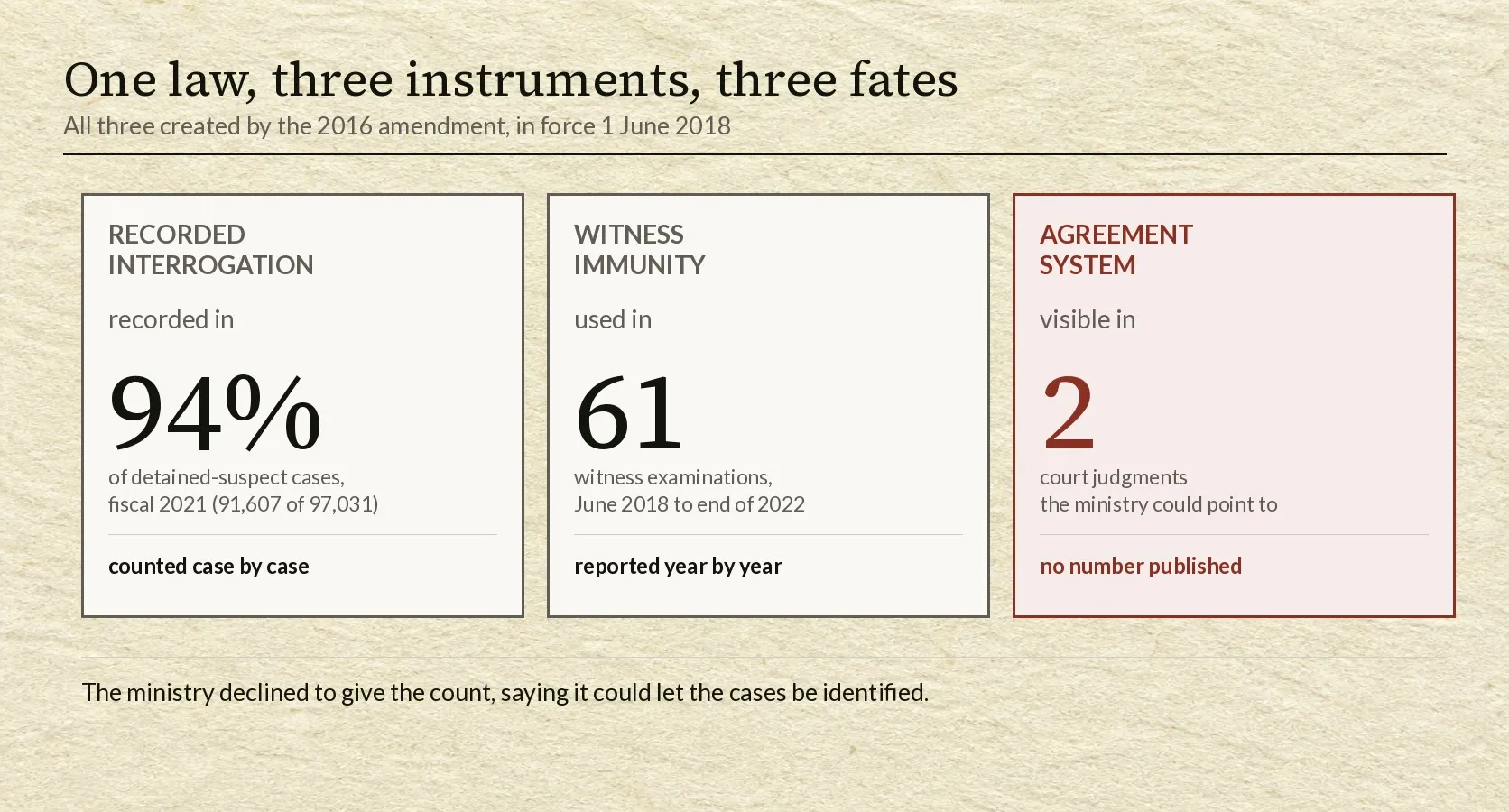
Immunity, in other words, is counted to the case, split by timing, and printed. The agreement system, created by the same law on the same day for overlapping purposes, is represented in the same report by two court judgments and a sentence saying nobody is sure why. One law, three instruments, three fates, and only one of them arrived with no number attached.
If you want the wider picture of how Japan’s justice system decides what to record and what to leave unrecorded, we have taken apart the statistics behind its unsolved killings and the reasons it still executes people, and, in a different register, what happens when the state dissolves a religious organisation.
In this article
- Quick answer
- What the law actually permits
- The crimes it cannot touch
- The safeguards are unusually heavy
- What the review actually found
- The one explanation anybody put on the record
- The two cases
- What a court did with the purchased testimony
- The deals that are never counted
- So does Japan have plea bargaining?