Quick answer
In 2024 Japanese police accepted 82,563 missing person reports. That is the number the state publishes, and it is not the number of people who are missing.
It counts reports, and the National Police Agency says so on the page: the total is a duplicated count, and its own definition of a missing person requires that somebody has filed a report about them. 34,116 of those cases were closed on the day the report was taken.
The largest single reason recorded is not debt, or shame, or a new life in another city. It is dementia: 18,121 cases, 21.9 percent of everything. Among people aged 80 and over, dementia accounts for 77.0 percent of reports.
“Crime” appears in the table exactly once, at 604 cases, 0.7 percent, and the police definition of that category is a person who committed an offence and vanished to avoid being caught. It does not mean the missing person was somebody’s victim.
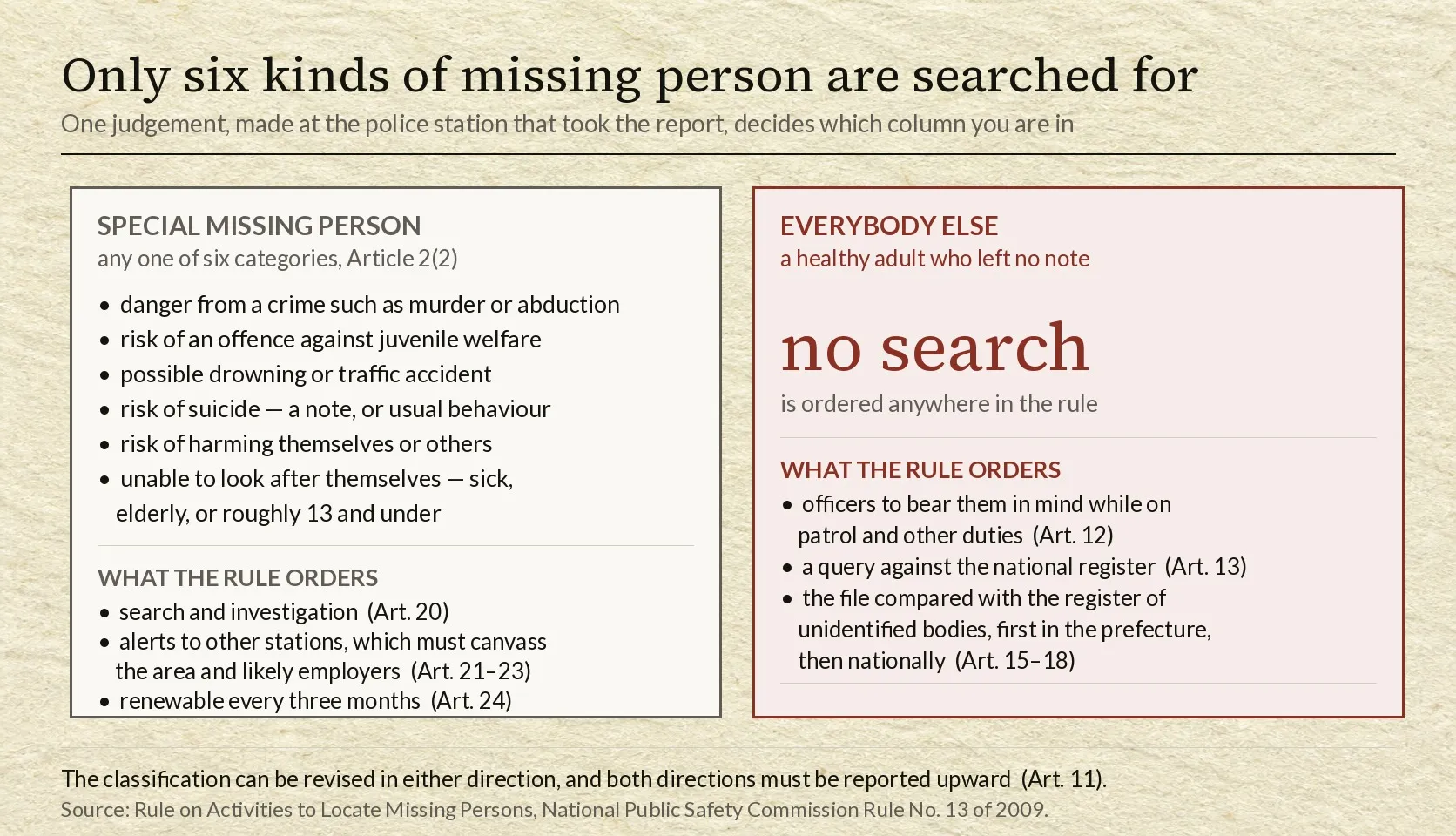
And there is the part that explains why Japan has a reputation for people evaporating. The rule that governs all of this authorises searching, investigating and circulating alerts only for six defined categories of person. If you are a healthy adult who left no note, you are not in those categories. What the rule guarantees you is a file, and a periodic comparison of that file against the register of unidentified bodies. That register is one product of the police’s handling of bodies. Another is the count published every year of people who died at home while living alone, which reached 76,020 in 2024.
Then, if an officer does find you, Article 26 lets them decline to tell the person who reported you where you are.
The number is a count of paperwork
Article 2 of the governing rule (National Public Safety Commission Rule No. 13, issued on 11 December 2009) defines a missing person as somebody who has left their base of living and whose whereabouts are unclear, and about whom a report has been filed under Article 6(1).
Both halves matter. The second half means the statistic is administrative. A person nobody reports is not a missing person in Japanese law, however missing they are.
Article 6 also fixes who is allowed to file. The list runs: a person exercising parental authority or a guardian; a spouse, including somebody in a de facto marriage, or another relative; a person with actual custody; a welfare office official or somebody else engaged in the person’s welfare; and finally a cohabitant, an employer, or another person with a close relationship in social life.
That last category is broad enough to cover a landlord or a manager. It is also the category that quietly explains the shape of the statistics: reports come overwhelmingly from households, and households are where dementia is noticed.
The National Police Agency’s footnote (that the figure is a duplicated count of people for whom reports were filed) means one person reported twice in a year is two entries. Nobody publishes how much duplication there is.
Most of them are found immediately
The same document reports how the cases closed. In 2024, 82,647 cases were resolved, including reports filed in earlier years.
Of the 66,861 people located alive:
| Time from report to being located | People |
|---|---|
| Same day | 34,116 |
| 2–3 days | 18,675 |
| 4–7 days | 3,883 |
| 8–14 days | 2,037 |
| 15 days – under 1 month | 1,640 |
| 1 – under 3 months | 1,946 |
| 3 – under 6 months | 1,056 |
| 6 months – under 1 year | 1,225 |
| 1 – under 2 years | 986 |
| 2 years or more | 1,297 |
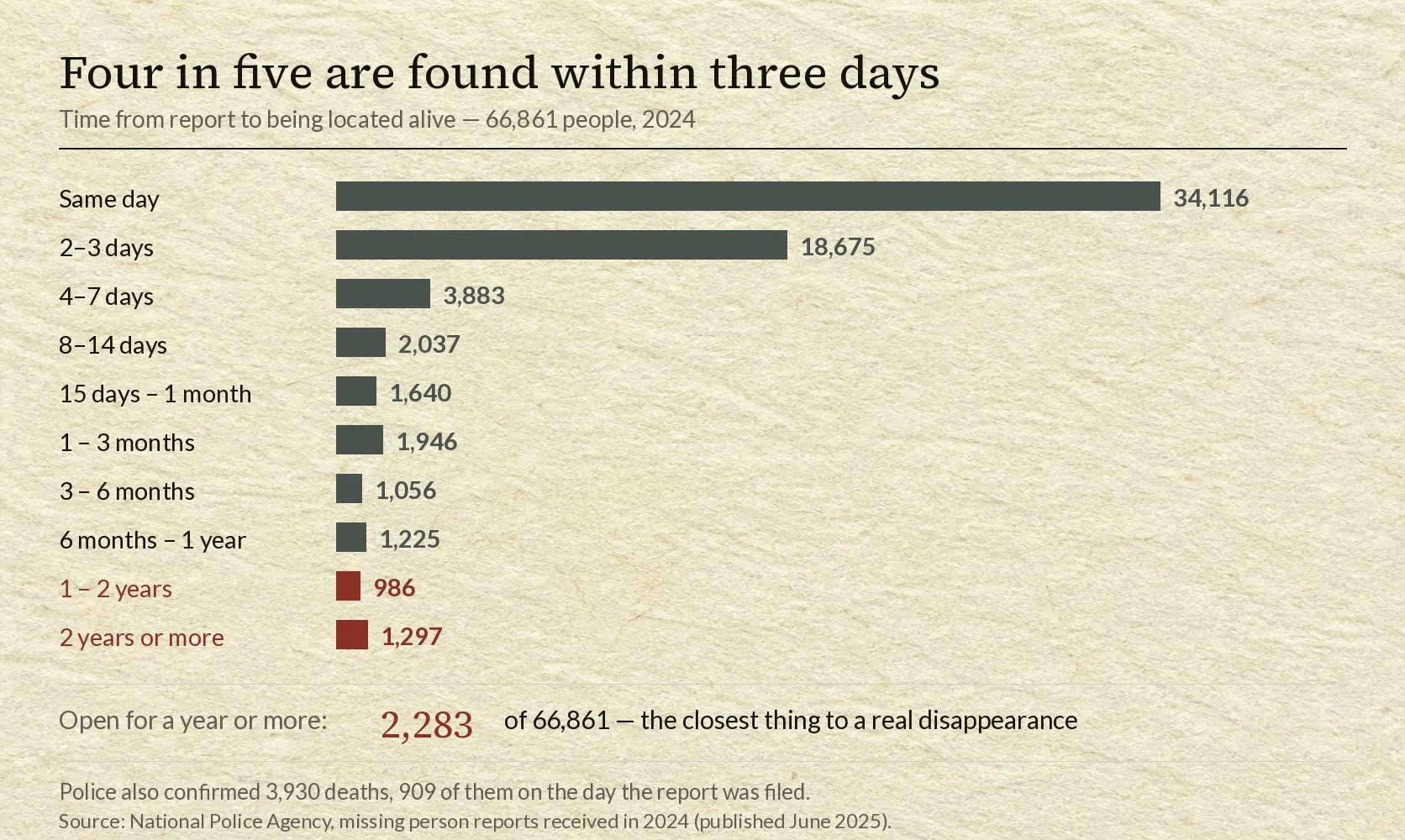
About 79 percent were found within three days. Police separately confirmed 3,930 deaths, 909 of them on the day the report was taken. A further 11,856 files closed for other reasons, which the rule’s own wording describes as the report being withdrawn.
Add the long tail and you get the closest thing to an answer for people who stay gone: 2,283 cases closed in 2024 took a year or more to close. That is the order of magnitude of a genuine Japanese disappearance: not 82,563, and not 100,000.
The largest cause is dementia
Reasons are recorded as whatever the person filing the report tells the officer. In 2024:
| Reason given | Cases | Share |
|---|---|---|
| Illness | 23,663 | 28.7% |
| , of which dementia or suspected dementia | 18,121 | 21.9% |
| Family problems | 12,466 | 15.1% |
| Work or business | 6,722 | 8.1% |
| Schooling | 1,830 | 2.2% |
| Relationships | 1,519 | 1.8% |
| Crime | 604 | 0.7% |
| Other | 15,478 | 18.7% |
| Not known | 20,281 | 24.6% |
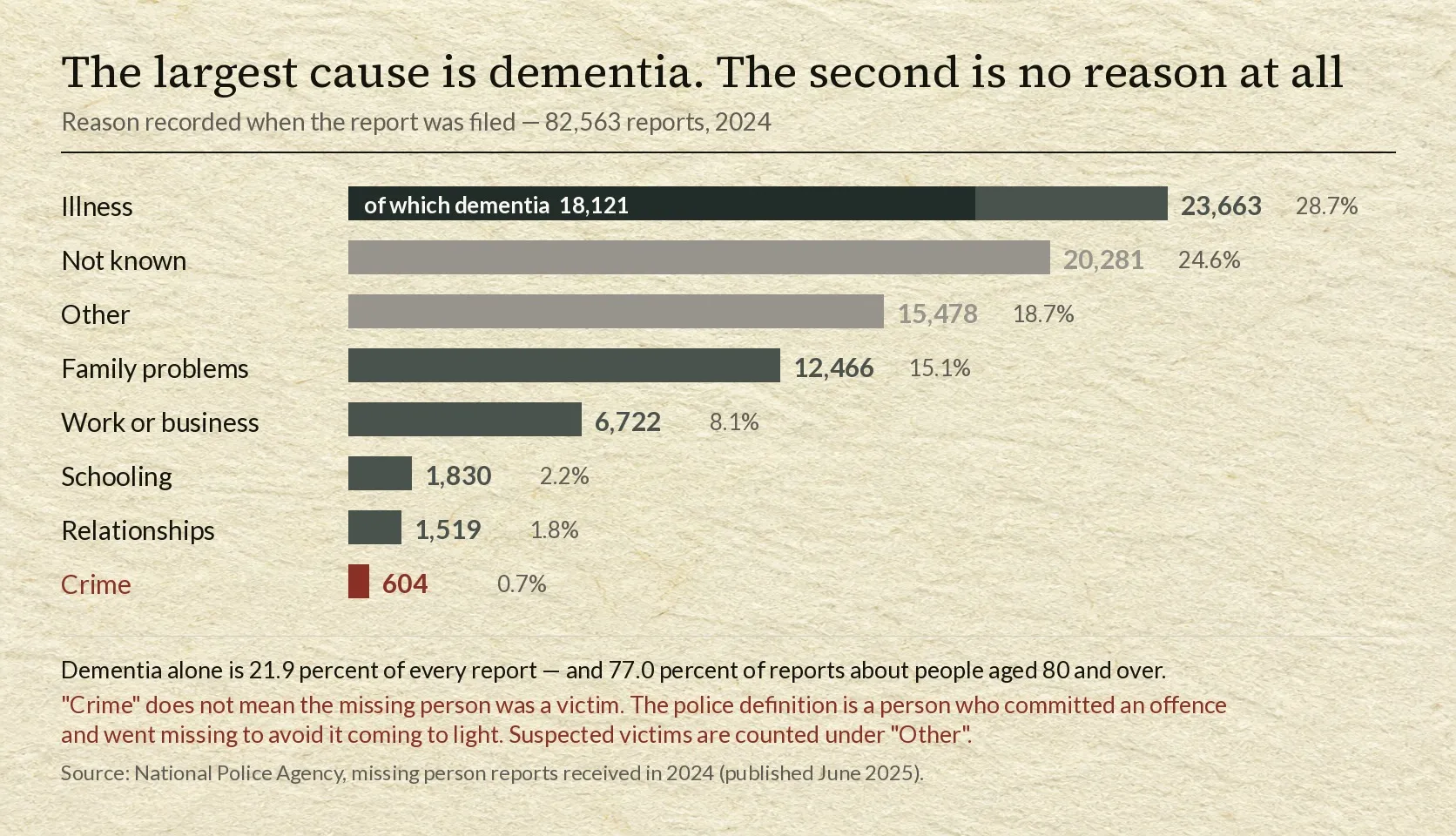
Broken down by age, the illness column is almost entirely a story about old age. Of the 14,490 reports about people aged 80 and over, 11,152 were dementia, 77.0 percent. In the seventies bracket it is 6,054 of 9,790, or 61.8 percent. Below 60 it collapses: 129 cases in the fifties, nine in the forties, zero below that.
The dementia count has grown from 12,208 in 2015 to 18,121 in 2024, a rise of about 48 percent in a decade. It fell slightly last year, by 918.
This is the first place where the English-language picture of Japanese disappearance comes apart. The recurring figure of nearly 100,000 evaporating Japanese entered English through a 2016 book of reportage, Léna Mauger and Stéphane Remael’s The Vanished, which follows people who deliberately walked out of their lives and the businesses that help them do it. Those people exist. But the number attached to them is the national report total, and the largest thing inside that total is a person with dementia who walked out of their own front door and was found, the same day, less than five kilometres away.
The second largest group is teenagers
Age tells the other half of the story. The most-reported bracket in 2024 was not the salaryman in his forties. It was teenagers: 16,645 reports, followed by people in their twenties at 15,053. Together they are about four in ten of everything.
For teenagers the leading recorded reason is family problems, 5,580 cases, 33.5 percent of their bracket, with schooling second at 1,520. For people in their twenties it shifts to work and business, 3,099 cases, 20.6 percent. Reports about children aged nine and under number 1,035.
Set against Japan’s own history this is a collapse, not a crisis. In 1970, police recorded 44,992 reports about minors. In 2024 the figure was 14,660, with the definition of a minor tightened to those aged 0 to 17 in 2022.
The same decades thinned out the loud version of Japanese teenage revolt as well. The motorcycle gangs that once owned the night roads shrank on the police’s own count over the years in which teenage runaways fell by two thirds. Fewer young people are leaving, in either direction.
“Crime” in this table means the missing person committed one
The 604 crime-related cases are the smallest named category, and the footnote defines them as a person who committed some offence and went missing out of fear that it would come to light.
So the statistic does not tell you how many missing people were victims. Where does that go? Into “Other,” 15,478 cases, whose footnote reads: a habit of drifting or wandering, or a risk of having become the victim of a crime or met with an accident.
A category that mixes wandering with suspected homicide cannot answer the question anybody actually wants answered. If you want to know what Japan does when a disappearance turns out to be a killing, that shows up in a different set of books, the statistics on unsolved murder, where the clearance rate has been known to exceed 100 percent.
A quarter of the reports do not say why
The largest column in the reasons table is not a reason. “Not known”: 20,281 cases, 24.6 percent.
It has been growing: 19.0 percent in 2020, 19.9 in 2021, 20.1 in 2022, 21.1 in 2023, 24.6 in 2024. In the fifties bracket a third of reports, 33.2 percent, give no reason at all; in the forties 31.9 percent; in the twenties 29.6 percent.
Since the reason is supplied by the person filing, this column measures something specific and rather bleak. It is the number of times a family, an employer or a landlord walked into a police station, reported that an adult had gone, and could not say why.
The police search for six kinds of person
Here is the mechanism that most English-language accounts of jōhatsu leave out, and it is written down.
Article 2(2) of the rule creates a second class: the tokui yukue fumeisha, the special missing person. There are six categories:
- a person whose life or body is in danger through a crime such as murder or abduction;
- a person at risk of becoming the victim of an offence against juvenile welfare, as defined by Article 37 of the Rule on Juvenile Police Activities;
- a person who, judging from their conduct immediately before disappearing, may have met a life-threatening accident, the rule names drowning and traffic accidents;
- a person at risk of suicide, judging from a note left behind or their ordinary behaviour;
- a person who may harm themselves or others, judging from a state of mental disorder or the carrying of dangerous objects;
- a person who is unable to look after themselves (the rule names the sick, the elderly and the young) such that their life or body is at risk.
Gunma Prefectural Police’s own instruction on the rule fixes the sixth category’s “young” at roughly 13 or under, and specifies that the fifth applies whether or not the person actually intends harm.
The classification is a judgement made by the head of the station that took the report, under Article 11, and it can be revised in either direction as information arrives. It has to be reported upward to the prefectural headquarters both when somebody is classified in, and when they are classified out.
Everything that resembles searching in the ordinary sense hangs off that classification. Article 20 (gathering information on the person’s whereabouts, conducting the necessary search or investigation, keeping in contact with the family, requesting cooperation from government bodies and private businesses) applies to special missing persons. Articles 21 to 24, which let a station circulate an alert to other stations covering places the person is expected to turn up, and require those stations to check the locations and canvass the kinds of employer the person might approach, apply to special missing persons. The alert lasts three months and can be renewed in three-month blocks.
None of it is written for anybody else.
What everybody else gets is a file
For the ordinary missing adult, the rule provides three things.
Article 12: police officers are to bear in mind the discovery of missing persons in the course of patrols, community visits, juvenile guidance, traffic enforcement, investigations and other police work. The Japanese verb is 配意する, to give consideration to. It is an instruction to notice, not to look.
Article 13: a station or prefectural division may query the national register of missing person records held by the NPA’s Safety and Juvenile Affairs Division, which must search and answer immediately.
Articles 15 to 18: the copy of the report file goes to the prefectural identification division, where it is compared against the file of unidentified bodies. If that comparison produces nothing, both records go up to the NPA’s National Criminal Identification Officer, and the comparison is run again at national level. The unidentified-body files exist under the 2012 Act on Investigation of the Cause of Death and Identity of Bodies Handled by the Police.
Individual prefectures add a discretionary layer. Toyama’s standing instruction implements Article 14 by letting the receiving station publish details of a missing person by appropriate means, and sets the publication period at roughly three months unless the person is found first.
Put plainly: for a healthy adult who leaves no note, the Japanese state does not promise to look for you. It promises to remember you, and to check whether you turn up dead.
The 869 counted somewhere else
There is one kind of Japanese disappearance the annual table does not reach, and it is the reason the word carries political weight here.
The National Police Agency’s security bureau keeps a separate account of 13 abduction cases involving 19 victims taken by North Korea. The locations read like a coastline: a brother and sister taken near the shore in Fukui in June 1974; a schoolgirl near the shore in Niigata in November 1977; a series of young couples and a mother and daughter taken from beaches in Fukui, Niigata and Kagoshima across July and August 1978; and a run of abductions of Japanese nationals in Europe between 1980 and 1983. In August 1978 an attempt in Toyama failed.
The purpose, the agency says, appears from earlier cases to have been the training of North Korean agents to pass as Japanese, and the substitution of agents for real Japanese identities. Ten people (agents involved in the abductions and members of the Yodo-go hijacking group) are subject to arrest warrants and international wanted notices circulated through Interpol. When North Korea produced new physical evidence at the third round of working-level talks in November 2004, testing of bone said to be the remains of abductees returned DNA belonging to somebody else.
The government’s count is a different number. It has recognised 17 people, including the five who came home in October 2002 after twenty-four years, a month after Pyongyang admitted the abductions and apologised at the first summit. Its stated position is that every abductee whose fate is unknown is to be treated as alive. Petitions carrying more than 19.3 million signatures had been submitted to the prime minister as of the end of January 2026.
Then there is the third number, and it is the one that belongs in this article. On a separate page the National Police Agency states that there are 869 missing persons whose abduction by North Korea cannot be ruled out, and that the names published on prefectural police websites (447 of them) are the ones where the family has consented.
Four hundred and forty-seven out of 869. The gap is not operational secrecy. It is the same principle running through everything above: what the police may say about a missing person is bounded by what the family, and where possible the missing person, wants said.
Note also what the classification buys. An ordinary missing adult gets Article 12, an instruction to bear them in mind. A missing person whose abduction cannot be ruled out is a security bureau file with international arrest warrants attached to it. From the doorstep the two disappearances can look identical. What separates them is a judgement made inside a police station about which category the person belongs in.
If they find you, they may not tell your family
This is the provision that makes Japan genuinely different, and it runs across two articles.
Article 25(2). When an officer reports having found a missing person, the station chief must confirm the person’s safety and then, while respecting the wishes both of the missing person and of the person who filed the report, take measures such as encouraging the missing person to contact the family themselves. Gunma’s instruction converts that into an order: the station chief where the person was found is to prompt the missing person to make contact and is not himself to contact the person who filed the report or other relatives.
Article 26(1). The station that took the report must notify the family of the discovery (the time, place and circumstances) except that, having considered the missing person’s wishes and other circumstances, it may withhold the notification or limit what the notification contains.
Article 26(2) goes further and removes the discretion. Where the person who filed the report had been stalking the missing person within the meaning of Article 2 of the 2000 Stalking Regulation Act, or had committed spousal or partner violence within the meaning of the 2001 domestic violence act, the notification is not to be given unless the missing person consents. Gunma’s instruction adds the operational detail: the station is to ask the found person directly whether the reporting party had been stalking them or abusing them, and where consent is given for contact, to take it in writing on a prescribed form.
And it starts earlier than the discovery. Article 7(1) lists what the officer must ask when the report is filed, and item four is the reporting party’s wishes as to what should be done when the person is found. Item two of the same article requires the officer to explain to the family, at the counter, what the police can and cannot do.
So the family is told, at the moment of reporting, that finding is not the same as returning. Japan’s rules on missing persons are written on the assumption that some adults are missing on purpose, and that the person looking for them is sometimes the reason.
That is the legal architecture underneath a phenomenon English readers usually meet as a cultural curiosity. It is also the quiet counterpart to the long withdrawals that happen without anybody leaving the house.
Seventy years of the same number
The last page of the police document is the one nobody quotes. It is a table of annual report totals going back to 1956, the year the series begins.
| Year | Reports |
|---|---|
| 1956 | 85,719 |
| 1970 | 100,753 |
| 1983 | 115,236 (peak) |
| 2000 | 97,268 |
| 2010 | 80,655 |
| 2020 | 77,022 |
| 2023 | 90,144 |
| 2024 | 82,563 |
Seven decades inside a band of roughly 77,000 to 115,000, with the high point in 1983 and the low point in 2020, the first year of the pandemic. Whatever Japanese disappearance is, it is not new, and the current level is below the long-run average.
One thing did invert. In 1968 police recorded 46,037 reports about men and 50,032 about women; the female total was higher through much of the 1960s and 1970s. In 2024 men are 52,502 of the total, 63.6 percent, against 30,061 women. The postwar image of the runaway daughter has been replaced, statistically, by a man, most often a very old one, or a teenager.
Where the missing are found dead
The 2024 report closes with a section on dementia cases that reads like an operational memo, because that is what it is.
Of dementia-related reports taken in 2024, 491 people were confirmed dead. 382 of them (77.8 percent) were found within five kilometres of where they went missing. 235 were within one kilometre.
The places: rivers and riverbanks 115, irrigation channels and roadside ditches 79, woodland 71. Those three are 54.0 percent of the deaths. The document’s own conclusion is that these are the places human search parties struggle with, and that delay in finding somebody bears directly on whether they live.
Its recommended answers are GPS tags and drones, illustrated with cases. A missing person’s bicycle carried a GPS unit; police located them 28 kilometres away in a neighbouring prefecture within two hours. A lost-item tracker put someone on a train; they were found near a station 70 kilometres from home 45 minutes after the report was filed. A drone put over dense woodland found a person pushing through undergrowth five minutes after take-off.
The people the system is fastest at finding are the ones who never chose to go.
How a disappearance ends in law
Nothing in the police rule closes a case that never resolves. That is done by the Civil Code.
Article 30: where a person’s life or death has been unclear for seven years, a family court may, on the application of an interested party, issue a declaration of disappearance. Where they were caught in a specific peril (the article names those who went to a battlefield and those aboard a sunken ship), the period is one year from the end of that peril.
Article 31: the person is then deemed to have died, at the moment the seven years expired, or at the moment the peril passed.
Article 32: if proof arrives that they are alive, the court must revoke the declaration. Acts done in good faith before the revocation stand. Anybody who gained property through the declaration loses the right, but has to return it only to the extent they still hold the benefit.
Nobody has to prove a death. The state simply lets a fixed period of silence do the work, and leaves the door open for the silence to end.
One more thing the same statistical shelf shows. The police report that recorded crime in Japan has now risen for four straight years, and that almost all of the growth is fraud: including a method, counted for the first time in 2025, in which the caller says he is a police officer. The gap between that rise and how unsafe people feel is measured in the same document, and it is not explained by anyone’s experience.
So how many people go missing in Japan?
Four numbers, and they answer different questions.
82,563 is how many missing person reports Japanese police accepted in 2024. It is a count of paperwork, duplicated, and about four in five of the people behind it were located within three days.
2,283 is how many cases closed in 2024 had been open for a year or more. That is closer to the population the word “disappeared” is reaching for.
3,930 is how many of the year’s closures were the confirmation of a death.
869 is how many missing persons the security bureau holds in an entirely different file, as people whose abduction by North Korea cannot be ruled out. They are not in the annual total, and only 447 of them have been named in public.
The famous figure (nearly one hundred thousand evaporating every year) is the national report total, borrowed from a book about a real but much smaller phenomenon. Japan has recorded a number in that band every year since 1956, and its largest single component today is dementia.
What is actually unusual about Japan is not in the statistics at all. It is in a National Public Safety Commission rule that authorises a search only for six kinds of person, that asks every other officer merely to bear the missing in mind, that runs the rest of the files against the unidentified dead, and that, when somebody is found, requires the officer to ask whether the family looking for them is the thing they were escaping, and to say nothing if it is.
In this article
- Quick answer
- The number is a count of paperwork
- Most of them are found immediately
- The largest cause is dementia
- The second largest group is teenagers
- “Crime” in this table means the missing person committed one
- A quarter of the reports do not say why
- The police search for six kinds of person
- What everybody else gets is a file
- The 869 counted somewhere else
- If they find you, they may not tell your family
- Seventy years of the same number
- Where the missing are found dead
- How a disappearance ends in law
- So how many people go missing in Japan?