Quick answer
Yes. The membership figure that English Wikipedia still carries for Aum Shinrikyo traces back to a National Police Agency report from June 2005. Japan, meanwhile, has required the organisation to report its members every three months since 2000, has collected 105 such reports, and puts the current total at about 1,600.
That figure is from the end of February 2026: about 1,600 members in Japan, roughly 250 of them living communally, in 30 facilities across 15 prefectures. The English entry’s most recent membership figure in its body text is from 2011, and since September 2025 the page has carried a notice asking editors to expand it from the Japanese version.
What the Japanese filings describe is an organisation whose headcount has barely moved in a quarter of a century while almost everything else about it has changed. The Public Security Intelligence Agency now names the founder’s second son as the man whose intentions Aleph follows. Its recruitment targets people aged thirty or under, and it tells them the 1995 sarin attack was somebody else’s conspiracy. Its declared assets fell from about ¥1.3 billion in 2019 to about ¥8 million in 2024, while inspectors put the real figure at least around ¥700 million. No compensation has been paid to the victims since 2018, and Aleph has ignored a Supreme Court judgment, final in 2020, ordering it to pay about ¥1 billion.
The number that stopped in 2005
The infobox on the English Wikipedia entry reads “approximately 1,650 (2011)”. Follow the footnote and it lands on a National Police Agency page, archived in July 2011, quoting a report from June 2005: Aleph had about 1,650 members, of whom 650 lived in the group’s compounds. The year in brackets is the date the page was archived, not the date of the count.
The body text has later figures, the last of them from 2011: the Public Security Intelligence Agency putting membership at about 1,500 in April of that year, and the organisation itself reporting 1,030 in July. The entry’s account of state surveillance ends with a Tokyo High Court ruling in February 2019. Its one sentence on compensation records that in 2000 the group “apologized to the victims of the sarin gas attack and established a special compensation fund.” The infobox field for the current leader is blank.
The entry for Hikari no Wa, the breakaway group founded in 2007, lists “106” members. That is the number of lay members it had at its foundation, nineteen years ago.
The agency that watches the organisation publishes, in Japanese, a running summary on its website, a yearly review, a briefing sheet on the group’s current strength, and the text of the dispositions it obtains. The figures below are drawn from those documents, the most recent of them dated February and March 2026.
What the state counts, and how often
In February 2026 the agency’s briefing sheet set out the organisation’s strength in three lines.
| As of the end of February 2026 | |
|---|---|
| Members | About 1,600 (about 250 renunciants living communally, about 1,350 lay members) |
| Facilities | 30, in 15 prefectures |
| Declared assets | About ¥78 million in cash, deposits and loans, as of the end of January 2026 |
The reporting is a legal requirement. Under the Act on the Control of Organizations Which Have Committed Acts of Indiscriminate Mass Murder, promulgated in December 1999 and applied to Aum in January 2000, an organisation under observation must file a report every three months listing its members by name and address, its land and buildings, and its assets. The agency’s sheet notes that it has now collected these reports 105 times.
It also enters the premises. In 2025 the agency carried out 43 on-site inspections at facilities in 15 prefectures. It passed the results to 17 local governments on 39 occasions, and held 21 meetings with residents living near the group’s buildings.
Japan does not know the size of any other religious body within its borders to anything like this precision. Religious corporations report their own membership and nobody checks; the national register adds up to more than the population. The one group whose membership the state collects four times a year and publishes is the one whose religious corporation a court dissolved in 1996.
From 11,400 to 1,600, and then nothing moves
The agency’s yearly review published in January 2026 includes a bar chart of membership since the attack. The bars carry their own labels.
| Year | Event | Members |
|---|---|---|
| 1995 | Tokyo subway sarin attack | 11,400 |
| 1997 | Request to dissolve the organisation under the Anti-Subversive Activities Act rejected | 1,000 |
| 2000 | Observation disposition imposed | 1,500 |
| 2003 | First renewal | 1,650 |
| 2006 | Second renewal | 1,650 |
| 2009 | Third renewal | 1,500 |
| 2012 | Fourth renewal | 1,500 |
| 2015 | Fifth renewal | 1,650 |
| 2018 | Sixth renewal | 1,650 |
| 2021 | Seventh renewal | 1,650 |
| 2024 | Eighth renewal | 1,650 |
| 2025 | 1,600 |
Nine in ten members left within two years of the attack. Then the line flattened. At every count the agency has published since 2000, the figure has been between 1,500 and 1,650. The 1,650 that English Wikipedia carries for 2005 sits 50 above the 2026 total; in 2005 the organisation operated under the single name Aleph, while the 2026 total covers three groups.
A flat line in an organisation whose founder and twelve other members were hanged in July 2018, and many of whose renunciant members, in the words of the agency’s January 2026 review, “joined before the Matsumoto and Tokyo subway sarin attacks,” implies that people keep joining. The agency does not publish an annual intake figure or the membership’s age profile. It does describe how the recruiting is done, below.
The one recent movement is downward. The review states that membership, “which had held at around 1,650 in recent years, fell to around 1,600 as of January 2025,” and gives the reason: dispositions banning the use of Aleph’s training halls made it “difficult to operate as an organisation,” the recruitment it had run “stagnated,” fewer people joined, and more left. The state credits its own measures for the fall. Whether it holds is a question for the next chart.
Three groups, one photograph on the wall
The 1,600 belong to three organisations. The agency groups two of them as the mainstream faction and treats the third separately.
Aleph is the main body, the name the organisation adopted in 2000. The agency’s description: it “continues to hold up Asahara as absolute,” displays his portrait photograph inside its facilities, and acts “in line with the intentions of Asahara’s second son.” Since dispositions closed its halls it has moved its activity outside them.
The Yamada group has kept “a certain distance” from Aleph since January 2015, but the agency lists it alongside Aleph as mainstream: the same absolute devotion to Asahara, the same portrait on the wall, and “large quantities” of teaching materials similar to Aleph’s.
Hikari no Wa was founded in May 2007 by Fumihiro Joyu. The agency’s phrase for its position is “concealing Asahara”: it displays Buddhist paintings the agency says are “identified with” him, runs “pilgrimages” to sites connected to him, and holds three intensive seminars a year, in January, May and August. Hikari no Wa has challenged the observation in court. It won at the Tokyo District Court in September 2017 and lost on appeal in February 2019, which is where the English Wikipedia account of the matter ends. The observation has continued since.
How the 1,600 divide between the three is not in any of the published documents. The agency reports the total.
Recruits who were not born in 1995
A person who turned twenty in 2025 was born in 2005, a decade after the attack. The agency’s summary says that Aleph “has directed its recruitment mainly at the young generation with little knowledge of Aum Shinrikyo, chiefly those aged thirty or under.”
It describes the method in three stages, and the description is specific enough to set out in full.
First, a website. It advertises classes in “yoga, psychology, mental health” and similar subjects, under a name that is not Aleph’s, and recruits people mainly aged thirty or under.
Second, a study group. Members of the organisation act as instructors without disclosing who they are. Over repeated sessions they build personal relationships, steer the conversation toward religion and “the spiritual world,” and, in the agency’s words, explain that “the Tokyo subway sarin attack and other incidents were a conspiracy by persons other than Aum Shinrikyo,” to remove the recruit’s resistance.
Third, the name. Once the relationship is established, the organisation reveals itself and invites the recruit to join. To those who decline, the agency reports, it says “everything you have learned until now will have been wasted,” in a “forceful tone,” to make refusal difficult.
The summary also notes “non-face-to-face recruitment using SNS and web conferencing systems.”
Some of this has reached the courts as ordinary consumer offences. The agency’s list of enforcement cases includes a January 2018 case in which recruits at a “Buddhist study group” were not given the contracts the Specified Commercial Transactions Act requires, and a December 2022 case involving the same offence at a “yoga course.” The list also records fraud cases, in 2018, 2021 and January 2024, involving flats rented for the group while concealing what they were for.
The second son
The title of the Aum section in the agency’s 2026 review reads: “Thirty years since the Tokyo subway sarin attack: in Aleph, Asahara’s second son becomes the new guru.”
According to the review, the second son has “since around 2014” called himself the guru and the successor designated by his father. He has held online meetings with senior members, and Aleph “has acted in line with his intentions on important matters of organisational management, including personnel and accounting.” Senior members who do not follow his wishes are “isolated within Aleph and stripped of their rank.”
The Japan Times reported in July 2025 that the agency had publicly identified him as the de facto head of Aleph. He was thirty-one at the time, the paper said, and has not been named; the agency’s documents refer to him only as Asahara’s second son. By that count he was one or two years old when the attack happened.
The review also records a payment to Asahara’s widow. Since around 2002 she has received ¥400,000 a month from Aleph, described as a “fee for the use of paintings,” and manages the funds herself.
Two failures the agency attributes to Aleph are, it says, his decision. The first is not reporting its assets. The second is not paying the victims.
¥1.3 billion, ¥8 million, ¥700 million
Aleph’s quarterly filings put its assets at about ¥1.3 billion in November 2019. By February 2024 the declared figure was about ¥8 million. The agency, on the basis of its inspections, states that the organisation in fact “held assets of at least around ¥700 million.”
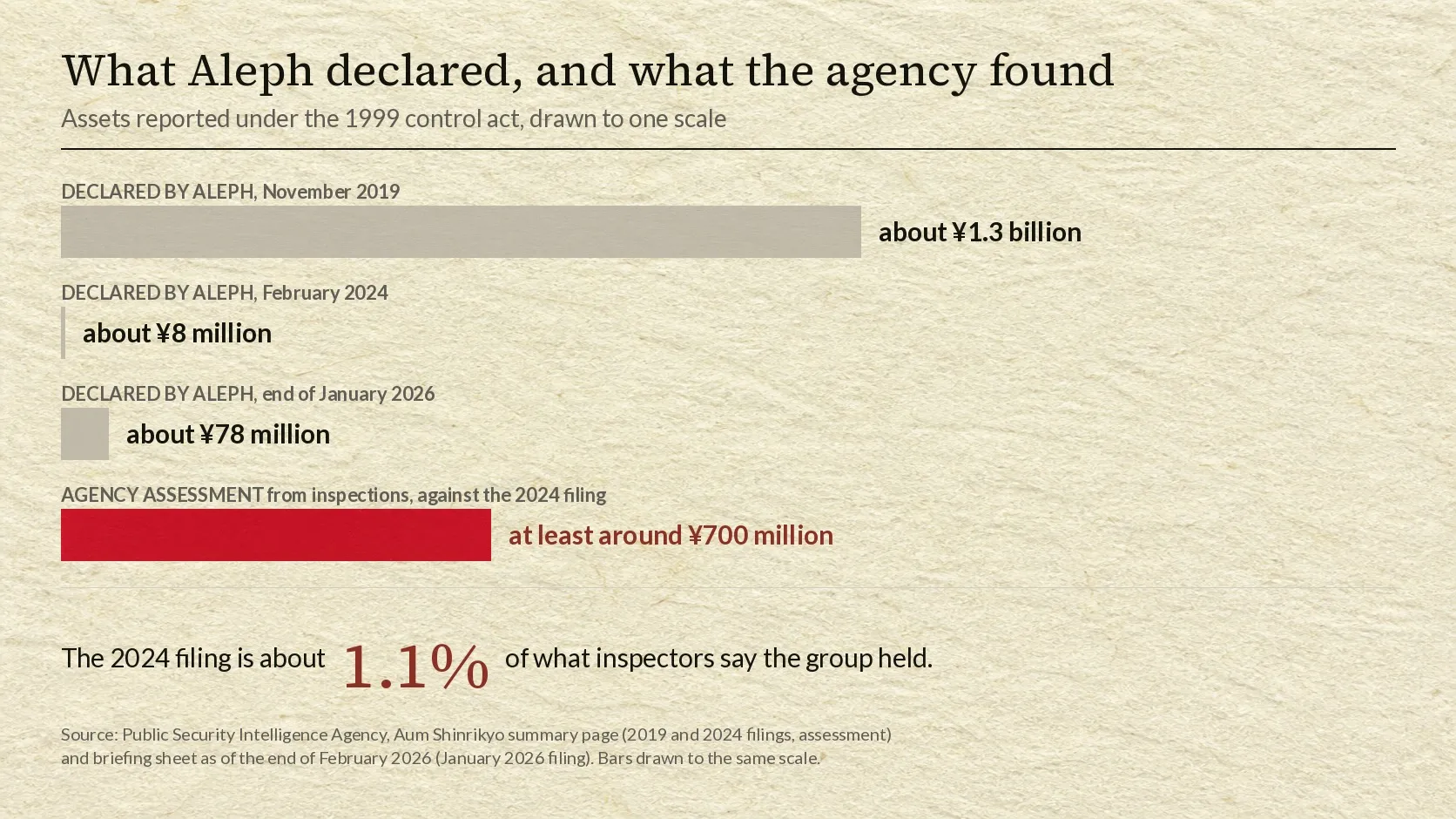
The review explains the gap. From February 2020, Aleph stopped reporting the assets of the revenue-earning businesses it “effectively operates.” The agency’s finding is that the omission carries “an intention to hide assets,” and it connects that intention to a Supreme Court judgment that became final in November 2020. AFP reported in March 2025 that the group was alleged to have hidden income from yoga and spiritual seminars.
By the end of January 2026 the declared figure had risen to about ¥78 million. That is roughly ten times the 2024 filing and about a ninth of the agency’s assessment of what the organisation held in 2024.
The compensation that stopped in 2018
The Supreme Court judgment concerned money owed to the Aum Shinrikyo Victims Support Organization, the body set up to assist victims and bereaved families of the Tokyo subway sarin attack and other Aum crimes. The judgment, final in November 2020, ordered Aleph to pay the remaining debt of about ¥1 billion.
The agency’s summary states that Aleph “has made no compensation payments whatsoever since 2018,” that it “is believed to hold substantial assets,” and that it “has ignored” the Supreme Court judgment and “continues to evade compensation to this day.” The same passage says that both the non-reporting of assets and “the insincere handling of the compensation debt” have been “confirmed to be in accordance with the intentions of Asahara’s second son.”
Those are the agency’s words. AFP reported in March 2025, on the thirtieth anniversary of the attack, that survivors and bereaved families had asked the Justice Minister to do more to make Aleph pay.
Money from an offender is only one route. The state runs another, a benefit paid to crime victims and bereaved families directly, which does not depend on anyone collecting a judgment.
What the state can do, and what it did in 2025
A court dissolved Aum’s religious corporation in 1996. The organisation itself was never dissolved: a request to do so under the Anti-Subversive Activities Act was rejected in 1997. The law promulgated in December 1999 created something narrower. An organisation that had committed indiscriminate mass murder could be placed under the agency’s observation for three years at a time, renewable on request. Aum was placed under observation on 28 January 2000. The disposition has been renewed every three years since, the eighth renewal in January 2024. It runs to 31 January 2027, when the agency will have to apply again.
The same law allows a second, harder measure when an observed organisation breaks its reporting duties: a recurrence-prevention disposition banning the use of specific buildings and the receipt of donations. The agency first requested one in October 2021, withdrew it a month later, requested again in January 2023 and obtained it in March 2023. It has obtained one every six months since. The seventh, decided on 9 March 2026, bans all use of four of Aleph’s facilities and partial use of eleven more, the offices, workshops and training halls of the businesses it runs, and bars the organisation from receiving any gift of money or property. It runs from 21 March 2026 for six months. Breaching it carries up to two years’ imprisonment or a fine of up to ¥1 million.
The fifteen buildings are listed by name in the decision: two in Sapporo; three in Saitama prefecture, at Yashio and Kita-Koshigaya; two in Tokyo, at Adachi and Nishiogi; and one each in Mito, Kyoto, Fukuoka, Noda in Chiba, Yokohama, Tokushima, Nagoya and Osaka’s Ikuno ward.
The agency’s list of enforcement cases for September 2025 includes one under the control act for using a banned building for the organisation’s purposes. Its inspectors describe being answered with “there is no obligation to respond” and “it is as you see,” and being filmed on video camera by members during inspections. Twenty-five municipalities, including those with Aum facilities, have formed a liaison council, and in 2025 petitioned the Justice Minister and the agency’s Director-General to keep the observation in place.
What we could not confirm
The published documents give totals. They do not say how the 1,600 members divide between Aleph, the Yamada group and Hikari no Wa, and the agency has not published that split. They say the organisation has members in the Russian Federation without giving a number. They describe how recruitment works but not how many people join in a year, and we found no annual intake figure or age profile of the membership in any of the reports.
The National Police Agency’s most recent statutory report on the enforcement of the 1999 law is published as a vertically set PDF whose text could not be reliably extracted, and we did not find figures in it beyond those already in the Public Security Intelligence Agency’s documents.
The Aum Shinrikyo Victims Support Organization’s own accounting of what it has received and what remains outstanding was not available to us. The ¥1 billion figure and the 2018 cut-off come from the agency’s summary and the Supreme Court judgment it cites. Japanese press reports in November 2025 describe the organisation suing Aleph in the Tokyo District Court to recover the debt; we have not seen the filing.
What can be confirmed is the count. A state whose register of believers exceeds its own population knows, four times a year, how many people remain in organisations it says are still under the influence of a man executed in 2018. The current observation period runs to 31 January 2027.
In this article
- Quick answer
- The number that stopped in 2005
- What the state counts, and how often
- From 11,400 to 1,600, and then nothing moves
- Three groups, one photograph on the wall
- Recruits who were not born in 1995
- The second son
- ¥1.3 billion, ¥8 million, ¥700 million
- The compensation that stopped in 2018
- What the state can do, and what it did in 2025
- What we could not confirm