Quick answer
Yes. By Japan’s own measure, recorded crime has risen for four consecutive years, and in 2025 it passed the level it was at before the pandemic.
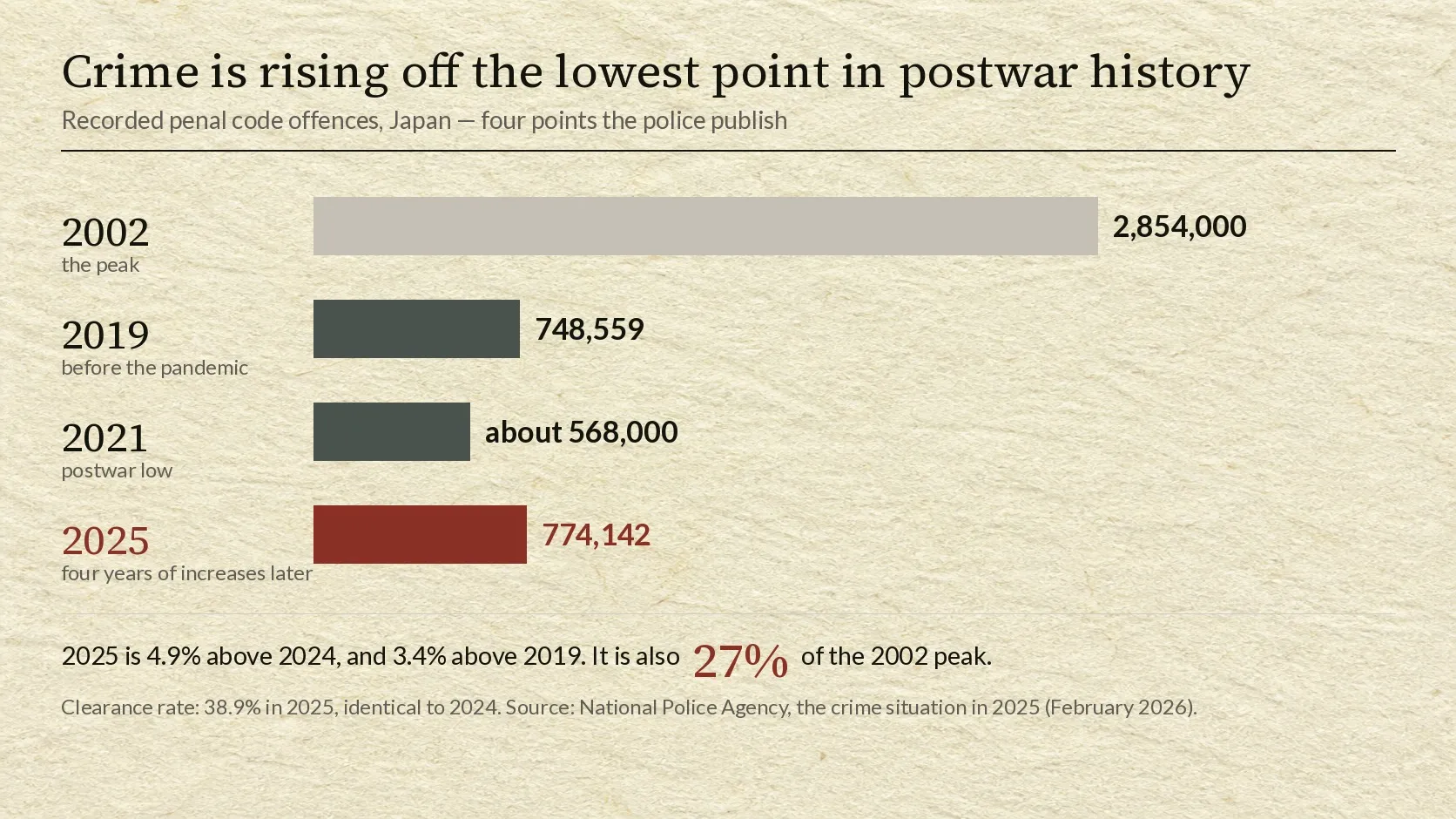
The National Police Agency recorded 774,142 penal code offences in 2025, up 36,463 on the year (4.9 percent) and 3.4 percent above 2019. The clearance rate did not move: 38.9 percent, identical to the year before.
Then there is the number that belongs in the same paragraph and is almost never in it. The same statistic peaked in 2002 at 2,854,000. Today’s total is about 27 percent of the peak. Japan is not returning to a dangerous past; it is coming off the floor.
What is actually growing is narrow. Fraud rose 26.5 percent in a single year, and 2.25-fold in six. And inside that, one method dominates: people telephoning to say they are police officers.
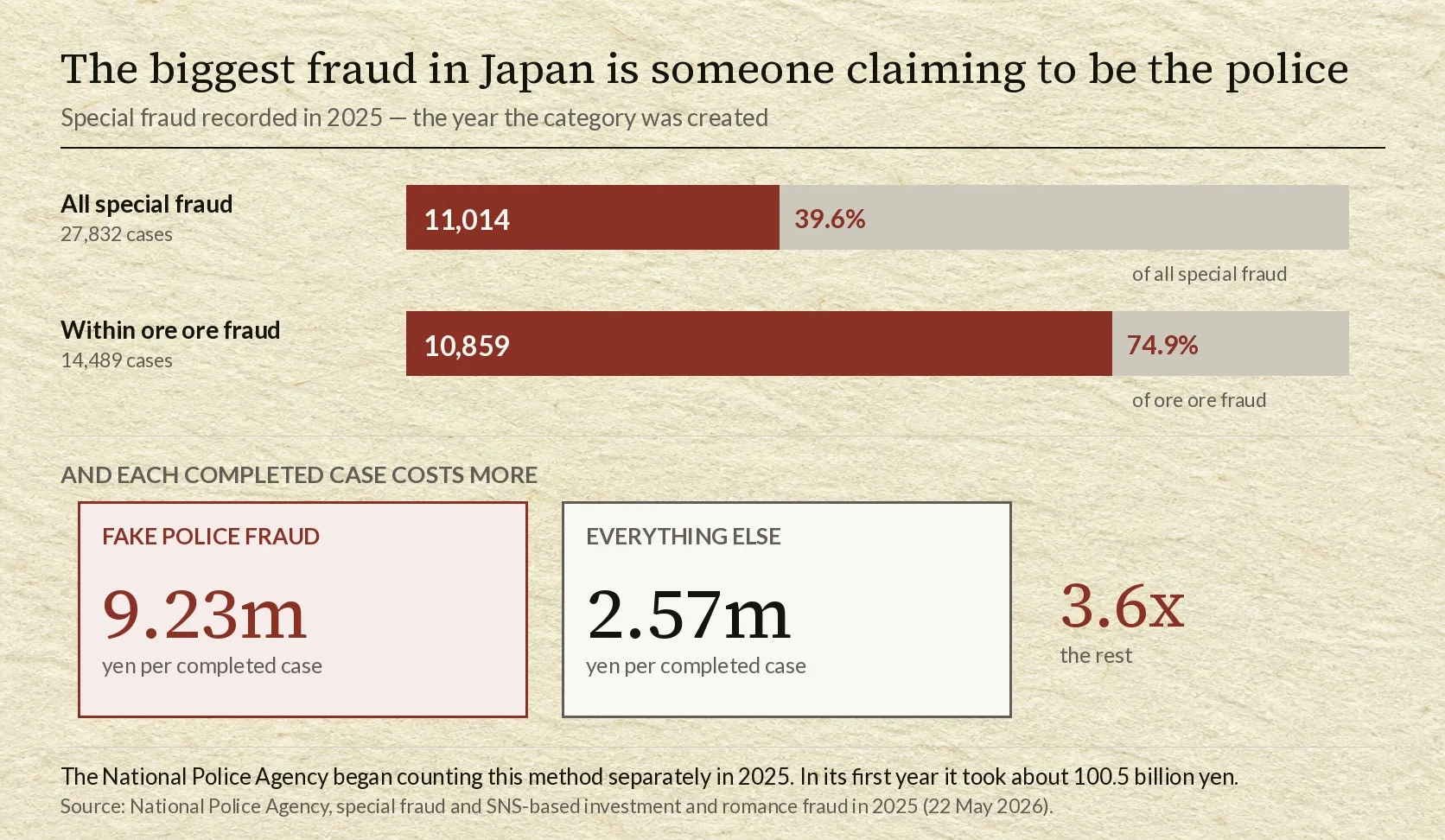
The agency began counting that method separately only in 2025. In its first year it recorded 11,014 cases and about 100.5 billion yen, 39.6 percent of all special fraud in the country.
Two more things about it break the standard picture. The age group reporting it most often is people in their thirties. And when the agency asked the public why they feel less safe, the most common reason given was not experience. It was the amount of crime reporting they see.
The number, and the peak it is nowhere near
The long shape of Japanese crime statistics is a mountain. Recorded penal code offences fell every year from 2003 to 2021, reaching a postwar low. Then they turned.
| Year | Recorded penal code offences |
|---|---|
| 2002 (peak) | 2,854,000 |
| 2019 (pre-pandemic) | 748,559 |
| 2021 (postwar low) | about 568,000 |
| 2024 | 737,679 |
| 2025 | 774,142 |
Four consecutive annual increases. Both 2024 and 2025 came in at 4.9 percent. Per thousand population the 2025 figure is 6.3 offences, up 0.3.
A recorded offence is not a prosecution, and a prosecution is not a trial. Of the people prosecutors dealt with in 2023, fewer than one in ten ever reached a courtroom. Most of the rest were either not charged at all or fined on paper without a hearing. It is worth holding on to when reading any Japanese crime figure: each stage of the system counts a different population.
Clearance held steady. Police cleared 301,055 cases, up 4.8 percent, and arrested 200,663 people, up 4.6 percent, a 38.9 percent clearance rate, unchanged. If you want the reason that number is lower than the one usually quoted for Japan, it is that murder and robbery are cleared at over 90 percent while the bulk of offences are theft; we went through how those columns are built in the piece on unsolved murder.
What is actually growing is fraud
Theft is still the volume business (the agency notes it is approaching its 2019 level again), but the growth is fraud, and the fraud numbers do not look like an ordinary trend.
| Year | Recorded fraud cases |
|---|---|
| 2019 | 32,207 |
| 2020 | 30,468 |
| 2021 | 33,353 |
| 2022 | 37,928 |
| 2023 | 46,011 |
| 2024 | 57,324 |
| 2025 | 72,532 |
That is +26.5 percent in a year and 2.25 times the 2019 figure.
The money moved further than the case count. Total losses from property crime reached about 498.4 billion yen, up 23.9 percent and the highest ever recorded. Fraud alone accounted for about 402.9 billion yen of it, up 31.1 percent. The agency’s own comment is that the loss per case is rising, the crimes are not just more numerous, they are bigger.
Counted the way the agency counts its headline anti-fraud category, special fraud plus SNS-based investment and romance fraud came to 43,000 cases, up 37.5 percent, of which special fraud was 27,832 and SNS-based investment and romance fraud 15,168.
Special fraud on its own: 27,832 cases, up 32.3 percent, with losses of about 142.31 billion yen, up 98.0 percent. The losses very nearly doubled in twelve months. Daily average loss: 390 million yen.
The fraud is police officers
Here is the part that has no English-language equivalent, because the category is a year old.
The agency now separately counts a method it calls nise keisatsu sagi (fake police fraud) in which the caller poses as a police officer and demands cash under the pretext of an investigation. Counting began in 2025. First-year figures:
- 11,014 cases
- about 100.5 billion yen in losses
- 39.6 percent of all recorded special fraud
- inside the ore ore category, 10,859 of 14,489 cases, 74.9 percent
The agency states directly that this method, whose damage became conspicuous from the second half of 2024, is the main reason the national totals for both cases and losses rose so sharply.
It is also the expensive one. Loss per completed case across all special fraud was 5.236 million yen, up 49.5 percent. Split it, and fake police fraud runs at 9.225 million yen per completed case against 2.567 million yen for everything else, about 3.6 times. The agency names it as the reason the average went up.
There is something worth sitting with here. The most lucrative confidence trick in Japan right now is to claim to be the institution people are supposed to call when they are being defrauded.
And the victims are not who you would guess
The English-language account of Japanese fraud is a story about the elderly. In 2025 that stopped being the whole story, and the agency says so in the data.
People aged 65 and over accounted for 14,273 cases: up 3.9 percent in absolute terms, but 51.3 percent of the total, down 14.0 percentage points in a single year.
The reason is where the new cases landed. In ore ore fraud:
| Age group | Cases | Change |
|---|---|---|
| 80 and over | 3,235 | +23.4% |
| 70s | 2,453 | +70.1% |
| 30s | 2,284 | +329.3% |
| 20s | 1,759 | +361.7% |
People in their twenties and thirties are now 27.9 percent of ore ore cases, up 14.4 points. In the fake billing category they are 30.0 percent.
And in fake police fraud specifically, the largest single age group is people in their thirties, with 2,239 cases, followed by their twenties at 1,718.
The money still sits with older victims: the largest loss totals by age were the seventies at about 27.46 billion yen and the sixties at about 25.63 billion yen. So the shape is now young people reporting it and old people losing the most.
The agency draws the conclusion itself, in the section on prevention: the methods have become sophisticated enough that once contact is made, anyone can be deceived. Its recommended response is not education but interception, cutting off the channel before the call lands, including free blocking of international numbers on landlines after a surge in scams routed through them from mid-2023.
Who is doing it
Three findings from the same documents, which fit together.
Motive. Across recorded fraud, the most common motive is financial hardship at 38.4 percent, ahead of funding entertainment at 21.5 percent.
Recruitment. Of 2,228 people arrested in the disposable roles (cash collectors, withdrawers, lookouts) 37.9 percent were recruited through applications on social media and 37.1 percent through acquaintances.
Structure. The agency’s fifth indicator for 2025 is what it calls anonymous, fluid criminal groups: networks with no fixed membership that draw funding from special fraud, SNS-based investment and romance fraud, drug offences and organised theft. This is the same phenomenon we traced from the other direction in the count of Japan’s designated crime syndicates. The registered organisations shrink, and the money moves to structures with no register at all.
The foreign share, with its denominators
This number gets quoted without context, so here it is with the context attached, from the National Police Agency’s own organised crime assessment for the same year.
Of all penal code cases cleared in 2025 (Japanese nationals included in the total) crimes by foreign nationals in Japan on short-term or working status accounted for 5.9 percent. Of all persons arrested, 3.7 percent.
The share has risen for three years. It is also not new. The same series runs back to 1989, and the cleared-case share was 5.1 percent in 2005, 4.8 percent in 2004 and 4.3 percent in 2006. The current level is roughly where it was two decades ago, after falling to 2.5 percent in 2012 and climbing since.
For denominators on the population side, the agency’s white paper gives the reference group (foreign nationals resident on status other than permanent residency) as about 3.12 million people as of mid-2024.
In special fraud, where the growth is, the numbers are smaller and more specific: foreign nationals were 239 of the people arrested, 10.2 percent of the total, up 109 on the year. Of those 239, 56.9 percent were cash collectors and 18.4 percent were withdrawers, the two roles recruited from social media adverts and discarded after use. By nationality the largest groups were China at 87, Vietnam at 56 and Malaysia at 36.
So: roughly nine in ten people arrested for Japan’s fastest-growing crime are Japanese, and most of the foreign nationals arrested were doing the job that gets you caught.
That is the share in a single year. The police also keep a separate count for this category going back to 1989, and its long-run direction is not the same as its recent direction: we follow all 37 years of it in Crime Involving Foreign Nationals in Japan.
Where it happens
Special fraud is concentrated. Eight prefectures account for 65.8 percent of cases and 66.0 percent of losses, against 51.4 percent of the population. Tokyo alone recorded 4,350 cases and about 28.16 billion yen, the latter up 84.0 percent in a year.
The gap between the numbers and the feeling
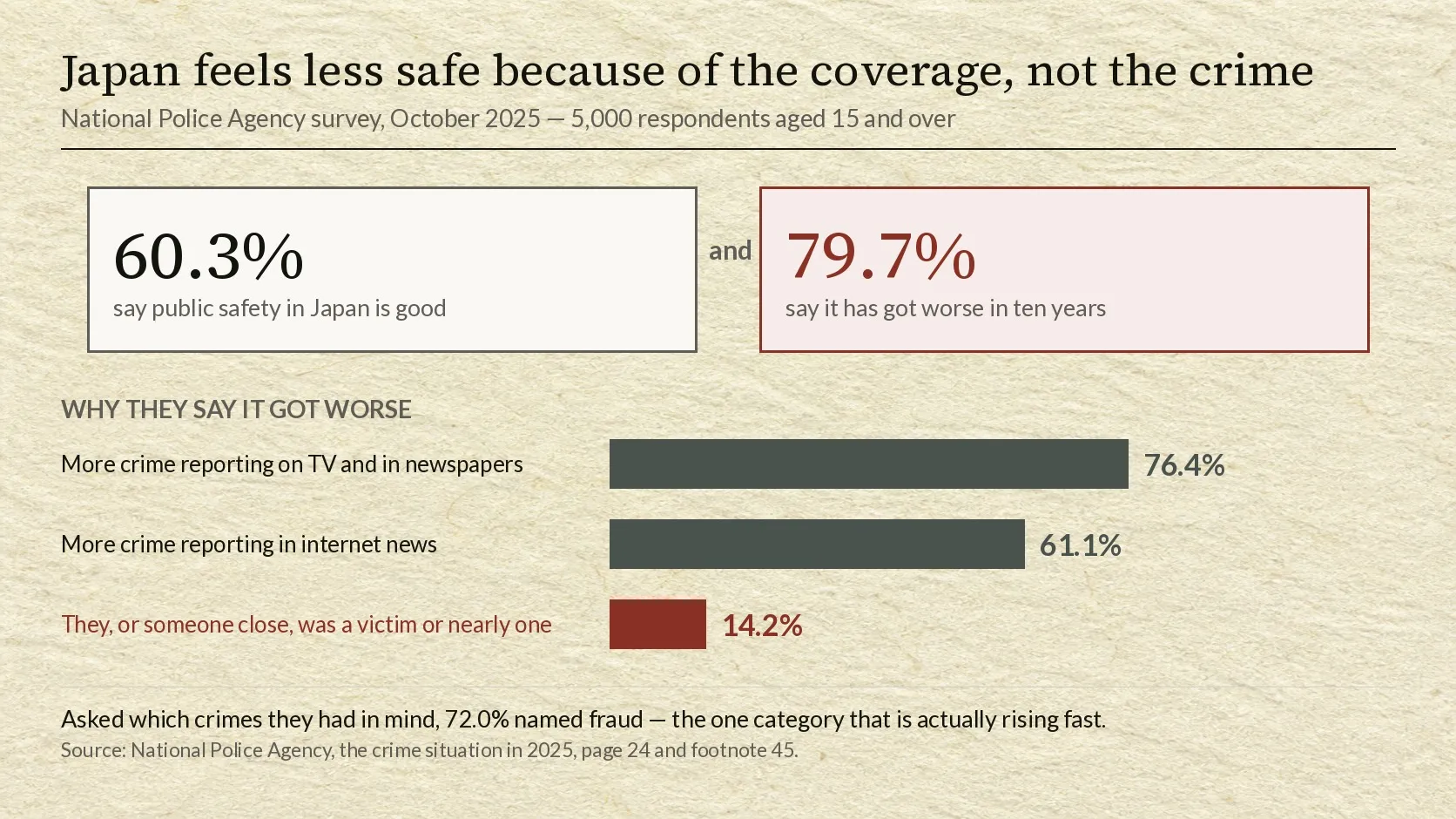
In October 2025 the agency surveyed 5,000 people. Two answers from the same survey:
- 60.3 percent said Japan’s public safety is good, up from 56.4 percent the year before
- 79.7 percent said it has got worse over the past ten years, up from 76.6 percent
Both went up. People simultaneously think the country is safe and think it is deteriorating, and more of them think both than last year.
Why people feel it
This is the finding that reframes everything above, and it is in a footnote of the agency’s own assessment.
Among respondents who said safety had got worse, the reasons given were:
| Reason | Share |
|---|---|
| See more crime reporting on television and in newspapers | 76.4% |
| See more crime reporting in internet news | 61.1% |
| They, or someone close to them, had been a victim or nearly one | 14.2% |
And when asked which crimes they had in mind, 72.0 percent named fraud: ore ore, investment, romance, phishing.
Read those two tables together and the picture is coherent rather than contradictory. The public has correctly identified the crime that is actually rising. They have identified it through coverage, not exposure. And the coverage is not misleading them about the direction (fraud really is up 26.5 percent in a year) while the thing they are inferring from it, that the country has become dangerous over a decade, is not what the offence totals show.
It is unusual for a police agency to publish the finding that the fear of crime in its country tracks media volume rather than victimisation. Japan’s did, in a footnote, on page 24.
So is crime rising in Japan?
Four answers, and they are all true at once.
Yes. 774,142 offences, four years of increases, above the pre-pandemic level, with fraud up 26.5 percent and special fraud losses nearly doubled.
Barely, historically. The total is about 27 percent of the 2002 peak. A person who lived through 2002 in Japan lived in a country with 2.8 million recorded offences a year.
In one specific way. The growth is fraud, the fraud is increasingly people claiming to be police officers, the biggest age group reporting it is in their thirties, and the largest losses are among people in their seventies.
And not in the way people mean when they say it. Four in five residents think the last decade made Japan worse. Three in four of them cite television coverage; one in seven cites anything that happened to them or anyone they know.
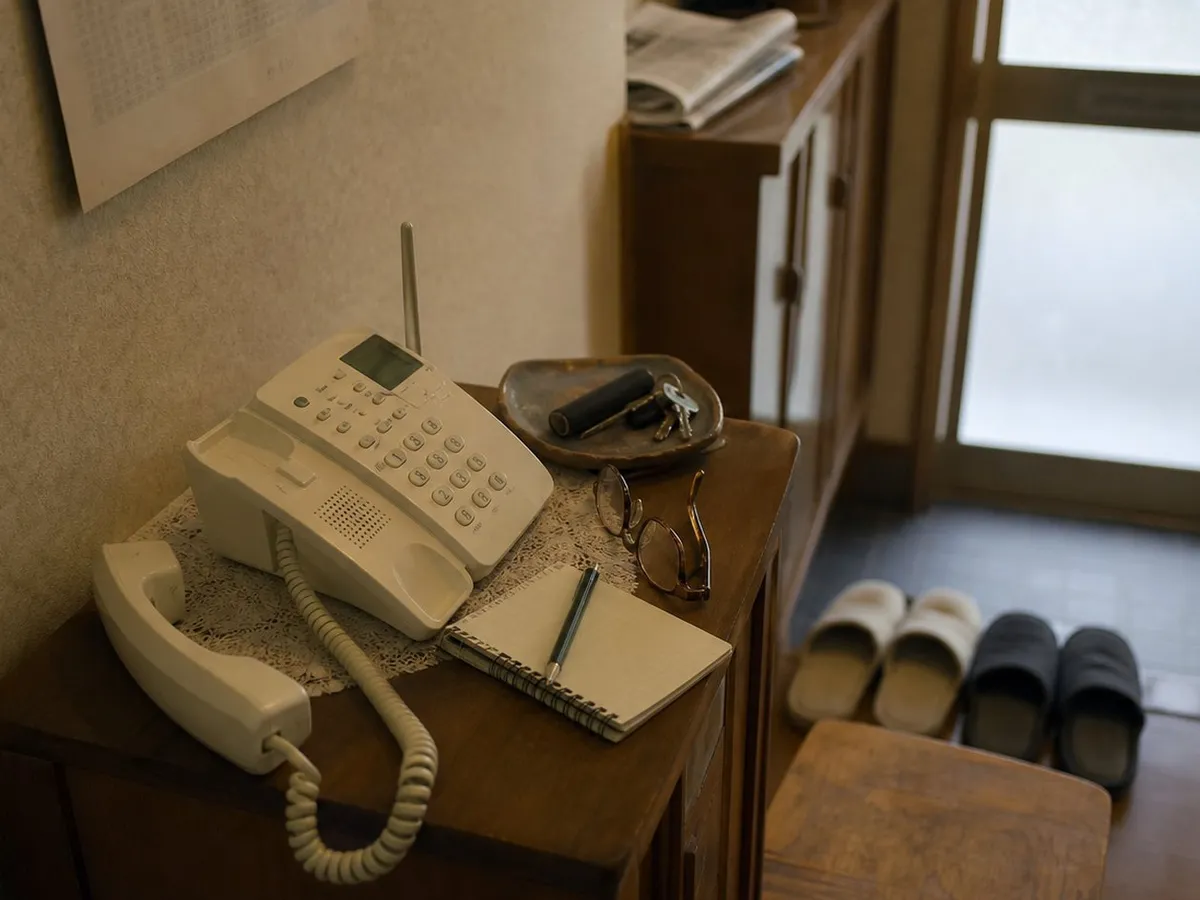
Japan spent twenty years getting quieter and has spent four years getting louder, and the loudest thing in it is a telephone call from someone saying they are the police. The state’s own recommendation, having measured all of this, is not that citizens be braver or better informed. It is that the call should never reach them, which is a quiet admission that once it does, the institution being impersonated is the one people were right to trust.
In this article
- Quick answer
- The number, and the peak it is nowhere near
- What is actually growing is fraud
- The fraud is police officers
- And the victims are not who you would guess
- Who is doing it
- The foreign share, with its denominators
- Where it happens
- The gap between the numbers and the feeling
- Why people feel it
- So is crime rising in Japan?