Quick answer
On the ninth day of the eleventh month of 1872, the Japanese government published an imperial edict and a proclamation. Together they did four things.
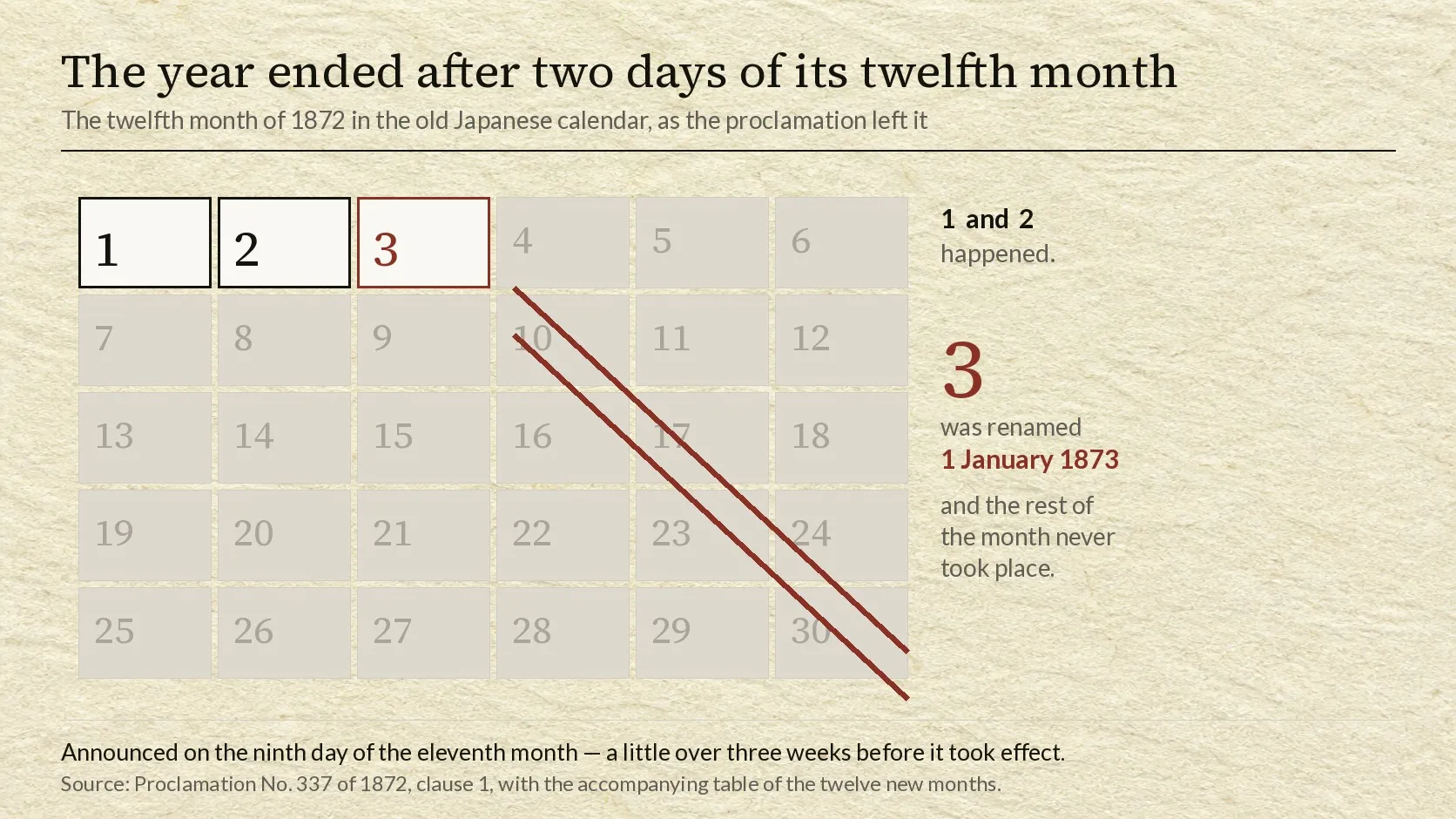
They deleted the rest of the year. The third day of the twelfth month was declared 1 January 1873, so the old year ended after two days of its final month.
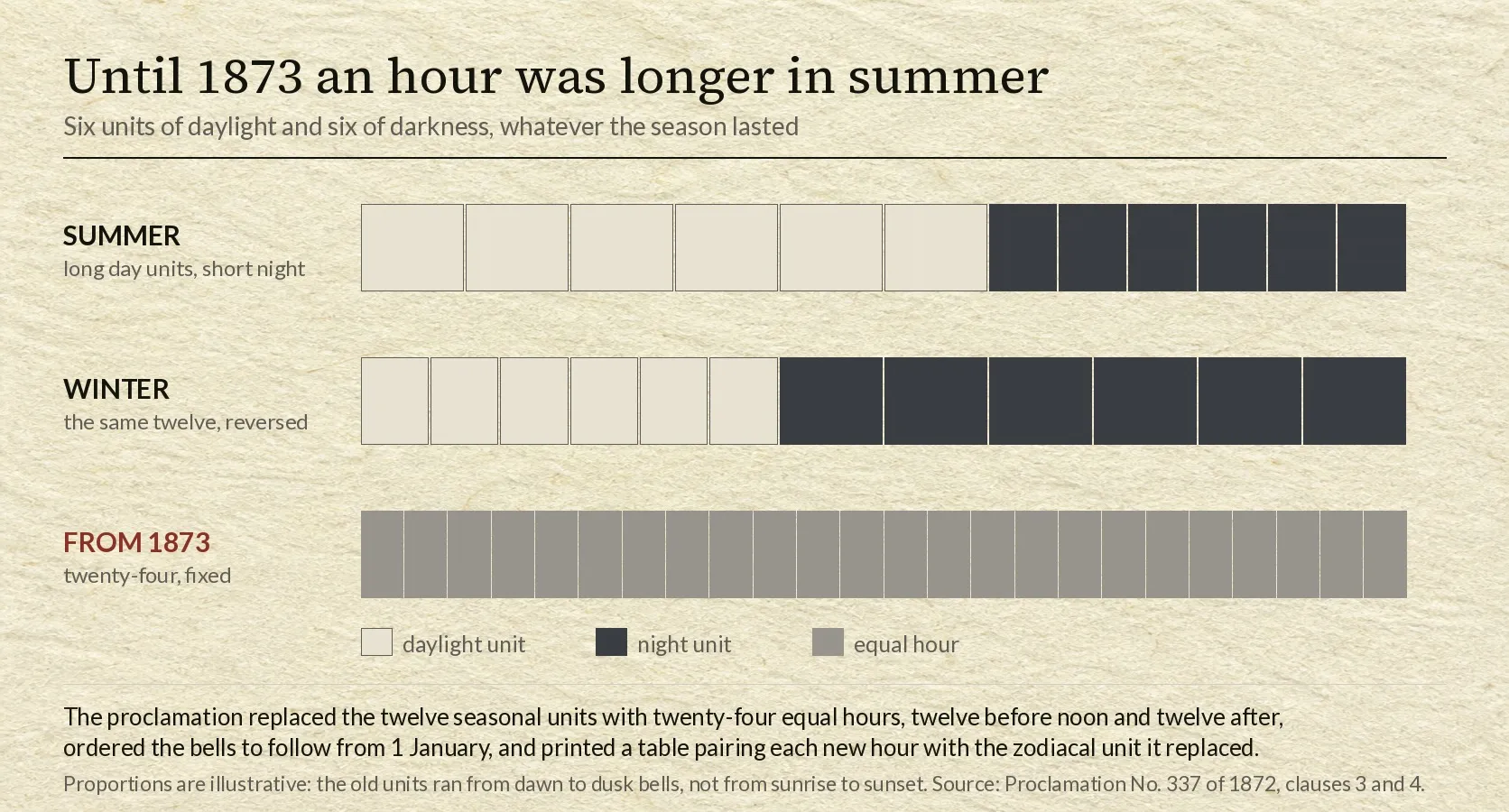
They abolished the hour. Until that morning a Japanese day held twelve units whose length changed with the seasons; the proclamation replaced them with twenty-four equal ones.
They called the almanac’s fortune-telling baseless. The edict, in the emperor’s voice, says the annotations printed in the middle and lower registers of every Japanese calendar are absurd and unfounded, and that they obstruct the development of human knowledge.
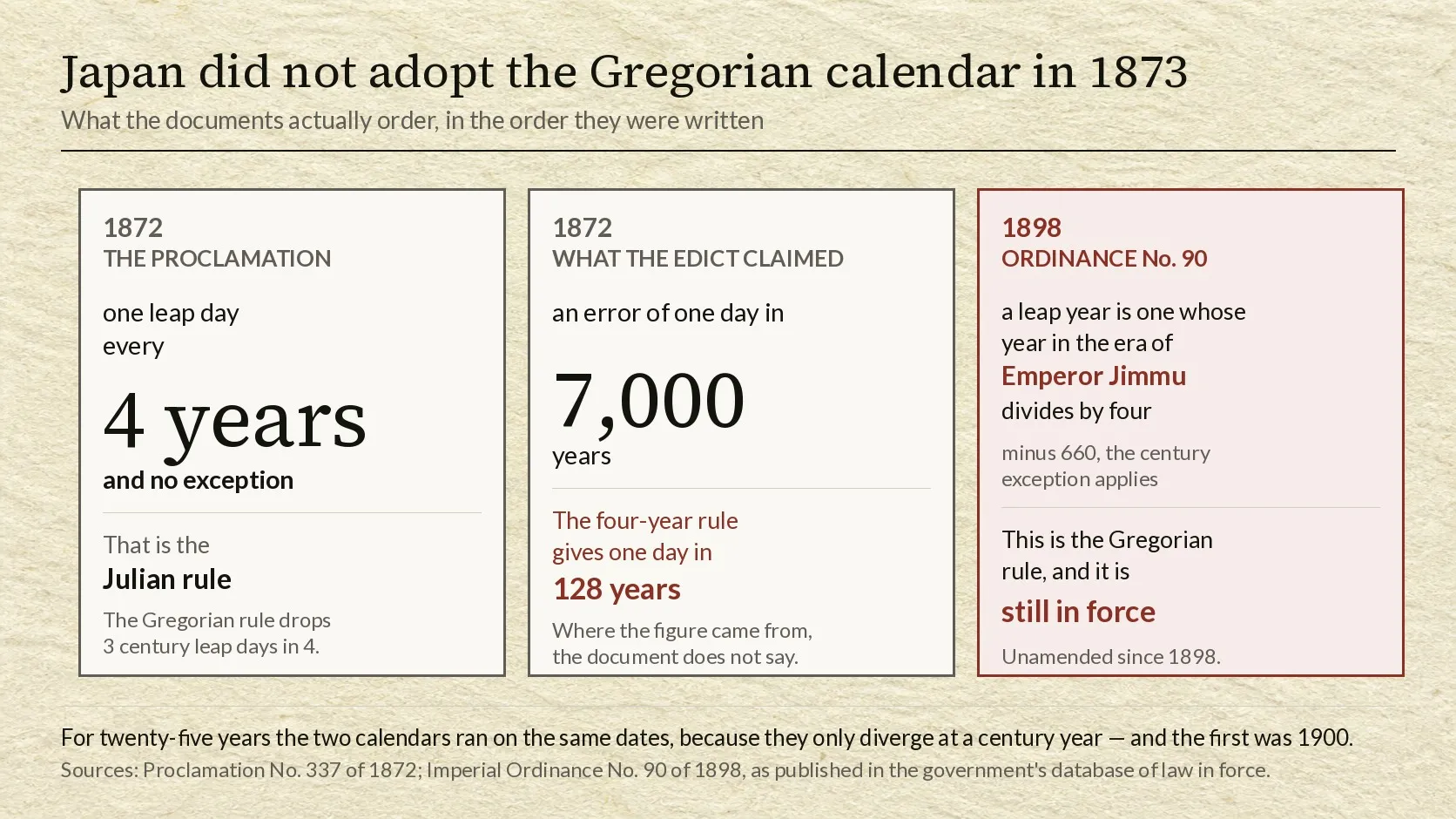
And they installed the wrong calendar. The proclamation orders one leap day every four years and states no exception, the Julian rule, not the Gregorian one. The Gregorian century rule did not enter Japanese law until 1898, and when it did it was written in imperial years, and it is still on the books that way.
The reason the edict gives is that the old calendar was clumsy and the new one precise. The reason that circulated afterwards is that the treasury could not afford the old one. Those are not the same claim, and only one of them is in the document.
What the edict actually says
The text is short enough to follow in one pass. The emperor observes that Japan’s calendar takes its months from the phases of the moon and must therefore be forced back into agreement with the sun, so that an intercalary month has to be inserted every two or three years; that the seasons consequently run early or late around each insertion; and that errors accumulate.
Then comes the sentence that does not read like a calendar reform at all:
Especially, the matters set out in the middle and lower registers are for the most part absurd and without foundation, and do not a little to obstruct the development of human knowledge.
The middle and lower registers are where a Japanese almanac put its annotations: the lucky and unlucky days, the directions to avoid, the days fit for a wedding or a funeral. The edict does not merely stop printing them. It says they are nonsense, in the emperor’s voice, in the same paragraph that abolishes the calendar carrying them.
The edict closes: from now on the old calendar is abolished, the solar calendar is to be used, and the realm is to follow it in perpetuity.
The proclamation attached to it is the operative part. Five clauses:
- the third day of the twelfth month becomes 1 January 1873, with new almanacs to be distributed as soon as they can be engraved;
- a year is 365 days in twelve months, with one intercalary day every four years;
- the twelve seasonal units of the day are replaced by twenty-four equal hours, twelve from midnight to noon called before-noon and twelve from noon to midnight called after-noon;
- the bells are to follow the new hours from 1 January, and the counter used for clock hours changes;
- festivals and observances are to be moved to the corresponding dates in the new calendar.
Below the clauses sits a table of the twelve new months with their lengths, and the note that matters most to anybody who had lived with the old system: the long and short months no longer change from year to year.
The calendar Japan adopted was not the Gregorian calendar
This is the part that is wrong in nearly every English account, and the edict itself gives it away.
A leap day every four years, and no exceptions, is the Julian rule. It overshoots the solar year by about eleven minutes annually, which is why Europe had abandoned it: the Gregorian reform of 1582 kept the four-year rule but removed the leap day from three century years out of four, so 1700, 1800 and 1900 are common years while 1600 and 2000 are leap years.
The Japanese edict contains no century rule. What it contains instead is a claim of accuracy: one day of drift in seven thousand years. That number does not survive contact with the rule the proclamation actually orders. A leap day every four years makes the average year 365.25 days, which overshoots the solar year by about eleven minutes, and eleven minutes a year is one day every hundred and twenty-eight years, not every seven thousand. Even the Gregorian rule, with its century exceptions, drifts by roughly one day in three thousand years. Where the edict’s figure came from, the document does not say.
What matters for the calendar itself is the clause, not the boast. A leap day every four years with no exceptions is the Julian rule.
So for twenty-five years, the calendar in force in Japan was arithmetically the Julian one, running on the same dates as the Gregorian calendar because 1900 had not arrived yet. The two systems only diverge at a century year, and the first century year after the reform was 1900.
The Gregorian rule arrived in 1898, written in imperial years
Two years before that divergence would have happened, the government fixed it. Imperial Ordinance No. 90 of 1898 is a single sentence, and this is the whole of it:
A year whose number in the era of the accession of Emperor Jimmu is divisible by four shall be a leap year. Provided that, among those years where subtracting 660 from the era number gives a figure divisible by 100, a year whose quotient is not further divisible by four shall be a common year.
Read it as arithmetic. Subtracting 660 from the imperial year gives the Western year, the era counts from 660 BC. So the proviso says: take the Western year, and if it is divisible by 100, it is only a leap year when it is also divisible by 400. That is exactly the Gregorian century rule, expressed in a numbering system that starts with a mythological accession.
Two things follow, and both are strange.
The first is that Japan’s leap years were defined by the Julian rule from 1873 to 1898, and by the Gregorian rule only after that. The country that is described in English as having adopted the Gregorian calendar in 1873 adopted its distinguishing feature in 1898.
The second is that the 1898 ordinance is still in force. It appears in the government’s database of current law, unamended. Whether this year has a 29 February in Japan is settled, as a matter of law, by counting from the accession of Emperor Jimmu and subtracting six hundred and sixty.
The reason that is not in the edict
The edict explains itself in terms of precision and superstition. There is another explanation, and it is the one Japanese sources reach for.
The National Astronomical Observatory of Japan (the office that still computes the national calendar) states plainly on its own site that the reform was carried through for fiscal reasons, and cites the recollections of Okuma Shigenobu, published in 1914 as Okuma-haku Sekijitsu-tan. The chain is short:
- the government had moved to monthly salaries in 1871;
- the old calendar’s 1873 contained an intercalary month, thirteen months;
- thirteen months of salary would have to be paid;
- the solar calendar has no intercalary month, so that expense disappears.
It is worth being exact about what kind of source this is. Okuma was one of the government’s central figures and later prime minister, and the passage is his account, compiled by an editor decades after the event. The edition consulted here is the 1914 reprint. It is not a cabinet minute. The edict says nothing about salaries, and no proclamation of 1872 says the government reformed the calendar to avoid paying wages. What can be established from the documents is the arithmetic: the monthly salary system existed, the thirteenth month existed, and it went away. And the payroll it applied to was not a light one: the same treasury was paying its foreign employees an average of 208.7 yen a month, six to thirteen times what a Tokyo stonemason earned.
This is the same distinction we have had to draw before, between what a Japanese state document says and what everyone knows, except here the gap runs the other way. The official reason is the high-minded one. The unofficial reason is the one that adds up.
The December that was two days long
The saving did not stop at the vanished thirteenth month.
Proclamation No. 374, issued later in the same eleventh month, moved the government’s accounting year from October–September to January–December, with transitional arrangements settled days before the new year began. According to the observatory, the same proclamation withheld the salary for the two-day December as well, so the treasury kept a month it would have had to pay and a month it had already begun.
Two months of wages, in a government that had been paying monthly for barely a year.
It is a small, dry, entirely bureaucratic fact, and it sits underneath one of the largest cultural discontinuities in Japanese history. The country did not slide from one calendar to another. It stopped on the second day of its twelfth month, which was a Tuesday, and opened the following morning as New Year’s Day.
The same edict abolished the hour
The clause on time is easy to skim past, and it changed daily life more than the date did.
Before 1873 a Japanese day was divided into six units of daylight and six of darkness. Because daylight is longer in summer, the units were longer in summer, a daytime unit in June and a daytime unit in December were not the same length, and only at the equinoxes did they match. Japanese clockmakers built mechanisms to follow this, moving weights on a balance twice a day, and later building clocks that switched between day and night settings on their own.
The proclamation abolished all of it in one clause: twenty-four equal hours, counted twelve and twelve, with a table mapping each new hour onto the old zodiacal unit it replaced: midnight is the hour of the rat, six in the morning the hour of the hare, noon the hour of the horse. It then ordered the bells to change on 1 January, and instructed that clock hours previously called by one counter be called by another.
A country that had spent two centuries building clocks whose hours stretched with the seasons was told, with three weeks’ notice, that an hour was now a fixed quantity.
What it did to the people who printed calendars
Somebody had already printed 1873.
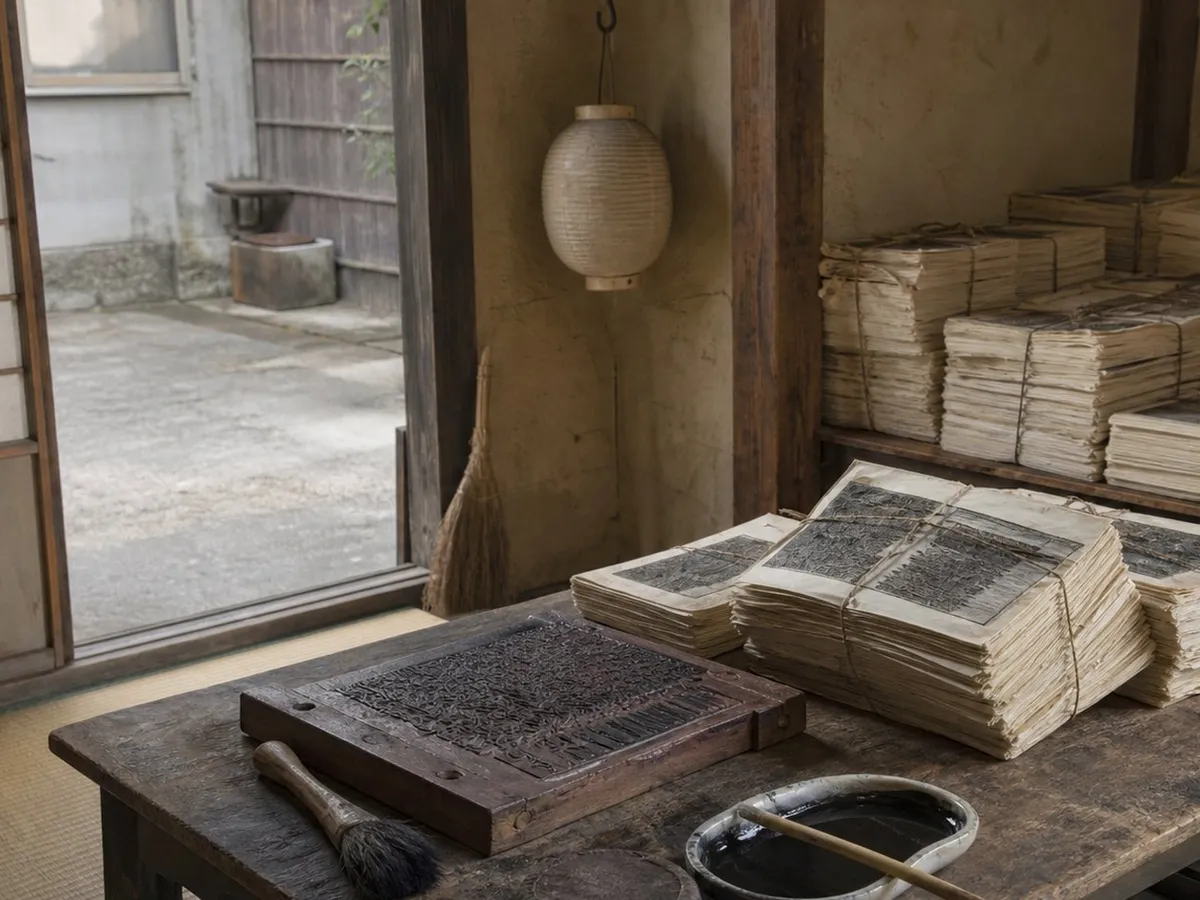
The old calendar’s almanac for the coming year was engraved, printed and on sale, because the year was about to start. The privilege of distributing it belonged to a licensed guild of almanac publishers, and the reform destroyed their stock overnight. The observatory’s account records the unsold inventory and the refunds. Worse, to get solar-calendar almanacs into circulation quickly, the government allowed anyone with permission to publish the abridged single-sheet version, which broke the monopoly itself.
The state’s remedy was to hand the guild back its exclusive right to everything except the single-sheet almanac and to waive the fees it owed. The arrangement was extended repeatedly, until the Ise shrine administration took over distribution with the 1883 almanac.
The reform reads, from this angle, less like a country modernising than like a publishing industry being wiped out by a decree its members had three weeks to read.
The old calendar did not leave
Official almanacs kept printing the old dates beside the new ones until the 1909 edition, thirty-six years of parallel text. Public holidays for 1873 were declared provisional and settled later. Rest days remained the days ending in one and six; the Sunday week did not arrive until 1876. Contracts written before the reform were to be reinterpreted by converting their dates into the solar calendar.
And the annotations the edict called absurd did not die at all. The six-day cycle of auspicious and inauspicious days is printed in Japanese diaries and wall calendars now, consulted for weddings and funerals, and the observatory notes drily that these are regularly determined by rule from the calendar itself, which makes them easy to compute and impossible to stamp out. The old Bon is still observed on lunar dates in much of the country.
A state that could delete twenty-nine days from the year could not delete the lucky days from the almanac. If you want the longer version of that pattern (an official position on belief, and a population that kept doing what it was doing), it is the same shape as the gap between what Japan’s own statistics say about religion and what people answer when asked.
There is one more way the calendar remains unfinished. Japan’s Act on National Holidays lists the vernal equinox day and the autumnal equinox day among its public holidays without stating when they fall. The observatory says so plainly: the law contains no specific date, and the dates are announced by publishing the Calendar Requirements in the official gazette the previous February.
So two of Japan’s national holidays are not set by statute at all. They are set by an astronomical calculation, released eleven months ahead, by the same office whose predecessors were told in 1872 to stop printing lucky days.
So why did Japan change its calendar?
The documents support three answers at once, and they are not in competition.
The stated reason. The lunisolar calendar drifted and needed patching every two or three years, the solar calendar did not, and the annotations attached to the old almanac were, in the emperor’s published words, absurd and an obstacle to knowledge.
The diplomatic reason. The observatory puts it briefly: sharing a calendar with other countries was convenient for dealings with them, and the change announced that the era had turned. A nation that had spent two centuries receiving the outside world through a single controlled channel was now going to keep its books on the outside world’s dates.
The reason that adds up. 1873 was going to be thirteen months long, the government had just started paying by the month, and the reform removed the thirteenth month and the last two days of the twelfth.
What is genuinely remarkable is not the switch. Every calendar reform is a state overriding a habit. It is that the document doing the overriding got the arithmetic of its own new calendar wrong by twenty-five years, corrected it with an ordinance that counts from a mythological emperor, and left that ordinance in force, so that the most Western thing about the Japanese calendar is still defined, in law, by the year Emperor Jimmu is said to have taken the throne.
In this article
- Quick answer
- What the edict actually says
- The calendar Japan adopted was not the Gregorian calendar
- The Gregorian rule arrived in 1898, written in imperial years
- The reason that is not in the edict
- The December that was two days long
- The same edict abolished the hour
- What it did to the people who printed calendars
- The old calendar did not leave
- So why did Japan change its calendar?