Quick answer
Japan received a written report on world events once a year, every year, for more than two centuries. The Dutch factory chief at Nagasaki was required to submit it, hereditary interpreters translated it, and it travelled to Edo under seal. The requirement began in 1641 and the reports were abolished in the seventh month of 1859.
From 1840 a second, fuller report was added because of the Opium War. In 1852 that fuller report told the shogunate that the United States was sending warships to open trade, that they wanted a coaling station for steamers running between California and China, that the ships had been ordered to deliver an envoy to Edo, and that the commander was expected to be a man named Perry.
Perry arrived in 1853.
So the answer to the question is not that Japan was ignorant. Japan was informed, on a schedule, in writing, by a single supplier who had every reason to shade what he wrote.
A report that named Perry, a year early
The document survives because a politician kept it. Abe Masahiro, head of the shogunate’s council of elders, held a set of these reports, and the copies of the 1850 and 1852 translations made by the shogunate’s astronomical bureau are the only ones whose whereabouts are known. They were published in 1995 in the research bulletin of the Kanagawa Prefectural Museum.
The 1852 report opens the American section like this:
It is lately rumoured that the government of the United States of North America is dispatching ships, intending to come to this country in order to establish trade relations.
It then sets out what the mission wants:
The envoy will also request that the people of North America be permitted to enter and leave one or two ports in Japan, and that a suitable port be granted for use as a coal depot, to serve the steamships that pass between California and China.
And who is coming:
The envoy is to be dispatched to the emperor of Japan, bearing a letter from the president — hakurishitentoku, glossed in the text as the head of government of the United States — and is said to be bringing Japanese castaways with him.
By recent report, the commander Aulick was to be the officer commanding these warships, but it is heard that a commander named Perry is to replace him; and it is further heard that, beyond the five warships described above, additional warships are to be added.
The report lists the American warships then lying in Chinese waters, ship by ship, with their commanders (the Susquehanna, the Mississippi, the Princeton, the Plymouth, the Saratoga) and notes, of one of them, “the commander Perry is said to be aboard this vessel.” It adds that the ships had been ordered to carry the envoy to Edo.
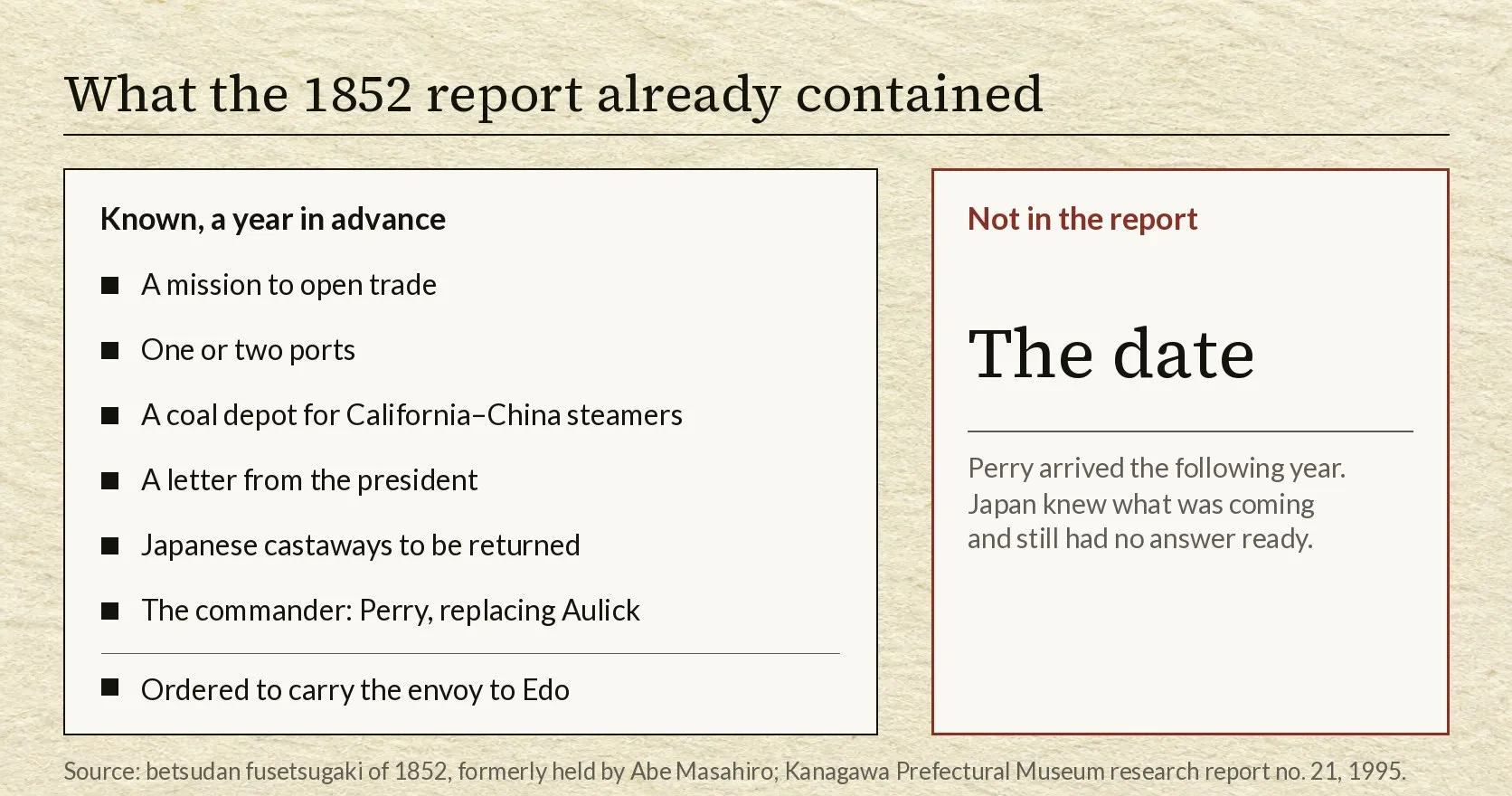
Set against the way Perry’s arrival is usually told in English, the specificity is startling. The shogunate had, a year in advance, the sending country, the diplomatic objective, the commercial objective, the change of commander, the names of the ships, and the destination. The one thing it did not have was a date.
This is the point most often missed. Being informed and being prepared are not the same thing. Japan knew what was coming and still had no answer ready when it came, which tells you something about what the information was for.
The channel: one ship a year, for 218 years
The arrangement that produced that report was old by 1852.
The policy it belonged to was religious before it was commercial. Christianity had been banned by Toyotomi Hideyoshi in 1587 and missionaries expelled; the shogunate then forbade Japanese subjects from travelling abroad or returning in 1635. What the state was sealing out was a faith, and the machinery it built for that purpose is still visible in how Japan handles religion today. That prohibition outlasted the shogunate by five years, and the number of Christians in Japan still carries its shape.
In 1640 the Dutch trading post at Hirado was ordered demolished (the pretext was the Christian date carved into a warehouse) and in the fourth month of 1641 the factory was moved to Dejima, the artificial island in Nagasaki harbour that the Portuguese had just been expelled from. The Protestant Dutch had been allowed to stay by arguing that they had no interest in spreading the faith. From 1641 they were required to submit a report on foreign affairs every year.
The scale of the place is worth holding in mind while reading anything grand about “Japan’s window on the West.” Dejima was 3,969 tsubo (a little over 15,000 square metres) connected to the mainland by a single stone bridge. It held about sixty buildings and between ten and fifteen Dutch residents: the factory chief the Japanese called kapitan, his deputy, clerks, a doctor, a carpenter, a cook, along with servants brought from Java. One Dutch ship was permitted to call each year.
The translation was done by the Nagasaki interpreters, a hereditary corps of more than thirty families, ranked into senior and junior grades and subdivided into a dense hierarchy of posts. Their numbers grew as the work grew: six posts and thirty-six people in 1704, ten posts and fifty-seven people in 1750, fourteen posts and fifty-nine in 1854.
The finished translation did not circulate. It was translated in Nagasaki at once, sealed, and sent directly to Edo, in the museum’s description, a document of state secrecy.
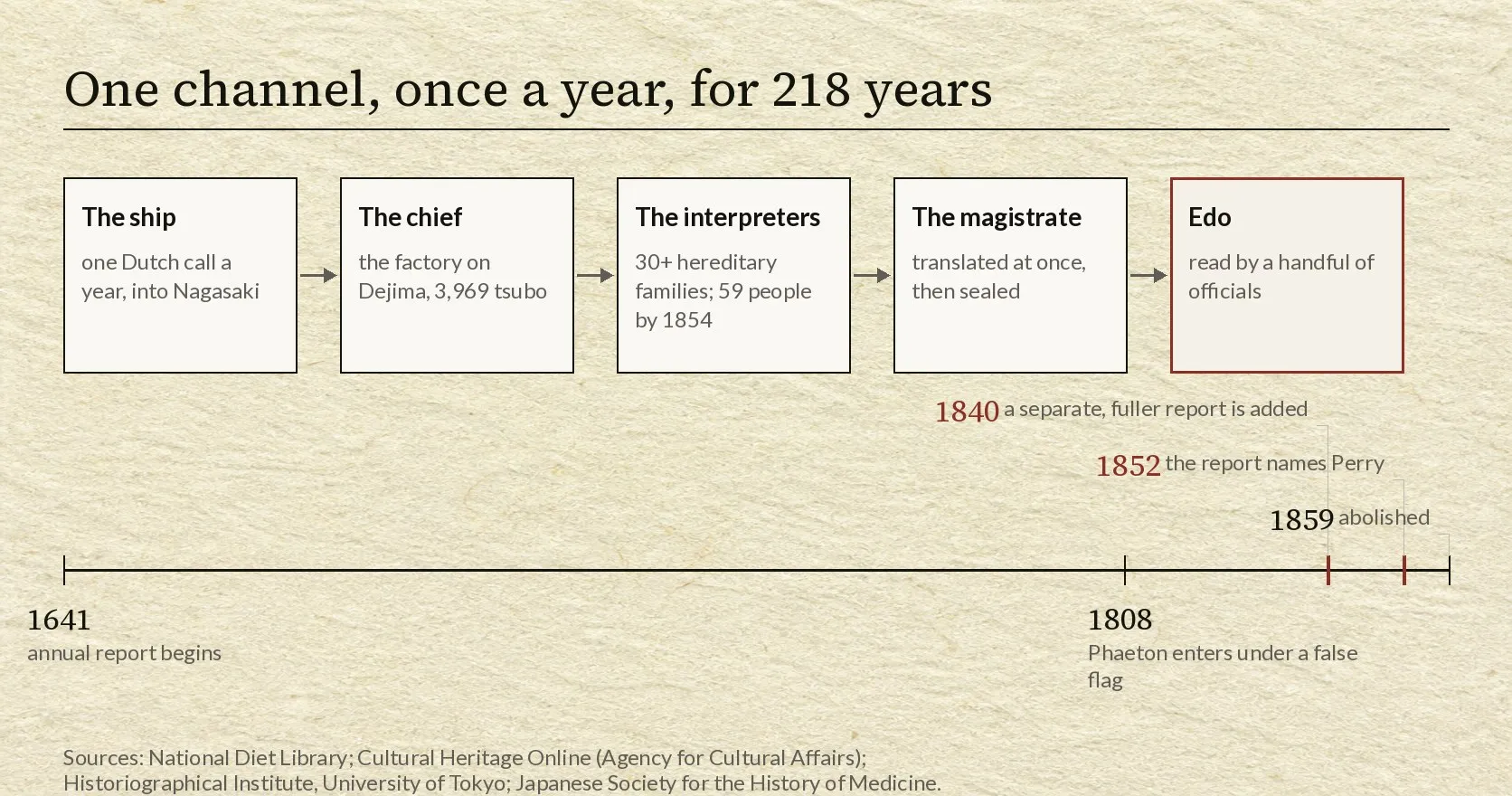
That last detail decides how the whole system should be read. This was not a newspaper. It was intelligence, gathered on a fixed schedule from a single vendor, for a very small readership.
The Opium War widened the channel
By the 1830s the annual report had become formulaic, a routine filing, shortened and standardised by long habit.
Then Britain went to war with China.
From 1840 the Dutch began submitting a separate, detailed report on the war alongside the ordinary one. This was the betsudan fusetsugaki, the separate report, and it outlived its occasion: after the war ended it continued as a fuller account of world affairs, arriving once a year until 1857. The early ones, up to 1845, are concentrated on relations between China and Britain. From 1846 they widen out to the world in general.
The shogunate did not simply file them. It had four of the war reports, covering 1840 to 1843, translated and compiled into a volume titled Ahen shokaroku, a record of the calamity invited by opium. The National Archives of Japan holds it, and describes its purpose plainly: the shogunate, already receiving the ordinary reports, wanted fuller information once the Opium War began.
There is a detail in the 1853 report worth noting, because it shows what the channel had become by the end. Analysing the Dutch text, the Historiographical Institute of the University of Tokyo observes that the sources are named outright: the China Mail and the Herald. By the 1850s Japan was not receiving rumour from sailors. It was receiving a digest of the English-language press of Asia, translated, once a year.
Japan changed the law after watching China lose
If you want proof that the reports were read rather than merely received, look at what the shogunate did next.
In 1825 Japan had issued the order to drive off foreign ships, the ikokusen uchiharai rei, an instruction to repel approaching foreign vessels by force. In 1842, that order was replaced with something markedly softer: the shinsui kyuyo rei, under which arriving ships were to be given firewood, water and food, and then sent on their way.
The National Archives of Japan states the reason without hedging:
Such overwhelming British military power gave a great shock to shogunate officials and to intellectuals throughout the country. In the seventh month of Tempo 13 (1842), the shogunate changed the order to drive off foreign ships to the more lenient order to supply fuel and water.
China was defeated in 1842 and signed the Treaty of Nanking: indemnities, the cession of Hong Kong, consular jurisdiction. Within the same year, Japan quietly abandoned the policy of firing on strangers.
A country that has learned nothing about the outside world does not do that.
The window had an editor
Here is where the usual telling of this story, in either language, tends to stop. It should not.
The Dutch reported on the world to Japan. The Dutch also had a trade monopoly to protect, and they were the only ones who could report. Those two facts were never separated, and at least once the second one won.
Between 1810 and 1813, the Netherlands did not exist. Napoleon annexed it into France in 1810, after his brother Louis had ruled it as king from 1806. Batavia, the Dutch base in Java, was taken by the British in 1811, and the ships stopped coming to Nagasaki. The staff on Dejima ran short of clothing and food.
The factory chief through those years was Hendrik Doeff. According to the National Diet Library, he kept the true state of his home country out of the reports.
The same passage records what that period looked like from outside: Dejima at that time is said to have been the only place in the world where the Dutch flag was still flying.
So for three years, the single authorised source of world news reaching the Japanese government was a man reporting on behalf of a country that had ceased to exist, who was concealing exactly that fact, while standing under the last Dutch flag on earth.
The flag that was not Dutch
Four years before that, the arrangement had already been shown to be exploitable from the other direction.
In the eighth month of 1808, a ship flying the Dutch flag entered Nagasaki after a long absence. Factory staff went out to meet it and were taken hostage. The ship was the British frigate Phaeton. It demanded to know whether there were Dutch vessels in the harbour, demanded provisions, and left.
The Nagasaki garrison, held by the Saga domain, was not at strength; peace had lasted a long time. The magistrate, Matsudaira Yasuhide, granted the demands on the factory chief’s advice, wrote his report to the shogunate, and killed himself.
Entry procedures for Dutch ships were tightened afterwards. Coastal defence studies began. The Nagasaki interpreters started learning English. And the incident became one of the reasons for the 1825 order to drive off foreign ships, the order that the Opium War would reverse seventeen years later.
Both episodes point at the same structural weakness, and it is not the weakness the phrase “closed country” suggests. Japan’s problem was not that it had no information. Japan’s problem was that it had one supplier, who could withhold, and one identifying mark (a flag) that anyone could counterfeit.
Americans had already been there, sixty-two years earlier
There is one more thing the shogunate knew about the United States before 1853, and it is recorded on both sides of the Pacific.
In 1791, two foreign ships put in at Oshima-ura, on the Kii peninsula in what is now Wakayama Prefecture. The Japanese record of it appears in the Tsuko ichiran, the compilation of Japan’s foreign relations that the shogunate commissioned from the Confucian scholar Hayashi Fukusai in the mid-nineteenth century. The entry notes two foreign vessels driven ashore.
The American record names them. The Lady Washington, out of Boston, and the Grace, out of New York, entered a port in southern Japan in 1791. The Diplomatic Archives of Japan’s Ministry of Foreign Affairs sets the two records side by side and notes that this is taken to be the first visit by Americans to Japan. A memorial hall stands at Kushimoto in Wakayama to mark it.
Sixty-two years before the black ships, then, American merchants had already tried the door and found it shut. When the 1852 report said that the United States wanted ports and coal, it was describing a country that had been circling Japan for two generations.
What ordinary households could see
None of the above was public. The reports were sealed state documents read by a handful of officials.
But it does not follow that ordinary people had no picture of the world, and this is where the English-language version of Japanese isolation is furthest from the record.
The first world map printed in Japan appeared in 1645. A popular edition followed in 1671: the Bankoku sozu, printed in Kyoto, with phonetic glosses added to the Chinese characters so that it could be read without specialist training. The National Diet Library holds a copy.
Then the maps moved into the home. Setsuyoshu began as dictionaries in the Muromachi period and grew, edition by edition, into household encyclopaedias in wide domestic use. One of them, printed in Kyoto in 1761, carries a map of Japan, a map of Kyoto, and a world map derived from the Bankoku sozu, with an illustrated survey of the world’s peoples. The National Diet Library notes when this began: world maps appear in setsuyoshu from the Genroku era, 1688 to 1703.
The library’s own comment on this is worth quoting, because it is a public institution stating the case against the standard story:
It is interesting that books carrying a world map were in wide circulation in ordinary households, alongside maps of Kyoto and Edo.
Curiosity was also a commercial product. Komo zatsuwa, published in 1787, sold itself with what the library calls, in modern terms, a catchphrase on the cover: magnifying glasses, flying ships, water automata, the electrostatic generator. An earlier book, Oranda banashi of 1765, had introduced the electrostatic generator to a general readership. A 1799 volume by the scholar Otsuki Gentaku exists specifically to correct the errors that had spread as Dutch learning became popular: including, it turns out, a widespread belief that Dutch people died young.
Around 1794 the painter Shiba Kokan produced the first copperplate world map made in Japan, drawn to show plainly that the earth is a sphere.
Set these against each other and the picture inverts. The government’s knowledge of the world was precise, current and secret. The public’s knowledge was vaguer, older and freely on sale in Kyoto.
Nagasaki was not the only door
One more correction, because “Dejima was Japan’s only contact with the outside world” is the sentence that does the most damage.
Dejima was the only European contact. It was not the only foreign one.
Korean embassies came to Japan twelve times between 1607 and 1811, full diplomatic missions, travelling overland to Edo. Missions from the Ryukyu Kingdom made the journey to Edo eighteen times between 1634 and 1850, the last of them setting out in 1850 on behalf of King Sho Tai. Trade with China ran through Nagasaki continuously, and Chinese ships submitted their own news reports, the to fusetsugaki, in parallel with the Dutch ones. In the north, contact with Ezo (now Hokkaido) was handled through the Matsumae domain.
Historians in Japan sometimes group these as the “four gateways,” and the framing has become common enough to appear in primary school textbooks. It is worth flagging that the framing itself is contested: the Historiographical Institute of the University of Tokyo records the objection that the phrase has no clear documentary basis and may not be a good one. The underlying facts are not in dispute. The tidy label for them is.
What is not contested is the substance. Diplomacy by formal state letter with Korea. A relationship of dominance over Ryukyu. Trade without state letters with China and the Netherlands. Four different kinds of relationship, operating simultaneously, for two centuries, under a policy that English-language accounts still render as a locked door.
The state that rationed those reports eventually went the other way entirely. Within twenty years of the ports opening it rewrote the calendar itself, so that Japan kept its books on the outside world’s dates, deleting the rest of a year to do it, with three weeks’ notice. In the Edo period the picture of the world had arrived in ordinary houses by a slower route: a household dictionary.
So what did Japan know?
It knew a great deal, and it knew it late, and it knew it from one interested party.
The channel was formal: one report a year, from 1641 to 1859, translated by a hereditary corps of interpreters and delivered to Edo under seal. It thickened when the world got dangerous, in 1840, and it stayed thick until 1857. It was accurate enough that in 1852 the shogunate could read the name of the officer who would arrive in 1853, and the reason he was coming, and the fact that he wanted coal.
It was also a channel with an author. In 1810 the author concealed the destruction of his own country. In 1808 someone else had used his flag to get into the harbour.
The image of a sealed nation, taken by surprise, is not what the Japanese records show. They show a government reading intelligence reports about a world it had decided not to enter, revising its coastal policy when its neighbour was defeated, and receiving, one year ahead of time, a written description of the ships that would end the arrangement.
The gap was never information. It was what a government does with information when it has already decided that the answer is no.
When the answer became yes, the change was abrupt and it was itemised. The government stopped reading about the outside world and bought it by the month: 2,690 foreign employees hired up to 1890, at an average of 179.8 yen a month, entered ministry by ministry in registers that survive.
That habit did not end with the shogunate. Reading the modern statute book, the same shape recurs: a rule that forbids something in a sentence carrying no penalty, a machine that is regulated to the yen while the question of its legality goes unanswered. Knowing precisely, and declining to act on the knowledge, is one of the oldest working methods in Japanese government.
In this article
- Quick answer
- A report that named Perry, a year early
- The channel: one ship a year, for 218 years
- The Opium War widened the channel
- Japan changed the law after watching China lose
- The window had an editor
- The flag that was not Dutch
- Americans had already been there, sixty-two years earlier
- What ordinary households could see
- Nagasaki was not the only door
- So what did Japan know?