Quick answer
Japan’s own count of Christians, published by the Agency for Cultural Affairs, is 1,872,320 as of 31 December 2024. Against a population of about 124 million that is roughly 1.1 percent.
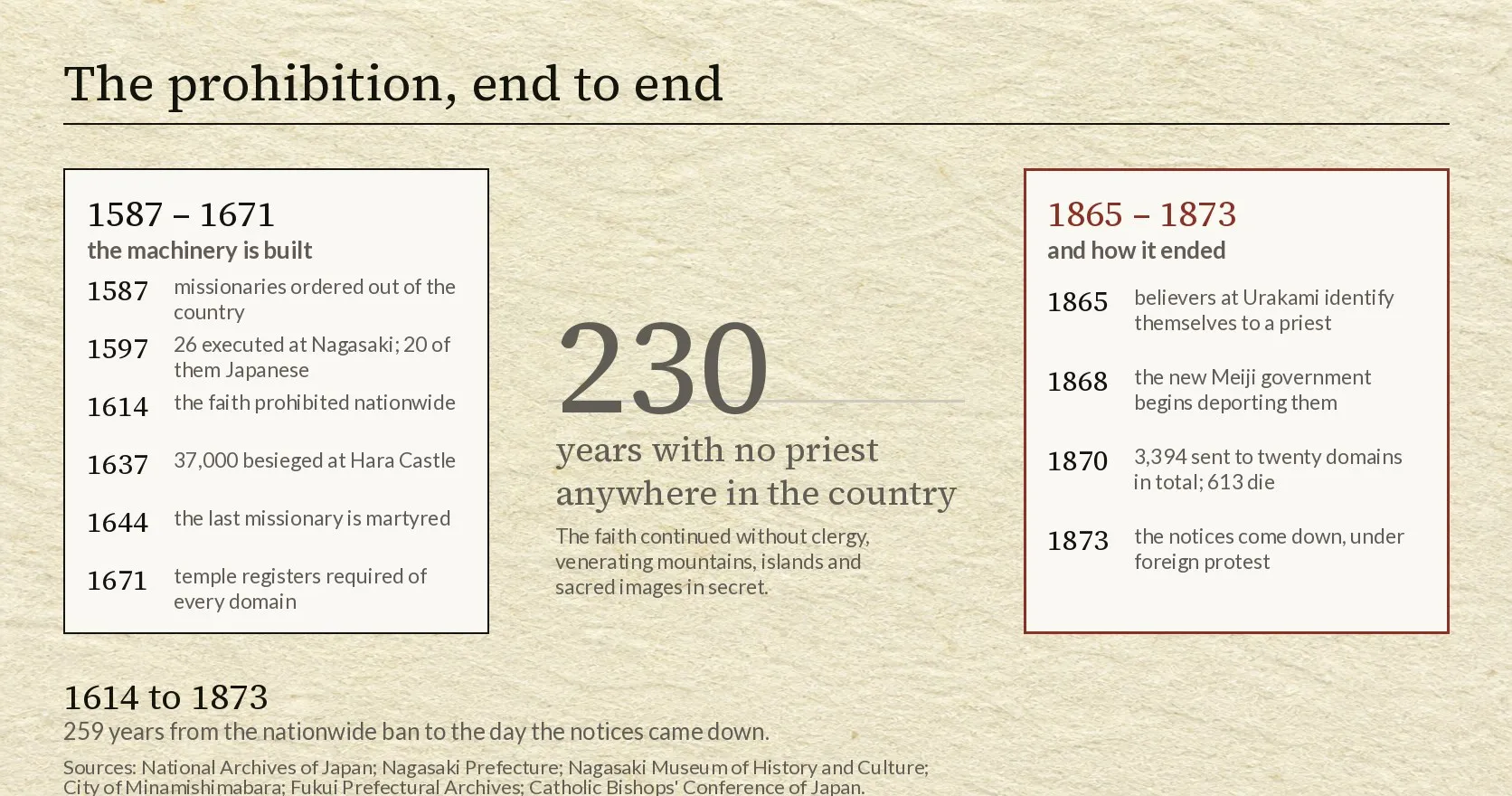
The usual explanation is that Christianity was banned for centuries. That is true, and the dates are more specific than the round number suggests: the nationwide prohibition was issued in 1614, and the notices announcing it were not taken down until 24 February 1873, a span of 259 years.
But two things in the record are less often said in English.
The first is that the worst single deportation of Japanese Christians happened after the Edo period ended, under the modern Meiji government, and that the ban was lifted not by domestic reform but under foreign protest, and even then, according to Nagasaki Prefecture’s own account, what followed was not religious freedom but tacit permission.
The second is that the 1.1 percent figure is not stable. A year earlier the same survey counted 1,246,742. The official number of Christians in Japan rose by 625,578 people (just over 50 percent) in twelve months, and no reason for it appears anywhere in the published summary.
The 1 percent moved 50 percent in a year
Start with the figure everyone quotes, because it turns out to be the least settled part of the story.
The Agency for Cultural Affairs runs an annual religious statistics survey. In the results published in 2025, for the position as of the end of 2024, the four families of religion came out like this:
| Family | Believers | Change from the previous survey |
|---|---|---|
| Shinto | 86,359,612 | +2,988,183 |
| Buddhist | 80,463,918 | −605,501 |
| Christian | 1,872,320 | +625,578 |
| Other | 6,358,197 | −187,060 |
Shinto grew by 3.6 percent. Buddhism shrank slightly. “Other” shrank slightly. Christianity grew by 50.2 percent.
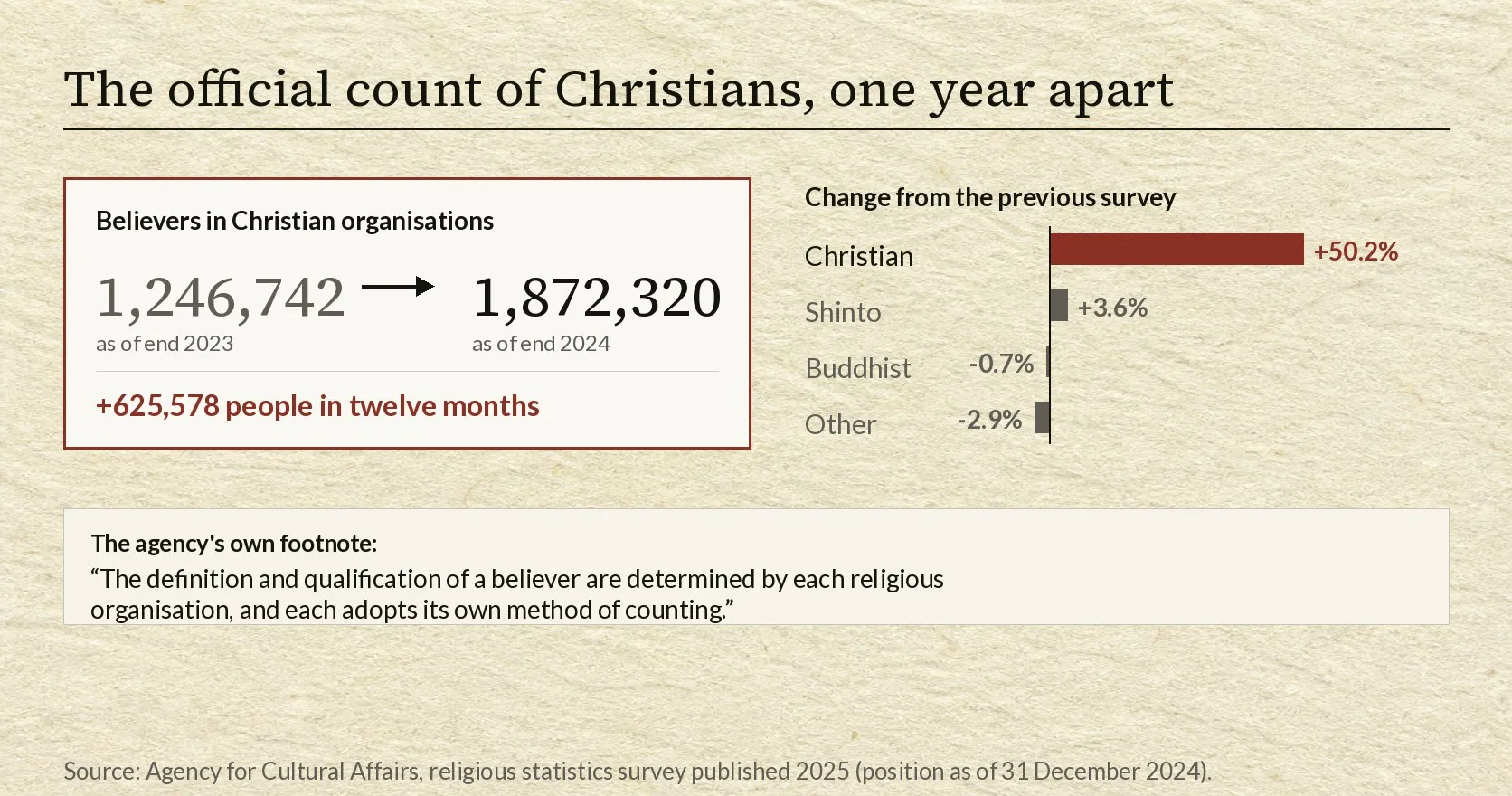
Nothing in the published summary explains it. There is no note about a re-count, a change of method, or a large organisation joining the survey. The document moves straight from the figures to a caveat that is worth reading closely:
Believers are called by different names by each religious organisation: parishioners of shrines, parishioners of temples, adherents, believers, members, comrades, venerators, practitioners and so on. The definition and qualification of a believer are determined by each religious organisation, and each adopts its own method of counting.
So the state publishes a total while stating that it does not define the unit being totalled. We have taken that structural problem apart in a separate piece on whether Japan is a religious country, where the same survey produces a national total of 175,054,047 believers, about 141 percent of the population.
For this question the consequence is narrower and sharper. The “1 percent” that English-language writing treats as a fixed fact was 0.8 percent in the previous year’s official count. Any explanation built on the precision of that number is built on sand.
What follows, then, is not an explanation of a number. It is an account of what was actually done to the people the number is trying to count.
What was banned, and when
The prohibition arrived in stages, and the stages banned different things.
In 1587 Toyotomi Hideyoshi issued the edict expelling missionaries, from Hakozaki in Kyushu. Nagasaki Prefecture’s official heritage site summarises its contents, and is careful to present this as the substance rather than a literal translation:
Japan is a country protected by its own gods, so for a Christian country to impart an evil law is entirely unacceptable. For a daimyo to make the people of his land into believers and have shrines and temples destroyed is unacceptable. Christians cannot be allowed to live in Japan, so return to a Christian country within twenty days from today. Trading ships are a separate matter; they come to Japan to trade, so they may continue to do so.
Read the last line again. The edict expels the missionaries and keeps the trade. What was intolerable was the organisation, not the commerce, a distinction that outlived the edict. The one European trading partner Japan kept for the next two centuries was the one that undertook not to proselytise, and the arrangement that followed became Japan’s only official channel of news about the outside world.
The Tokugawa shogunate went further. Commentary prepared by the Nagasaki Museum of History and Culture for the Ministry of Land, Infrastructure, Transport and Tourism sets out the sequence:
In 1612, Hidetada issued a prohibition on the religion in Edo, Kyoto and other territories under the shogunate’s direct control, and then in 1614 prohibited the Christian faith throughout Japan.
Note the difference. In 1587 the missionaries had to leave. By 1614 the faith itself was prohibited, everywhere.
⚠️ A note on sources here. The classical Japanese text of both edicts is quoted widely online, but we could not obtain either from a public archive or university repository, so we have used the official summaries above and flagged them as such. Where this article quotes, it quotes what a public institution published.
The executions began before the ban
One detail places the sequence in order. The first mass execution of Christians in Japan happened before either prohibition was fully in force.
In February 1597, twenty-six people were put to death at Nishizaka in Nagasaki. The Catholic Bishops’ Conference of Japan records the composition of the group: priests, brothers and lay believers, of whom five were Spanish, one Portuguese, and the remaining twenty were Japanese. They were beatified by Pope Urban VIII in 1627 and canonised by Pope Pius IX in 1862.
Two things follow from those numbers. The first is that the great majority of the dead were Japanese, which is not what the phrase “expelling foreign missionaries” suggests. The second is the date: 1597 is ten years after Hideyoshi ordered the missionaries out and seventeen years before the shogunate prohibited the faith nationwide. The enforcement ran ahead of the law.
There is also a long tail on the other side of the story. Canonisation came in 1862, while the prohibition was still in force in Japan, and three years before the believers of Urakami identified themselves at Oura Church. Rome was formally recognising Japanese martyrs at a point when their descendants were still hiding.
The uprising, and what happened at the castle
The enforcement hardened after an armed revolt. In 1637 and 1638, rebels including many Christians held Hara Castle on the Shimabara peninsula against the shogunate.
The figures published by the City of Minamishimabara, which manages the site, are these: around 37,000 people inside the castle, against a shogunate force of 120,000. The city’s own heritage account states that almost everyone besieged there lost their lives, and records only two exceptions, a painter and the family of a warehouse officer.
There is no official casualty count to the person. What exists is a public authority stating, of a site it maintains, that the population of the castle was essentially destroyed.
The persecution did not end with the shogunate
Here is the part that most English-language accounts skip, and it is the part that changes the shape of the answer.
The Tokugawa shogunate fell in 1868. The persecution of Japanese Christians reached its largest single scale after that.
In 1865, believers from the village of Urakami near Nagasaki had approached a priest at Oura Church and identified themselves as Christians, the episode known in Japanese as shinto hakken, the discovery of the believers. When the new Meiji government took power, it moved against them.
The commentary prepared for the Nagasaki Museum of History and Culture states it plainly:
In 1868 … Kido Takayoshi exiled 114 central figures to the domains of Hagi, Tsuwano and Fukuyama. … In January 1870, 700 men and even their families were exiled. In total 3,394 Urakami Christians were deported to twenty domains. … 613 people died in the places they were sent, and only 2,911 were able to return to Urakami.
⚠️ The arithmetic in that passage does not work. 3,394 deported minus 613 dead leaves 2,781, not 2,911. We could not resolve the discrepancy, and it is not ours to smooth over: the inconsistency sits in the source itself. Other figures circulate too, 662 deaths is cited to academic monographs we have not read directly. What can be said from a government-published source is that more than three thousand people were deported by the modern Japanese state for their religion, and that hundreds of them died.
This was five years into the Meiji era. The men who ordered it were the builders of modern Japan.
It was foreign protest that ended it
The prohibition notices came down on 24 February 1873. The National Archives of Japan holds the document and describes the act without ornament:
On 24 February 1873, by Decree No. 68 of the Grand Council of State, the government removed the notices prohibiting Christianity. With this, a stop was put to the anti-Christian policy that had continued since the early Edo period.
The archives’ own commentary does not give a reason. Nagasaki Prefecture’s does:
The Meiji government dispatched the Iwakura Mission to Europe and the United States, but because news of the persecution of Christians was already known in the West, the mission met unexpectedly severe protest at the places it visited. Thus, on 24 February 1873, the notices prohibiting Christianity were removed. … Japan’s persecution of Christians, abolished by outside pressure. Had there been no censure and protest from foreign countries, how much longer would it have continued?
And then the same official source adds the qualification that matters most:
This did not mean that freedom of belief was recognised unconditionally; it was merely tacitly permitted.
That is a prefectural government, on its official heritage site, saying three things a foreign ministry would not: that the policy was abandoned under external pressure, that it might otherwise have continued, and that what replaced it was not a right but a silence.
The mission that absorbed those protests was the same one Japan had sent to learn how modern states were built. It came home having learned, among other things, that the persecution was visible from outside.
Two hundred and thirty years of hiding
Between the ban and its removal, the faith did not disappear. It went under.
Nagasaki Prefecture’s official account of the World Heritage sites dates the beginning precisely: the last missionary was martyred in 1644. After that there were no priests, no sacraments administered by clergy, and no institution. What the believers did instead is described this way:
Mountains and islands … things close at hand and rooted in daily life and livelihood … sacred images … even shrines: they secretly venerated objects of their own.
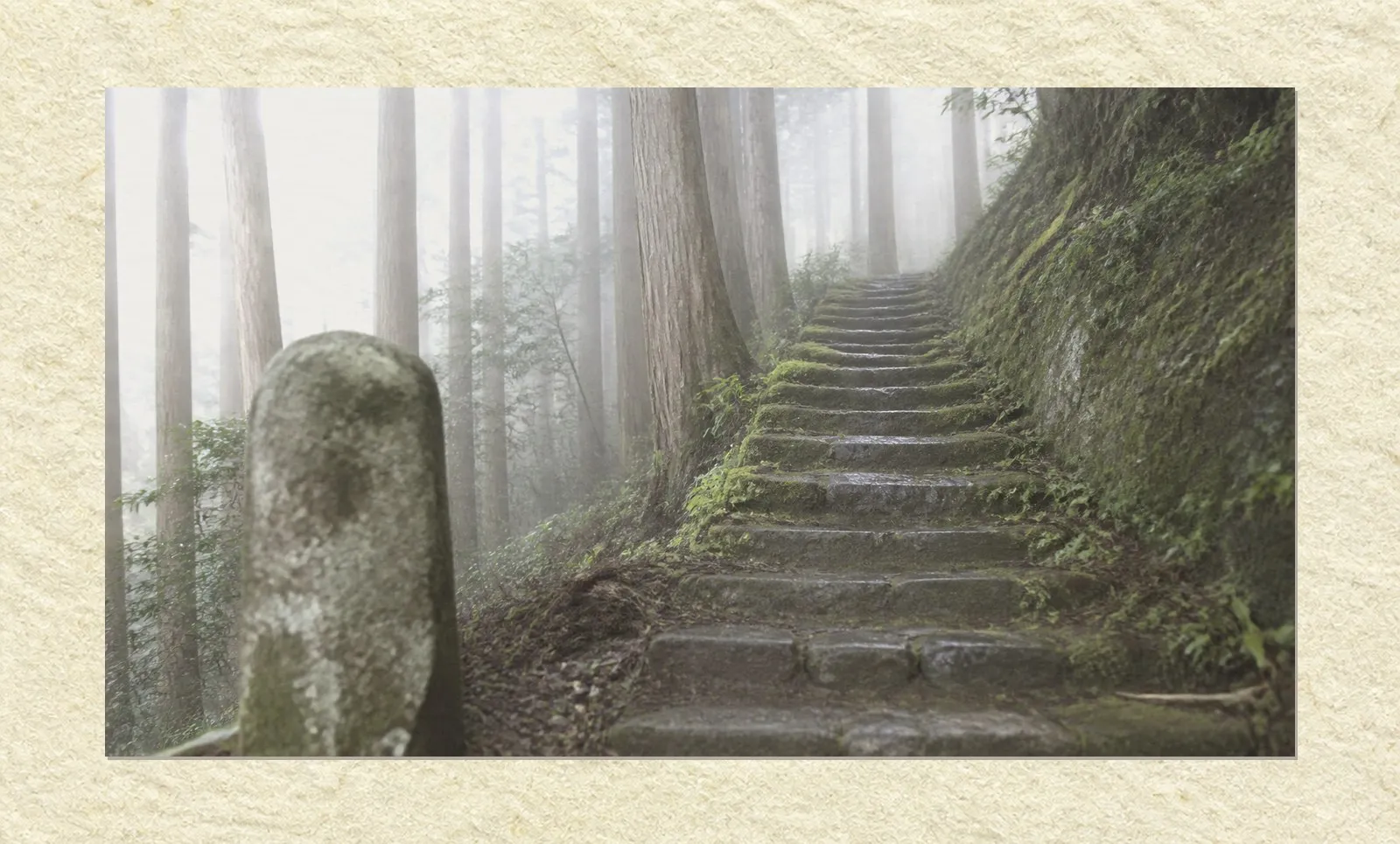
They continued for roughly 230 years, coexisting with Japan’s established religions rather than standing apart from them, which is precisely why they survived, and precisely why they are difficult to count.
Twelve sites associated with this period were inscribed on the UNESCO World Heritage list on 30 June 2018, under the name Hidden Christian Sites in the Nagasaki Region: the ruins of Hara Castle, the villages of Kasuga and Sakitsu, Shitsu and Ono, the island communities of Kuroshima, Nozaki, Kashiragashima, Hisakajima and Egami, and Oura Church itself.
⚠️ How many people were hiding is not known. Nagasaki Prefecture’s newsletter gives a figure of some 370,000 Christians around the time of the 1614 ban, but does not name the source it comes from, and that is a count before the concealment rather than during it. No public authority publishes a total for the hidden period, and we are not going to invent one.
Belief was administered, once a year, by a temple
The last piece is the mechanism, and it is the one that explains how a prohibition could hold for two and a half centuries in a country with no police force in the modern sense.
Being not-a-Christian was something you had to document.
The Fukui Prefectural Archives, describing the records in its own holdings, sets out the system:
The shumon aratamecho (shumon ninbetsu aratamecho) was a register created so that the Tokugawa shogunate could enforce the prohibition of Christianity. Once a year, temples were made to certify, individual by individual, that a person was one of their parishioners. At first this applied only to shogunal territory, but from 1671 the domains across the country were also required to compile these registers.
The archives then show what one looks like. In a register from 1762, from a village in what is now Fukui Prefecture, all 214 residents appear under one of four temples. Moving required a temple certificate (a terauke) to be issued and entered on the register at the destination. Without one, a person was treated as unregistered.
Alongside the paperwork there was a physical test. On the island village of Sakitsu in Amakusa, now a World Heritage site, the prefecture’s official account states that during the prohibition an annual treading ceremony was held at the village headman’s residence to find hidden Christians. The confiscated objects survive: the Tokyo National Museum holds 140 items from the Nagasaki magistrate’s office, designated an Important Cultural Property in 1977, comprising both the images used for the treading tests and the sacred images, crosses, medals and rosaries seized from believers.
The register system ended not by repeal but by replacement. The Family Register Act of 1871 and the census register compiled in 1872 took over the function of recording who everyone was.
⚠️ One inference we are not going to draw. It is often said that Japan’s habit of counting nearly everyone as a Buddhist parishioner descends directly from this temple registration. It is an attractive line, and the two things are obviously related in shape. But we could not find a public archive, museum or ministry that states the causal link, and the Agency for Cultural Affairs does not mention the Edo-period registers when explaining how believers are counted today. So it stays an observation about resemblance, not a finding.
There is one more thing worth setting beside that date. The notices banning Christianity came down in 1873, and the same year, on 1 January, Japan began keeping time on the Christian world’s calendar, by an imperial edict that deleted the rest of the old year and dismissed the Japanese almanac’s own auspicious days as baseless. The country took the calendar of Christendom wholesale within months of ceasing to punish the religion. It has never taken the religion.
So why 1 percent?
Because the answer is not really about persuasion.
For 259 years the faith was prohibited. For about 230 of those years it had no clergy in the country at all. Not being a Christian was certified annually by a temple, in writing, for every person in the village, and the checking was physical as well as documentary. When the shogunate fell, the modern state deported more than three thousand believers from a single village district and hundreds died. The prohibition ended in 1873 under foreign protest, and by the account of the prefecture that lived it, what arrived was not freedom but a silence.
Set that against the explanations in circulation (that Japanese people find Christianity culturally foreign, or are simply uninterested), and the difference is not that those observations are wrong. It is that they describe a landscape after the ground has been cleared, without mentioning who cleared it.
And the figure itself remains unsettled. 1,872,320 people, up from 1,246,742 the year before, in a survey whose own footnote says each organisation decides what a believer is. Japan does not know how many Christians it has, for the same reason it does not know how many believers of any kind it has: nobody has ever been required to say. The same gap opens wherever the state is asked for a number about belief. It does not count dangerous groups either, only corporations, of which exactly three have ever been dissolved for wrongdoing.
The Christian share of Japan is small, and it is measured by an instrument that moved 50 percent in a year. Both halves of that sentence are part of the answer.
In this article
- Quick answer
- The 1 percent moved 50 percent in a year
- What was banned, and when
- The executions began before the ban
- The uprising, and what happened at the castle
- The persecution did not end with the shogunate
- It was foreign protest that ended it
- Two hundred and thirty years of hiding
- Belief was administered, once a year, by a temple
- So why 1 percent?