Quick answer
- Nobody counts them, because the category does not exist in Japanese law. No statute defines a cult, so no ministry maintains a list and no official figure can be quoted.
- What the state counts is organisations and their property. 210,007 religious organisations, incorporated and unincorporated together. Registering as a corporation is optional (Article 4 says a religious organisation may become a corporation) so a group that declines to register is absent from every figure the government publishes.
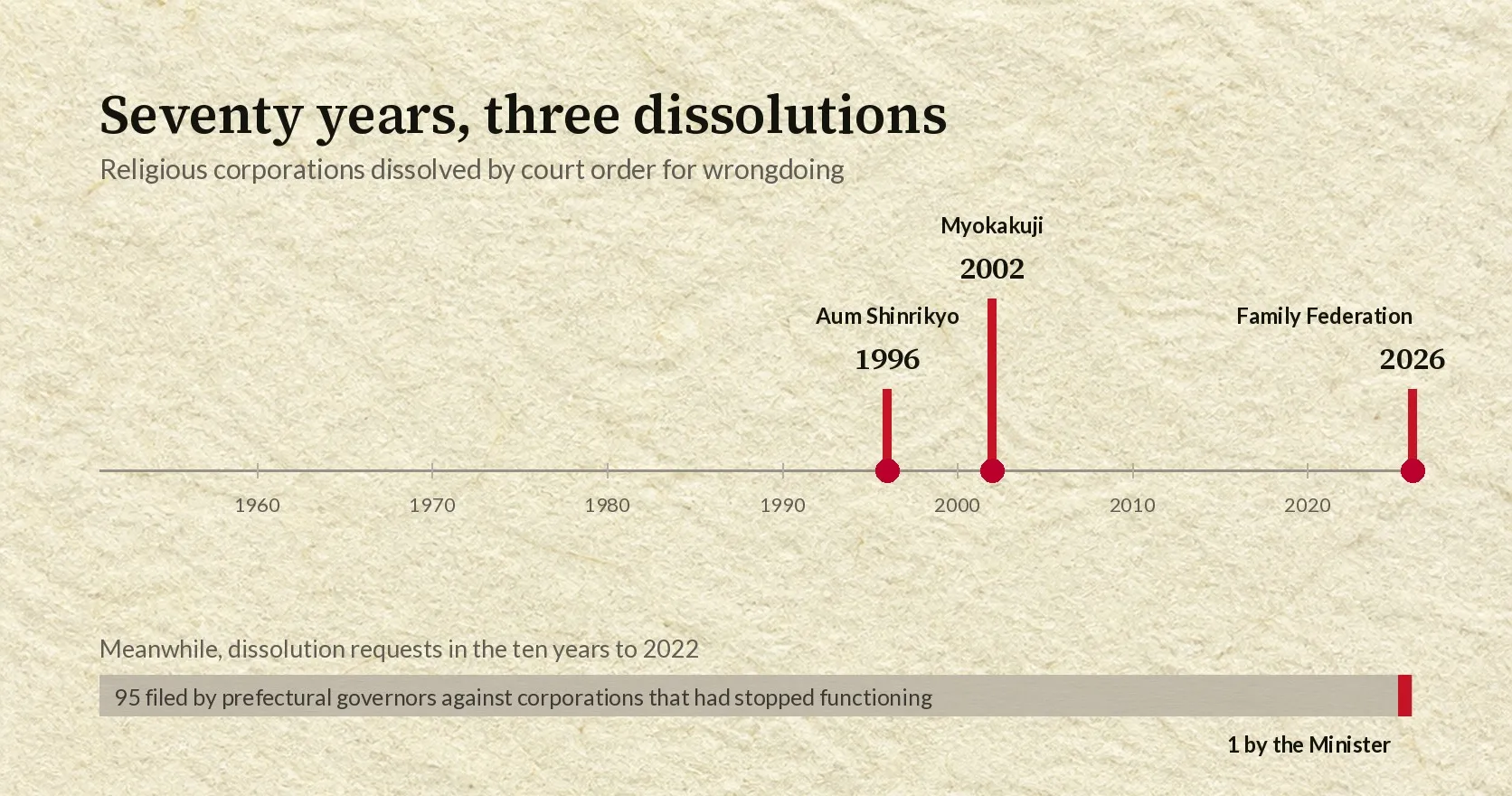
- Three groups have ever been dissolved for wrongdoing: Aum Shinrikyo (1996), Myokakuji (2002), and the Family Federation for World Peace and Unification, formerly the Unification Church (2026).
- Dissolution is mostly janitorial. Of 96 dissolution requests in the ten years to 2022, 95 came from prefectural governors clearing corporations that had stopped functioning.
- Dissolving a corporation does not end a religion, and the act says so in its own text. Article 1(2): no provision may be construed as restricting anyone from spreading doctrine or performing rites.
- The only group whose membership the state actually knows is one it dissolved. The successors to Aum hold no corporate status and are counted to the nearest hundred, quarter after quarter, 105 reports in.
The question has no answer, and that is the answer
Search in English for the number of cults in Japan and you will find estimates, none of them official. There is a reason for that, and it is not secrecy.
Japanese law contains no category for a cult. No statute defines the word, no ministry is charged with identifying one, and no register exists to be counted. The concept that English-language coverage treats as the starting point does not appear in the machinery at all.
What the machinery does contain is a different object entirely: the religious corporation. And the founding article of the law that creates it is worth reading before anything else, because it tells you what the state thinks it is doing.
Article 1 of the Religious Corporations Act:
This Act aims to give legal capacity to religious organisations, so that they may own facilities for worship and other property, maintain and operate them, and run the affairs and undertakings necessary to achieve their purposes.
The purpose is property and administration. Not doctrine, not danger, not truth.
And then paragraph 2, which is the sentence that governs everything else in this article:
The freedom of religion guaranteed by the Constitution must be respected in all state affairs. Accordingly, no provision of this Act may be construed as restricting any individual, group or organisation, on the basis of that guaranteed freedom, from spreading doctrine, performing rites and ceremonies, or carrying out other religious acts.
The law that can dissolve a religious corporation states, in its own opening article, that nothing in it restricts religious activity. Hold that sentence. It explains what happened to every group in the table below.
What the state actually counts
Since the state does not count cults, here is what it does count.
Religious organisations: 210,007. Believers: 175,054,047, a figure that comes to about 141 percent of the population, because each corporation reports its own number and nobody is asked twice. We took that apart in a separate article on whether Japan is a religious country.
Becoming a corporation is a choice. Article 4:
A religious organisation may become a corporation pursuant to this Act.
May. A group that never registers owns no property in its own name and receives no tax treatment, and in exchange appears in no government total. Whatever the true number of religious groups in Japan is, the published figures cannot contain it.
For those that do register, Article 5 sets the supervising authority: the prefectural governor where the organisation sits, or the Minister of Education where it maintains buildings across prefectural lines or has affiliated bodies in more than one prefecture. This is a test of geography, not of standing. The visible consequence is administrative. Organisations under the Minister’s jurisdiction are listed by name in the Agency for Cultural Affairs yearbook.
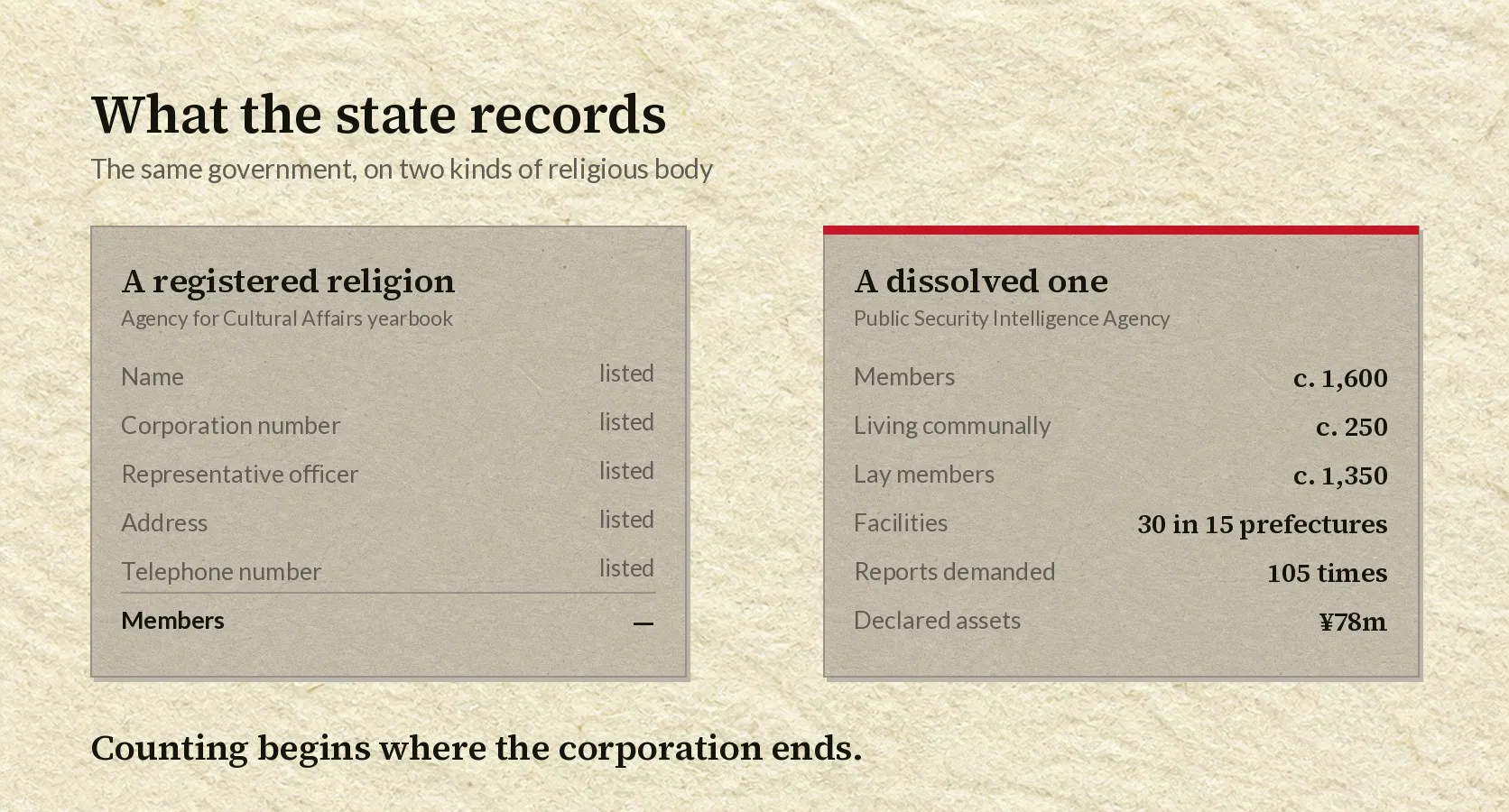
They are listed with their corporate number, their representative officer, their address and their telephone number.
There is no membership column.
The register, compared
Here are six organisations that English-language coverage tends to discuss together, set against what the record actually holds for each. Five are the groups most often named; the sixth is included as a control, a large, old religion that has never been in legal trouble.
| Organisation | Corporate status | Jurisdiction | Dissolution order | Political arm | Declared membership |
|---|---|---|---|---|---|
| Soka Gakkai | Corporation, non-affiliated | Minister of Education | None | Backs Komeito | 8.27m households in Japan, c. 3m abroad |
| Family Federation (Unification Church) | In liquidation since 2026 | Minister of Education | Yes, 2026 | None | No figure found |
| Aleph and other Aum successors | None since 1996 | ( | Yes) 1996 | None | c. 1,600 (state figure) |
| Happy Science | Corporation, non-affiliated | Minister of Education | None | Runs Happiness Realization Party | No figure found |
| Myokakuji | None since 2002 | ( | Yes) 2002 | None | Not known |
| Tenrikyo (control) | Corporation, umbrella body | Minister of Education | None | None | 1.2m |
Four things in that table are worth stating plainly.
The two organisations with political parties are the two with no legal trouble. Soka Gakkai backs Komeito, which has been in government (we have taken that relationship apart separately) and Happy Science runs its own party. Neither has faced a dissolution request. English-language writing frequently treats political involvement as evidence of a group being dangerous. In the record, the correlation runs the other way.
Membership is published only where the group chooses to publish it. Soka Gakkai and Tenrikyo state their own figures. For the Family Federation and Happy Science, no figure could be found: the Happy Science pages that describe the organisation carry none, and the Family Federation’s own site could not be read at the time of writing. No authority compels either of them to publish one. There is no official number to compare against, for any of them.
The three dissolved groups are the only ones whose status changed: and, as the next sections show, what changed was narrower than the word “dissolved” suggests in English.
Every organisation here falls under the Minister of Education. That is not a mark of size or seriousness. It follows mechanically from Article 5: operate buildings in more than one prefecture and the jurisdiction shifts.
Restraint of this kind is not a postwar invention, though its direction has reversed. For two centuries the state’s principal religious policy was exclusion: Christianity banned, missionaries expelled, and the only Europeans admitted being those who would state that they had no interest in spreading a faith, the arrangement that also gave Japan its one official channel of news about the outside world.
Dissolution is mostly caretaking
The power that dissolved these three sits in Article 81, and it lists the grounds. The first is the one the newspapers quote:
having committed an act in violation of laws and regulations that is clearly recognised as substantially harming public welfare
But read the rest of the list, because it is where the power is actually used. A corporation may also be dissolved for ceasing to act for its purposes for a year or more, for losing its facilities for worship and failing to replace them for two years, or for having no representative officer for a year or more.
Those are conditions of abandonment, not wrongdoing. And that is what the caseload looks like.
In April 2023 the Agency for Cultural Affairs circulated a briefing to prefectural authorities on inactive religious corporations. Requests for dissolution over the ten years to 2022:
- 1 by the Minister of Education, plus one by an interested party in 2022
- 95 by prefectural governors
Ninety-six requests, and 95 of them were officials striking dead corporations off their books. Meanwhile the number of inactive corporations barely moved (3,837 in 2012, 3,329 in 2022) and the Agency’s own briefing describes the trend as flat. About nine in ten of those dormant corporations sit under an umbrella body.
So the dissolution power is, in ordinary use, a filing cabinet function. The three cases everyone knows are the exceptions, and there have been three of them in seventy years.
A 2022 review of the case law in the Kyorin Journal of Social Sciences put the count as of that year at two, Aum and Myokakuji. The Family Federation became the third.
What dissolution actually removes
Aum Shinrikyo’s corporation was dissolved in 1996 after the sarin attack on the Tokyo subway. Myokakuji’s was dissolved by the Wakayama District Court on 24 January 2002, after a fraud scheme run through the corporation itself: representatives claiming spiritual powers they did not have, working from manuals, to induce payments for memorial services.
The Family Federation’s case ran through 2026. The Tokyo High Court upheld the dissolution order on 4 March 2026, and the Supreme Court dismissed the organisation’s special appeal on 22 June 2026. A liquidator was appointed by the Tokyo District Court on the same day the High Court ruled.
Now look at what the statute does with a dissolved corporation. Article 49 appoints a liquidator. Article 50 provides that remaining property is disposed of as the organisation’s own rules specify. The officers retire. The corporate person is wound up like any other.
Nothing in that sequence touches belief, and Article 1(2) has already said it cannot. The academic review of the case law states the consequence directly:
the dissolution in this case is the dissolution of the “religious corporation” as a legal person, and there is no obstacle to continuing activity as a “religious organisation”
Dissolution removes the container. It does not remove what was inside.
The state knows the size of exactly one group
Which produces the inversion this article has been building towards.
Japan does not know how many people belong to Soka Gakkai, or to Happy Science, or to the Family Federation. It publishes a national total that exceeds the population and lists corporations without a membership column.
The one organisation it counts precisely is the one whose corporate status it took away.
The Public Security Intelligence Agency’s assessment of the Aum successors, as of the end of February 2026:
- roughly 1,600 members (about 250 living communally, about 1,350 lay) across Aleph, the Yamada group and Hikari no Wa
- 30 facilities in 15 prefectures
- an observation disposition renewed for the eighth time in January 2024
- reports demanded 105 times in total; on-site inspections in 2025 covering 43 facilities across 15 prefectures
- declared assets of about ¥78 million at the end of January 2026
These groups hold no religious corporate status. They are counted under a different law altogether, the one written after 1995, when the existing powers were found not to reach Aum. That story we have told separately.
The pattern holds across everything above. A registered religion in Japan is asked for its address and its representative’s name. A dissolved one is asked, four times a year, who its members are.
Counting begins where the corporation ends.
So: how many?
- Cults: no number exists, because no Japanese law defines the category, and nothing counts what it does not define.
- Religious organisations: 210,007, counting incorporated and unincorporated bodies together, but registration is optional, and the published totals carry no breakdown by group.
- Groups dissolved for wrongdoing: three, in seventy years: 1996, 2002, 2026.
- Dissolution requests in the last measured decade: 96, of which 95 were administrative clean-up.
- Groups whose membership the state actually knows: one, and it is the one it dissolved.
Readers of this site will recognise the instrument. Japan regulates pachinko to the yen while declining to say whether the cash at the end is lawful. It forbids prostitution in a sentence carrying no penalty, then puts the surrounding trade on a register. It designates organised crime groups rather than outlawing them. And it dissolved a religious corporation through the courts while creating no category for a dangerous religion, because creating one would require defining it.
What the state built instead is a register: a list of who owns the buildings, who signs for them, and where to send the post. Ask it how many cults there are and it has nothing to say, because it was never built to answer that. Ask it who holds the deeds and it will tell you to the telephone number.