Quick answer
- The grievance was against a religious organization. The target was a politician. The man convicted of the killing blamed the Unification Church for the collapse of his family’s finances, and chose Abe because of Abe’s association with the organization’s affiliates. The court accepted the grievance and rejected the leap.
- The weapon was homemade, because in Japan there is no other way. In all of 2024 Japan recorded three shooting incidents nationwide and two deaths from them, both of organized crime members. Guns are not a thing a Japanese citizen can go and buy.
- The whole attack took about twenty-five seconds, and the decisive detail is a sound. Four officers were standing within five metres of Abe. According to Japan’s own police report, not one of them recognized the first shot as gunfire.
- Japan’s police published a report saying they failed. The National Police Agency found the protection had been watching the wrong direction, that it had never assessed the risk of an individual acting alone, and that it had never asked to see the plan.
Why this was, statistically, almost impossible
Start with the number, because nothing else about this case makes sense without it.
In 2024, Japan (a country of roughly 120 million people) recorded three shooting incidents in total. Not three hundred. Three. Two of them were attributed to organized crime groups, one of those to a feud between them. All three involved handguns. The incidents produced three casualties: two deaths and one injury, and both of the dead were members of organized crime groups. Police seized 18 handguns nationwide over the year and made 14 arrests for smuggling handguns or handgun parts. These are the National Police Agency’s own figures, and the agency notes that the 2024 total was the lowest since 1989.
That is the baseline against which the killing of a former prime minister has to be understood. Firearms in Japan are not restricted in the sense that Americans or Europeans use the word. They are, for practical purposes, absent from civilian life. A private citizen cannot own a handgun. The small number in circulation is concentrated in organized crime, and even there the numbers are collapsing.
Key finding
A country that records three shootings a year does not have a population that knows what a gunshot sounds like — including, as it turned out, the officers assigned to protect the target.
This has a second consequence that matters more than it sounds. Because guns are absent, Japanese protective policing evolved around other threats: crowds, thrown objects, knives, someone rushing a stage. The National Police Agency’s own report on the killing says this directly. Among the failures it identified was that the agency had never evaluated the risk of a case in which “an individual not belonging to any particular terrorist organization holds strong dissatisfaction and attempts to attack a protected person using a firearm.”
That sentence is the institutional admission at the centre of this story. The scenario had not been ruled out. It had not been considered.
Why there are no guns to buy
English-language coverage usually says Japan has “strict gun control.” That is the wrong frame, and it makes the homemade weapon look like a workaround rather than the only available option.
Japan’s Firearms and Swords Control Act, passed in 1958, does not license gun ownership subject to conditions. It begins from prohibition. Article 3 states that “no person shall possess a firearm or a sword” except in a closed list of circumstances: police and other officials carrying them in the course of duty, national or local government employees holding them for testing, research, training or public exhibition, and a small number of similar exceptions. Hunting rifles and air guns can be licensed under a separate permit regime that involves police interviews, mental-health documentation, a shooting test, a written test, secure storage inspected by police, and periodic renewal. Handguns are not in that regime at all. There is no lawful route by which an ordinary citizen acquires one.
The penalties follow the same logic. Under Article 31-3, simply possessing a handgun in violation of Article 3 carries imprisonment of one to ten years, one to fifteen if two or more are involved, and more again if the possession is organized. Not using it. Not threatening anyone with it. Having it.
Key finding In Japan, a gun is not a regulated product. Possession is the offence. That is why a man who wanted to shoot someone had to build the weapon himself — and why nobody around him was prepared for the result.
This inverts the usual causal story. In countries where firearms are available, the availability is the risk. In Japan, the absence created a different one: an entire protective apparatus, and an entire public, with no working experience of the thing that happened on 8 July 2022.
The emperor, the prime minister, and who actually governs
A note here for readers outside Japan, because the two highest-profile figures in the country are constantly confused and the confusion changes what this killing means.
Japan has an emperor and a prime minister. Only one of them governs.
The Constitution makes the emperor “the symbol of the State and of the unity of the people,” and Article 4 states that he “shall not have powers related to government.” He performs ceremonial acts and nothing else. Article 65 places executive power with the Cabinet, and the prime minister heads that Cabinet, chosen by the Diet from among its members.
So Abe was not a royal. He was the elected head of government (the person who ran the country) and by the time he was killed he was a former head of government who had never stopped being the most powerful figure in the ruling party’s largest faction. In a system where the emperor is deliberately kept out of politics, the prime minister absorbs all of the political weight. Killing one is not a symbolic act against a figurehead. It is an attack on the actual centre of governmental power.
Who Shinzo Abe was
Abe was prime minister twice. His first term ended after a year in 2007. His second began on 26 December 2012 and lasted until his Cabinet resigned on 16 September 2020.
The numbers from that second run are the reason his name is known outside Japan. 2,822 consecutive days in office, the longest unbroken tenure in the history of Japan’s constitutional government, passing his great-uncle Eisaku Sato in August 2020. 3,188 days in total, which passed Taro Katsura’s record in November 2019 to become the longest of any Japanese prime minister ever.
For a country whose prime ministers had, for decades, tended to last a year or two, this was an anomaly. It made Abe the face of Japan abroad for most of the 2010s, and it made him the organizing centre of Japanese conservative politics at home. When he left office he did not retire. He led the largest faction of the governing Liberal Democratic Party, and in July 2022 he was doing what faction leaders do before an election: standing on a street, campaigning for someone else.
The plan that was not made
The police report spends its first pages not on the shooting but on two earlier days, and the reason becomes obvious.
Abe had spoken at the same location in Nara twice already that summer, on 25 June and 28 June. The second of those drew about 600 people (more than the prefectural police had expected) and after the speech Abe spent longer than planned walking through the crowd shaking hands on his way to the station. Nothing went wrong.
The report records what happened next inside the police organization: no formal review or evaluation of that operation was carried out. What officers took from it, informally, was a lesson about crowds, that future operations needed stronger vigilance when large numbers gathered, and better handling of a protected person walking on foot afterwards.
Read that lesson against what killed him. The crowd was on the north side. The attacker came from the south.
Then the timing of the final operation. During the upper house election campaign, Abe’s protection had been arranged in Tokyo and 19 other prefectures. Nara police learned of the Nara visit at 12:50 p.m. on 7 July, the day before. At around 4:30 p.m. they learned it would be at the north exit of Yamato-Saidaiji Station. At around 7:00 p.m. on 7 July they were told the exact spot: the same place as 25 June.
And because it was the same place as 25 June, the report states, no advance on-site coordination was carried out the day before. The dangers to be anticipated from holding a speech at that location “were not specifically considered, as with the 25 June operation.”
Key finding The site had been used twice, reviewed never, and treated the third time as settled because it was familiar. Familiarity was doing the work that a risk assessment should have done.
One more detail from the timeline sits badly against all of this. The attacker did not appear from nowhere. The report’s chronology begins with him starting to move south along the pavement beside the bus rotary at 11:30:00 (a minute and a half before the first shot) and it separately records that no one at the scene was stopped and questioned.
What happened in twenty-five seconds
What follows is drawn from the National Police Agency’s verification report, which reconstructs the attack to the second. We are summarizing a public government document, not reconstructing the scene ourselves.
At 11:31 a.m. on 8 July 2022, on a road outside Yamato-Saidaiji Station in Nara, Abe was giving a campaign speech from a platform. He had spoken at the same location before; the report examines two earlier protection operations there, on 25 June and 28 June.
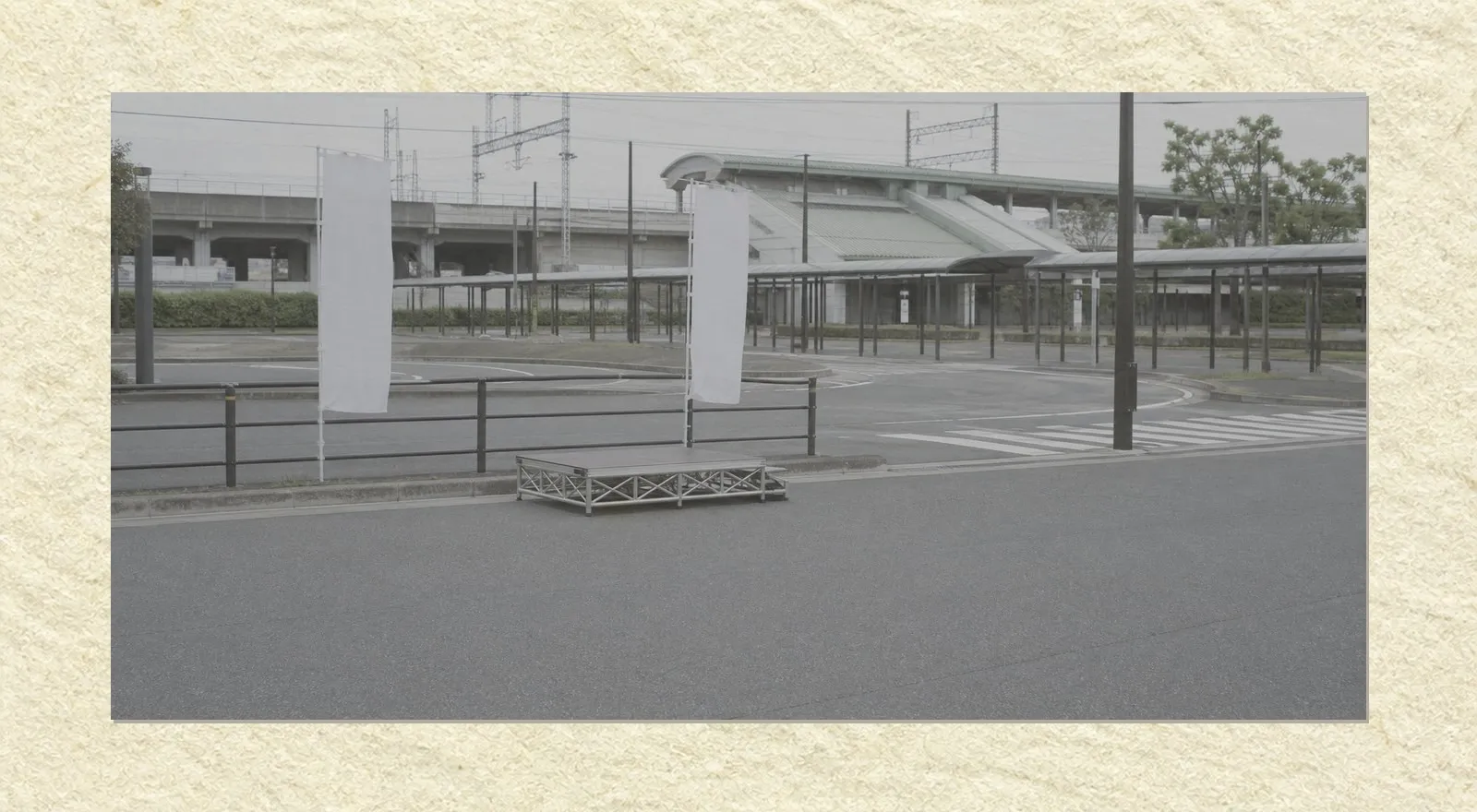
The sequence that mattered began less than half a minute before the shooting.
| Time | What the police report records |
|---|---|
| 11:30:43–11:31:05 | A man on a bicycle moves slowly along the road on the south side of the site, briefly stopping at 11:30:51 |
| 11:30:47 | A second man, pushing a hand cart, approaches from the west and reaches the same south-side area |
| 11:30:50 | The Tokyo Metropolitan Police officer standing 2 m southwest of Abe steps east and puts his body between the cyclist and Abe, anticipating a thrown object |
| 11:30:56 | The attacker enters from the bus and taxi rotary and walks northwest toward the site |
| 11:30:57 | He looks into his shoulder bag while walking, right hand inside |
| 11:31:02 | He begins crossing the 7.7 m-wide road, not at a crosswalk |
| 11:31:03 | About 2.7 m across, he draws an object resembling a firearm from the bag |
| 11:31:05 | At the centre of the road he raises it in both hands and aims at Abe |
| 11:31:06 | First shot, from about 7.0 m. Abe, turning to look behind him, is not hit |
| 11:31:08 | Second shot, about 2.7 seconds later, from about 5.3 m. Abe is hit |
| 11:31:09–10 | Abe steps down from the platform and collapses |
| 11:31:10–11 | Officers seize the attacker |
Four officers were close enough to intervene. The report states where each was looking at 11:31:05, the moment the gun was aimed:
- Officer A, 5 m east of Abe, was watching the crowd on the northwest pavement. Did not notice.
- Officer B, 3 m west-southwest, was watching the crowd on the northeast pavement. Did not notice.
- Officer C, 4 m east-southeast, had just turned from east to south, and had turned too late. Did not notice.
- The Tokyo officer, 2 m southwest and closest of all, had finished dealing with the cyclist and turned back to the north. Did not notice.
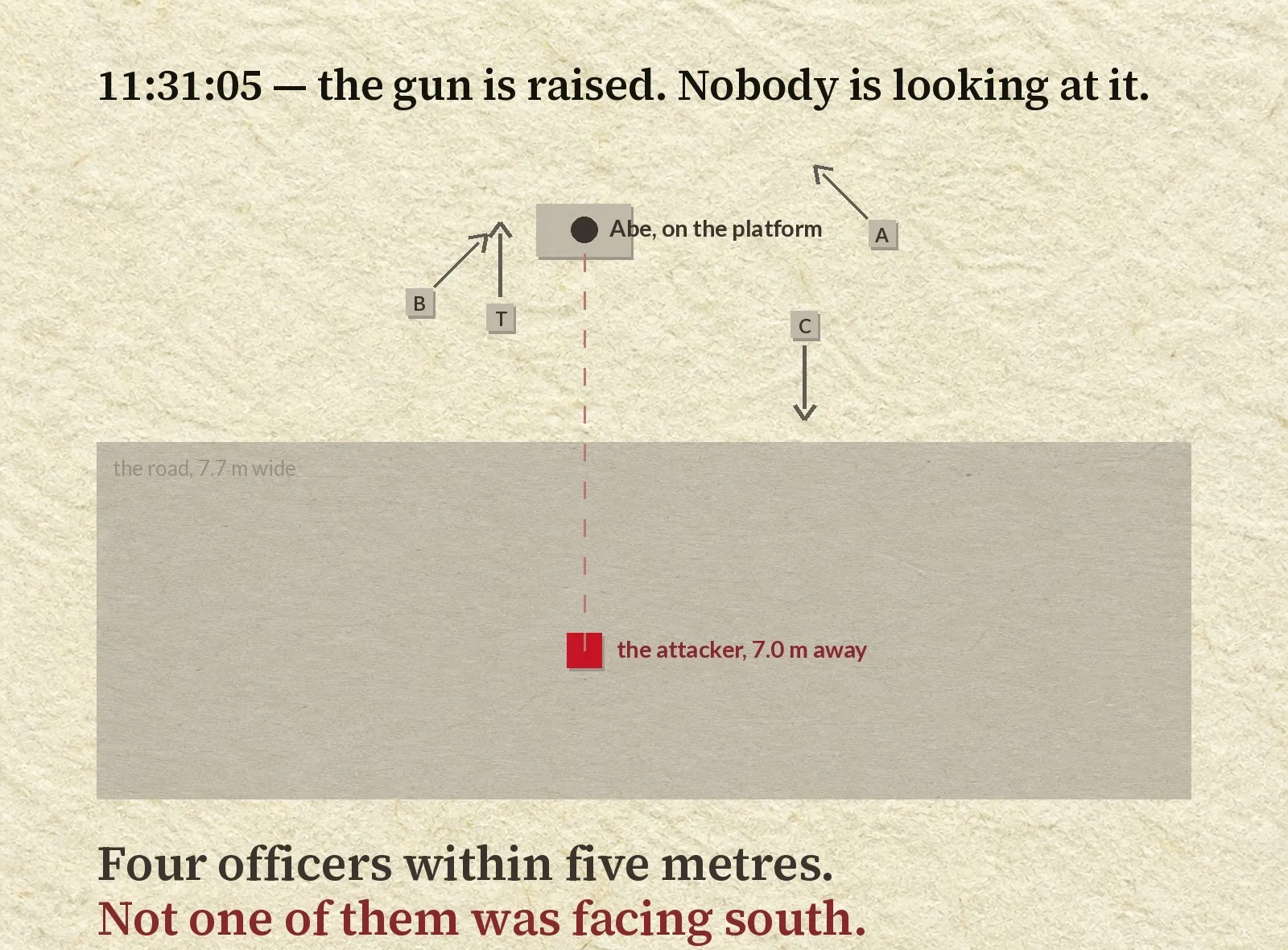
The report also disposes of two theories that circulated afterwards. Two campaign banners stood on the guardrail near Officer C, but the report states that from 11:29:28 onward he could see south between them, and that the banners did not obstruct his view. And it records that no one at the scene was stopped and questioned, including the attacker, walking toward a former prime minister with a bag he kept reaching into.
Why nobody recognized the sound
The single most revealing line in the report is repeated four times, once for each officer.
None of them recognized the first shot as gunfire.
Officer A registered it, turned about a second later, and saw a man holding a tube-shaped object. Officer B turned and saw a person. Officer C had just looked south when the shot came. The Tokyo officer turned, saw the attacker, and at 11:31:08 raised the ballistic shield he was carrying, and the second shot was fired before he could get it into the line of fire. Officer B was moving into the line of fire and did not make it. Officer C was climbing over a guardrail when the second shot went off.
They were not slow. From first shot to arrest was five seconds. What they lacked was the half-second of recognition that would have come automatically to a protection officer in a country where guns are common.
Key finding
The gap that killed Abe was not courage or distance. It was 2.7 seconds — the interval between a homemade weapon’s first shot and its second — spent by four trained officers working out what they had just heard.
This is what gun scarcity does. It removes the threat from daily life so completely that the professionals who guard against it lose the reflex. The report’s recommendations follow from exactly this: it calls for restructured training, for the National Police Agency to evaluate risk levels and communicate them to prefectural forces, and for protection officers to watch all directions rather than the direction where the crowd happens to be.
What the police concluded about their own failure
Japan’s institutional response to the killing was faster and more self-critical than outsiders often expect.
The National Police Agency began interviewing Nara prefectural police officers immediately. On 12 July, four days after the shooting, the National Public Safety Commission ordered the creation of a “Verification and Review Team” headed by the agency’s Deputy Commissioner. The team reported progress to the Commission eleven times, five of those in extraordinary sessions, and published its report on 25 August 2022, seven weeks after the attack.
The report’s conclusions about the agency itself are worth stating plainly, because they are unusually direct for a government document:
- The agency had never analyzed or evaluated the risk level of protection operations carried out by prefectural police, and had never passed such information to Nara or any other prefecture.
- For Abe, the agency had not required Nara police to report the substance of the protection plan. It had designated him as a protected person and left the rest to the prefecture. Had the plan been reviewed centrally, the report says, a correction could have been expected.
- The site’s south side faced a public road, so an approach from the road (by vehicle or on foot) should have been anticipated.
- Training for protection officers had not been structured by rank, experience or skill; content was pitched to the least experienced in the room.
Japan’s 2023 Police White Paper devotes a special topic to what followed: a rewritten set of protection rules, central involvement in planning, and a strengthened organization for dignitary protection.
Why the grievance travelled from a church to a politician
This is the part of the case that people outside Japan find hardest to follow, and it is where the courts drew their sharpest line.
The man who killed Abe had no connection to any organization. His grievance was against the Unification Church (the Family Federation for World Peace and Unification) to which his mother had given money until the family’s finances broke down. That is the grievance the defence built its case around, describing his upbringing as religious abuse.
The question is why that anger reached Abe, who had no role in his family’s finances and no formal connection to the organization. The answer offered at trial and in Japanese reporting is association: Abe, like many conservative politicians, had appeared at events held by the organization’s affiliates, most visibly in a video message he sent to a Universal Peace Federation event in September 2021 in which he expressed respect for the organization’s leader. In the eyes of the man who shot him, that association made Abe the reachable representative of something that had destroyed his family.
The Nara District Court accepted the existence of the grievance and refused the inference drawn from it. Its judgment held that the path “from anger at the religious organization to killing involved a leap, and the room for mitigation is not large.” It also stated that “there was no fault whatsoever on Abe’s part,” and that the crime rested on a “short-sighted and self-centred” decision.
Key finding
Both things are in the record. The court did not deny that a religious organization had ruined a family. It denied that this explained shooting a politician.
We are deliberately not going further into the family’s circumstances. What is documented and relevant is the shape of the reasoning, not the details of a private household.
What the court decided
The trial ran from October 2025 for about three months, with the defendant questioned on five occasions.
On 21 January 2026, the Nara District Court, presiding judge Shinichi Tanaka, sentenced him to life imprisonment, the sentence prosecutors had sought. The court called the crime “contemptible and extremely malicious” and held that “it cannot be said that his upbringing greatly influenced the decision to kill.”
The defence had asked for no more than twenty years, arguing that what he experienced amounted to religious abuse. On 4 February 2026 it filed an appeal with the Osaka High Court, calling the first-instance judgment unjust. That appeal has not been decided, which means the legal question (how much weight a defendant’s upbringing carries when the harm behind it was real and documented) is still open in a Japanese appellate court as this is published.
What the killing changed
The clearest consequence was not in criminal law. It was in the regulation of religious corporations.
Before July 2022, the Japanese state had spent four decades not acting on the Unification Church’s donation practices, despite accumulating civil judgments against it. Four months after the shooting, in November 2022, the Agency for Cultural Affairs began exercising its reporting-and-questioning power under the Religious Corporations Act, using it seven times. In October 2023 the minister asked the Tokyo District Court to dissolve the organization. The court ordered dissolution in March 2025, the Tokyo High Court upheld it on 4 March 2026 and liquidation began that day, and the Supreme Court finalized it on 22 June 2026.
We examined that case in detail in Why Japan Ordered the Unification Church to Dissolve, including the legal test the courts applied and the political relationships that had given the organization credibility for half a century. Whether Japanese law can label any religious organization a “cult” at all is a separate question.
The causal chain deserves care. The killing was not a legal basis for anything. The dissolution rested on donation-related harm dating back to the 1970s, none of which was discovered in 2022, and no court treated the assassination as evidence. What changed was political: a government that had been unwilling to use a power it already possessed became willing.
Two laws followed as well: one restricting unjust solicitation of donations, promulgated in December 2022, and one adding legal-aid measures and controls on how the organization could dispose of property, promulgated in December 2023.
What is still unresolved
The appeal. The Osaka High Court has not ruled. If it engages seriously with the religious-abuse argument, it will be the first Japanese appellate court to weigh how a documented pattern of organizational harm bears on the culpability of someone it harmed.
Whether the security reforms hold. The National Police Agency rewrote its protection rules, took a central role in reviewing plans, and restructured training. The test of that is the absence of a second case, which is not something that can be verified, only waited for.
How Japan talks about the man who did it. Public sympathy in some quarters for the defendant’s circumstances has been a persistent and uncomfortable feature of this case, and it sits alongside a killing that a court called contemptible. We are not going to resolve that tension here. It is worth noticing that it exists, and that the court addressed it in the narrowest possible way: the grievance was real, the leap was not justified.
What can be said with confidence is smaller and stranger than the case’s significance suggests. A former prime minister of a country with almost no guns was killed with a gun somebody made, in front of four officers who did not know what a gunshot sounds like, because a man decided that a politician who had lent his face to an organization was the closest thing to that organization he could reach.
In this article
- Quick answer
- Why this was, statistically, almost impossible
- Why there are no guns to buy
- The emperor, the prime minister, and who actually governs
- Who Shinzo Abe was
- The plan that was not made
- What happened in twenty-five seconds
- Why nobody recognized the sound
- What the police concluded about their own failure
- Why the grievance travelled from a church to a politician
- What the court decided
- What the killing changed
- What is still unresolved