Quick answer
They did not disappear. Japan’s National Police Agency counted 4,579 people in the bosozoku category at the end of 2023, almost exactly the same number as in 2019. In 2023 the number of gatherings, the number of participants and the number of vehicles involved all went up.
What disappeared was the group. In 2011, 60.2 percent of the people police counted as bosozoku belonged to no organisation. By 2023 that figure was 77.3 percent. The number of groups fell from 405 to 111 over the same period.
So the honest answer to the question is a correction of the question. The riding survived. The hierarchy died: the ranks, the embroidered jackets, the initiation, the money passed upward, the beatings handed out to anyone who tried to leave. Japan did not run out of teenagers who wanted to make noise at night. It ran out of teenagers who wanted to belong to something while doing it.
The numbers that say otherwise
Two tables from the police white papers, twelve years apart, tell the whole story.
| Year | Groups | Members | Belonging to no group | Gatherings | Participants |
|---|---|---|---|---|---|
| 2011 | 405 | 7,193 | 4,331 (60.2%) | 2,670 | 22,465 |
| 2015 | 211 | 5,416 | 3,909 (72.2%) | 2,738 | 19,158 |
| 2019 | 134 | 4,797 | 3,817 (79.6%) | 2,020 | 15,311 |
| 2022 | 99 | 4,581 | 3,730 (81.4%) | 1,731 | 15,085 |
| 2023 | 111 | 4,579 | 3,541 (77.3%) | 2,163 | 17,049 |
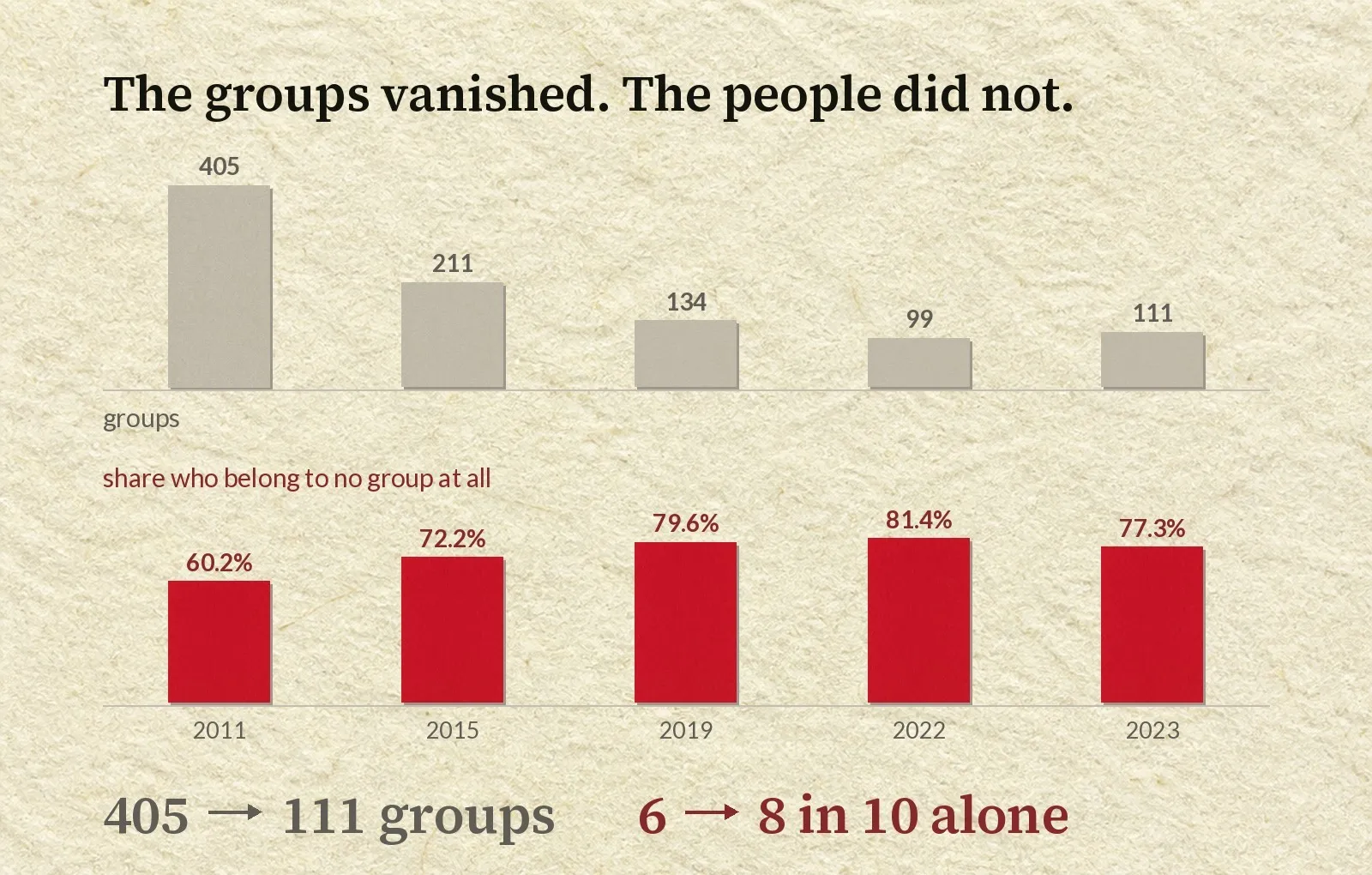
Read the first column and the story is extinction: 405 groups down to 111. Read the third column and it is something stranger. The people are still there. They are simply no longer members of anything.
The last row matters most. Between 2022 and 2023 the number of groups rose, gatherings rose by 25 percent, and participants rose by nearly 2,000. A separate category police track (the ihō kyōsō-gata, the ones who race rather than parade) has barely moved in fifteen years, holding at roughly 1,200 to 1,350 people. Its vehicle count more than doubled in a single year, from 1,840 in 2022 to 3,924 in 2023.
None of this looks like a subculture dying. It looks like one that has been stripped of its structure and left running.
There is one number this article cannot verify. English-language accounts of the bosozoku almost all cite a peak of 42,510 members in 1982, and many cite a low of 9,064 in 2011. Neither figure appears in any National Police Agency document we were able to obtain, and the 2011 figure does not match the police table above, which gives 7,193. The earliest membership figure we could confirm from a police source directly is about 18,800 at the end of 2004. The 1982 number may well be correct. It is simply being repeated from source to source without anyone pointing at the original.
What the law actually calls a bosozoku
The word has no legal definition in Japan. What exists is a police definition, built on a traffic offence.
The National Police Agency defines a bosozoku as a person who commits, or is likely to commit, as part of a group, a violation of Article 68 of the Road Traffic Act or a related act of driving that creates serious danger on the road or serious nuisance to others.
Article 68 reads:
Two or more drivers of automobiles or motorised bicycles shall not, when riding two or more automobiles or motorised bicycles in formation or side by side on a road, jointly commit an act that will cause serious danger to traffic on the road or cause serious nuisance to others.
Article 117-3 sets the penalty: up to two years’ imprisonment or a fine of up to 500,000 yen.
Three things follow from this. First, the offence requires two or more people, which is why a category defined by group behaviour can now be 77 percent people who ride alone, and why police describe modern gatherings as guerrilla-style runs of two to five vehicles. Second, the crime is the manner of riding, not membership of anything: Japan never outlawed being a bosozoku. Third, because it is a traffic offence, the entire apparatus of the traffic police could be turned against a youth subculture: vehicle inspection law, licence plate visibility rules, exhaust noise regulations.
That last point is the one that eventually decided the outcome.
Three eras, and the police drew the line themselves
The most useful periodisation of the bosozoku is not in any English-language article. It is on a single page of a National Police Agency traffic bureau document, under the heading “how bosozoku have changed.”
From the early 1970s to the 2000s (the agency’s own bracket is Showa 40s late to Heisei 10s) it lists three characteristics:
- convoy runs involving hundreds of vehicles
- escalating brutality, including inter-group warfare
- riding without helmets, on illegally modified motorcycles
From the late 2000s onward, it lists four:
- the groups are shrinking
- participants are recruited via social media
- they wear helmets and mostly hold driving licences
- they ride scooters rather than motorcycles
Put those two lists side by side and the shape of the change becomes clear, and it is not the shape anyone expects. The modern bosozoku is a licensed, helmeted rider on a scooter who found the meet-up on his phone. The subculture did not become more dangerous or more criminal as it shrank. In the eyes of the traffic police, it became more compliant.
The police white papers pin the turn precisely: membership has fallen continuously since 1999, and emergency calls about bosozoku have fallen continuously since 2000. In 2004 those calls dropped below 100,000 for the first time since 1988.
That is worth restating. As late as 2004, Japanese citizens were calling the police about motorcycle gangs a hundred thousand times a year.
The look was the argument
The visual language came first, and it came from outside the motorcycles entirely.
The subculture the bosozoku emerged from was yankī, a style of dress and hair among working-class Japanese teenagers. Ikuya Sato’s 1984 ethnography devotes an entire section to it, titled “The Birth of the Yankee,” with a subsection on “Pride and Ambivalence in the Yankee Style.” The riding came later, as a thing the style could be attached to.
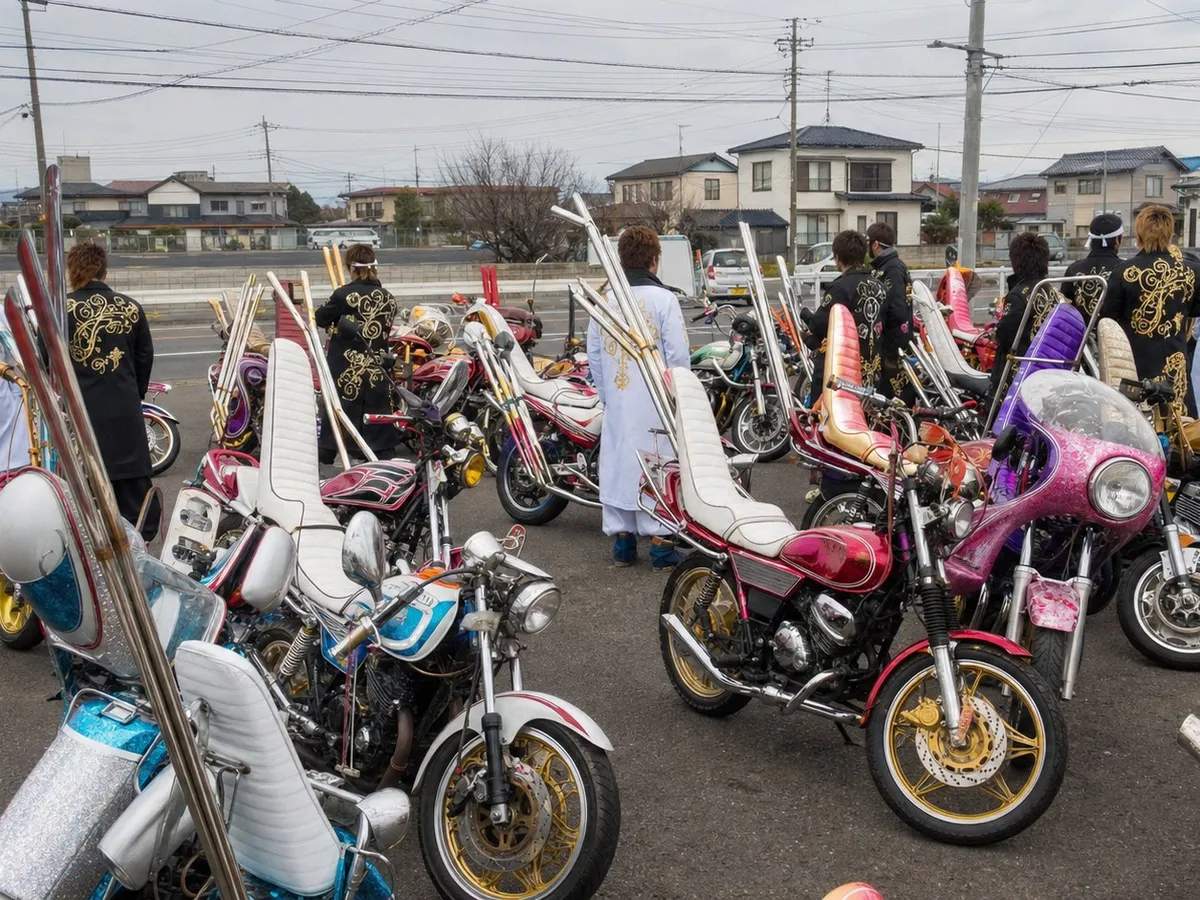
What the style consisted of is documented most concretely not by a police report but by an exhibition. In 2026 a museum-format show of bosozoku material culture ran in Tokyo, curated by the founder of Champ Road, a magazine that covered the scene. Its 300-plus objects included modified school uniforms (the long and short jackets known as chūran and tanran, worn with wide bontan trousers) and embroidered military-style jackets called tokkōfuku, a word borrowed from the special attack units of the Second World War.
The hair belongs to the same grammar: the high pompadour, the tight permanent wave, the shaved-in parting. Photographs and objects from the era show it clearly, and it is treated as period style rather than as evidence in any official record. We have found no government document that describes bosozoku hairstyles, and this article does not pretend otherwise.
The exhibition’s own description of what it was showing is worth quoting, because it is the subculture’s account of itself: “The flashy attire, the roaring exhausts, the bonds of friendship — all were expressions of staying true to oneself.”
Sato’s Japanese title makes a harder claim. Translated, it is An Ethnography of Bosozoku: The Revolt of Style and the Spell of Culture. The revolt was conducted through style. But it remained under a spell: the borrowed military ranks, the borrowed military jackets, the vertical order inside the group. A rebellion that dressed itself as the imperial army and organised itself like a company. The English edition, published by the University of Chicago Press in 1991, carries the title Kamikaze Biker: Parody and Anomy in Affluent Japan. Parody is the operative word in both.
The machines were instruments
The modifications were not about speed. They were about sound and silhouette.
The recognisable elements (the towering stepped seat, the swept-back handlebars, the exhaust pipe angled upward past the tail) turned a mass-produced Japanese motorcycle into something that announced itself before it arrived. The exhibition displayed the specific machines this was done to: two-stroke and early four-stroke mid-capacity bikes from the late 1970s, each with a distinctive intake or exhaust note, each with a nickname derived from that sound or its shape.
The sound was played, not merely produced. The exhibition materials describe kōru (riders working the throttle to generate rhythms out of the exhaust note) and note that the most accomplished practitioners obsessed over the length of the exhaust pipe down to the millimetre.
This is where enforcement eventually bit. The 2004 amendment to the Road Traffic Act, in force from November that year, created a new offence for noise-generating driving and strengthened the penalty for defective silencers. Police simultaneously pursued illegal modification through vehicle inspection law, seizing modified machines and prosecuting the shops that modified them, and worked with transport bureaux to do it.
An instrument that is illegal to own is harder to play. The scooters in the agency’s list of modern characteristics are, among other things, quiet.
The hierarchy that no longer exists
This is the part that the statistics kill outright.
The organisational form (a sōchō at the top, ranks below him, a group name painted on jackets and machines, formal admission, formal departure) required a group. In 2011, four in ten of the people police counted still belonged to one. By 2022, fewer than two in ten did.
Sato’s ethnography has a chapter on group names, treating them as part of the same symbolic system as the costumes and the vehicles. Naming presumes a thing to be named. A meet-up organised on social media between five riders who disperse afterwards has nothing to name.
Note what did not have to happen for this to occur. There was no crackdown on being in a gang, because being in a gang was never the offence. The organisation was not banned. It became pointless.
What the violence actually was
The 2005 police white paper is the least ambiguous document in the whole record, and the plainest.
Bosozoku crime, it states, extended beyond traffic law into the penal code, drug offences and others. Then, in one sentence, it describes two specific things: inter-group warfare using metal bats and iron pipes, and lynchings of members who left. It adds that some incidents pulled in people with no connection to the subculture at all.
The enforcement figures for that year carry the same weight. In 2004, police arrested 61,549 people for Road Traffic Act violations connected to bosozoku, of whom 2,990 were arrested for offences under Article 68 and related provisions. Counting all offences (including murder, robbery, obstruction of a public officer, and unlawful assembly with weapons), the total was 66,355 people.
Two details deserve to be read slowly. The first is that the violence was inward-facing: the recorded target was the member who tried to leave. Beatings, cigarette burns and similar injuries are described in accounts of the era as a means of enforcing loyalty; the white paper names the category (lynching of departing members) without describing methods, and this article follows it in that. Whatever else the bonds of friendship were, they were maintained with the credible threat of what happened to anyone who tested them.
The second is the charge of unlawful assembly with weapons. It is a penal code offence that exists to punish gathering while equipped to fight. Its presence in the annual bosozoku enforcement statistics means that the metal bats and iron pipes were not a rumour about the 1970s. They were a line item.
The money moved upward
Contributions collected from members are remembered as kanpa. The white paper describes what sat above them.
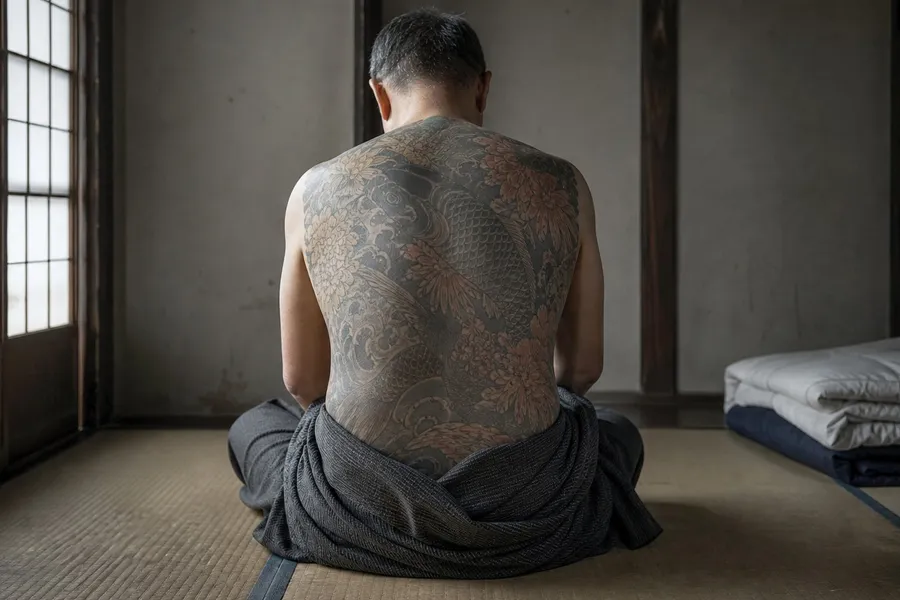
Some groups, it states, paid jōnōkin (money passed upward), and had deep ties to organised crime, functioning as a reserve force for the yakuza.
That single clause reframes everything above it. A teenager handing over cash inside a hierarchy that beats people who leave is not funding a club. Some part of that money was leaving the group entirely and moving up an organisational chart that extended well past anyone his own age.
Age was decided by statute
The bosozoku had an entry age and an exit age, and neither was chosen by its members.
Japanese juvenile law sets the boundaries. Under the old Juvenile Training School Act, whose text the Ministry of Justice still publishes, the institutions were divided strictly by age:
- elementary training school: roughly 12 to under 16
- middle training school: roughly 16 to under 20
- special training school: roughly 16 to under 23, for those “with no serious physical or mental impairment, whose criminal tendencies were advanced”
- medical training school: roughly 12 to under 26, for those with serious impairment
Those categories were abolished when the current Juvenile Training School Act took effect on 1 June 2015. What replaced them is not age-blind, but it stops using age as the primary label. The current Article 4 lists five types, and the second of them reads: those “with no serious physical or mental impairment, whose criminal tendencies are advanced, roughly 16 to under 23.”
The definition of the special juvenile training school was carried across almost word for word. Only the name was retired. When someone of that generation says a person “went to tokubetsu,” the category they are describing still exists. It is now called Type 2. A fifth type was added in 2022 for the new “specified juvenile” provisions of the amended Juvenile Act.
The practical effect on the subculture was structural. A member’s exposure changed at 14 (Article 41 of the Penal Code states flatly that “an act of a person under fourteen years of age is not punishable”) and then again at 16, at 20, and at 23. Each was a threshold written in a statute rather than felt as maturity. The scene’s habit of ageing out was not only a change of heart. It was a change of legal jeopardy.
The place where the state studied them
Between arrest and any sentence sits an institution with no close equivalent in the English-speaking world: the shōnen kanbetsu-sho, the juvenile classification home.
Under the Juvenile Classification Home Act, it does three things. It holds juveniles placed there by a family court’s protective measure. It provides them custodial care. And it performs kanbetsu (classification) which the statute defines in unusually specific terms.
Article 16 requires that the assessment be conducted “on the basis of specialist knowledge and techniques in medicine, psychology, pedagogy, sociology and other fields,” that it identify “the circumstances, in terms of the individual’s character and of their environment, that influenced the delinquency or crime,” and that it produce a concrete guideline for the person’s treatment aimed at improving those circumstances. Article 17 obliges the head of the home to carry out an assessment whenever a family court, a probation office, a children’s home, a juvenile training school or a penal institution asks for one.
Read that against everything above. While a subculture built its identity on standing out, the state was running a statutory process to determine, individual by individual, what in each teenager’s character and environment had produced the behaviour, and writing the answer down.
Those files are not public, and this article makes no claim about what is in them. But it is worth knowing that they exist. The question “what was going through their heads” was not left to sociologists. In Japan it was assigned by law to a facility, with a required methodology.
The first sunrise
One night mattered more than any other.
Hinode bōsō (the New Year’s first-sunrise run) was the scene’s high holiday, and it appears in the police white paper in exactly that register. Against large-scale mass runs including the first-sunrise run, the 2005 paper states, police deployed riot police units to ensure thorough enforcement.
A youth subculture whose annual festival is answered with riot police is being treated as a public order problem, not a traffic problem. It is also, in its own way, an admission of scale. Riot units are not deployed against five scooters.
The road that led to the yakuza
Removing organised crime’s influence over the bosozoku is not an inference drawn from the record. It is a stated objective of national police policy, listed alongside preventing recruitment and supporting members who want out.
The 2015 white paper repeats the finding in cooler language: some bosozoku have organised crime groups behind them. Between the 2005 phrase “reserve force” and the 2015 phrase “behind them” lies a decade in which the pipeline narrowed but did not close.
What happened to those who did not walk down it is a larger question than this article can answer from police statistics. The drift of delinquent youth into looser criminal networks rather than formally designated yakuza organisations is a separate subject, and it deserves separate treatment.
There is one visible destination, though, and the white papers name it. Former members formed groups known as kyūshakai (“classic car societies”) that ride modified older motorcycles in large convoys to scenic spots. The style survived its own subculture by becoming a hobby for the people who used to practise it.
Why the psychology did not change
The best evidence about what riding actually felt like comes from a participant-observation study conducted while the scene was at its height, and it is available in English, which means the reader can check it.
Ikuya Sato’s Kamikaze Biker, published by the University of Chicago Press in 1991, is the English edition of his 1984 Japanese ethnography. Its introduction includes a section called “‘Fun’ in Doing Evil” and another on an “attraction theory of delinquency.” Part I is titled “The Text of Play.” Its first chapter, on the experience of riding, has subsections named “Why Do Bosozoku Join in Boso Driving?”, “The Autotelic Nature of Boso Driving” (autotelic meaning done for its own sake, with no end beyond itself) and, tellingly, “Medatsu, Communitas, Flow.”
Medatsu means to stand out, to be conspicuous. It survives untranslated in the chapter heading of an American university press monograph because there is no clean English equivalent for the specific social good it names.
The third chapter is titled “Dramas and Dramatization: Bosozoku, the Saturday-Night Hero,” and it opens with the question “Why Are Bosozoku So Preoccupied with Media Presentation?” It goes on to consider the bosozoku as picaro, as kōha (the hard-line tough) and as celebrity, before turning to commercialisation and stylisation.
We have not read the book, and this article makes no claim about its arguments beyond what its own structure states. But set that 1984 chapter question (why are they so preoccupied with being seen?) against the National Police Agency’s description of the modern scene, in which participants are recruited via social media, and the continuity is hard to miss.
Forty years apart, two very different documents describe the same appetite. The stage changed from the television news crew to the phone. Standing out did not stop being the point.
What actually ended it
No single measure did it. The record supports four causes, and they compound.
The 2004 amendment to the Road Traffic Act. In force from November 2004, it revised the provisions on joint dangerous driving so that police could make arrests at the scene, created a new offence for noise-generating driving, and stiffened the penalty for defective silencers. Police white papers from the following years describe the amendment being used exactly that way.
Enforcement built around evidence rather than pursuit. The traffic bureau’s own working-group materials describe the method: analyse emergency calls, concentrate limited enforcement capacity, strike pre-emptively. One case is presented as a model: two mass runs in the Kitakawachi area of Osaka Prefecture, 65 people arrested on traffic, theft and obstruction charges. In the following period, emergency calls about bosozoku in that area fell 26.3 percent and motorcycle theft fell 29.4 percent.
Attrition of the machine. Seizure of illegally modified vehicles, prosecution of the businesses doing the modification, and enforcement of licence plate visibility rules under vehicle inspection law. A subculture whose identity was welded to a specific kind of machine loses its identity when the machine becomes a liability.
Institutional pressure on recruitment. Local ordinances aimed at eradicating bosozoku: enacted, as of the end of 2014, in 25 prefectures and 165 municipalities. Prevention classes held in middle schools and high schools. Coordinated withdrawal support involving families, schools and volunteer probation officers.
The traffic bureau’s documents also record what made enforcement harder as the scene shrank: runs became small and improvised, and the vehicles involved were mostly nondescript mopeds, which made gathering evidence more difficult. The subculture became less prosecutable at the same time as it became less interesting to belong to.
What is left
Three things, and they do not add up to a disappearance.
There are 4,579 people in the police count, four in five of them riding alone.
There is the kyūshakai convoy, the style preserved by the people who outlived it, riding to scenic destinations on old machines.
And there is a family-friendly exhibition in a department store in Tokyo, where visitors were invited to sit on a purple-cowled 1970s Suzuki and take photographs, among 300 objects curated by a magazine editor. Embroidered jackets in a display case. The uniform behind glass.
The question this article set out to answer assumes a vanishing, and the answer is narrower and stranger than the question. The riding survived, the noise survived, the wish to be seen survived and found a better instrument than the exhaust pipe. What died was the thing that made it a zoku, a tribe. The ranks, the initiation, the money moving upward, the beating waiting for anyone who left.
Japan did not stop producing teenagers who want to be conspicuous at three in the morning. It stopped producing teenagers who will accept a hierarchy in order to do it.
Related: why a homemade gun in a Japanese street exposed how little violence the country expects, and what Japan does and does not record about its own criminal justice system.
In this article
- Quick answer
- The numbers that say otherwise
- What the law actually calls a bosozoku
- Three eras, and the police drew the line themselves
- The look was the argument
- The machines were instruments
- The hierarchy that no longer exists
- What the violence actually was
- The money moved upward
- Age was decided by statute
- The place where the state studied them
- The first sunrise
- The road that led to the yakuza
- Why the psychology did not change
- What actually ended it
- What is left