Quick answer
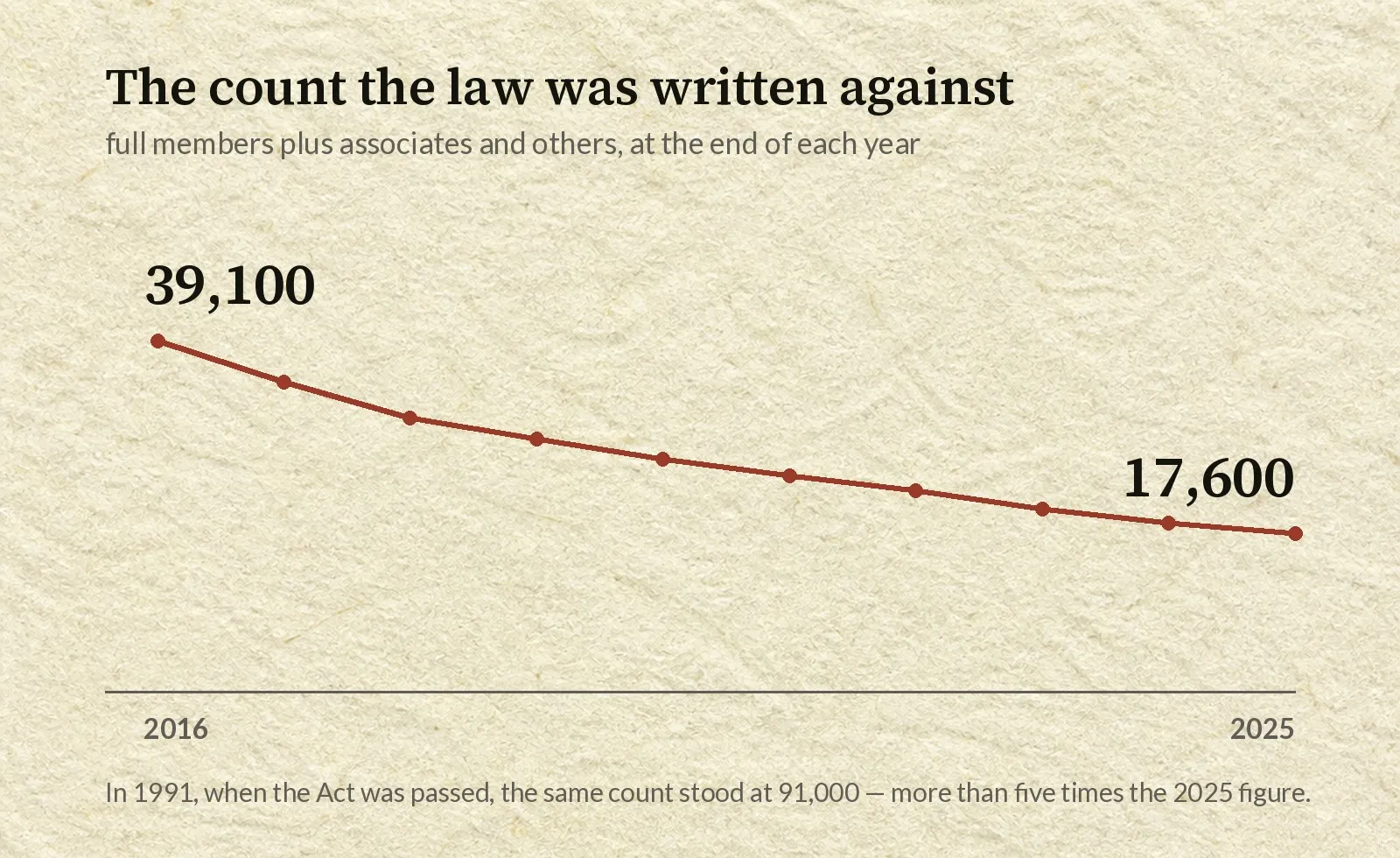
At the end of 2025 the National Police Agency counted 17,600 people in the organised crime category: 9,400 full members and 8,200 associates and others. That is the lowest total since the Anti-Organised Crime Act took effect in 1992, and the number has fallen every year since 2005. When the Act was passed in 1991, the same category held 91,000 people.
So the answer to the question, on the numbers, is yes.
But almost nothing about that yes means what an English-language reader will assume. Japan never banned these organisations. It designates them, using a statutory test that includes the proportion of members with criminal records. The crimes did not stop; police now track them under a category called anonymous and fluid crime groups, whose official definition begins with former members of motorcycle gangs, and the same report says money from those groups flows back to the designated ones, which sometimes supply their leadership. And leaving is so hard that a national support scheme set up in 2022 has produced twenty bank accounts in four years.
The organisation is dying. The crime moved somewhere harder to see, and the exit stayed shut.
The numbers
| Figure at the end of 2025 | |
|---|---|
| Total counted | 17,600 |
| Full members | 9,400 |
| Associates and others | 8,200 |
| Held by the six main groups | 12,500 (71.0% of the total) |
| Total in 1991, when the Act was passed | 91,000 |
| Falling since | 2005, continuously |
Nearly half of the people in the category are not full members. That ratio is worth holding onto, because it says something about what these organisations now are: a core of nine thousand, surrounded by almost as many people the state can only describe as associated.
The thirty-four-year figure is the one to sit with. The law was written in 1991 against 91,000 people. It is now applied to 17,600, more than eighty percent gone, on the state’s own count.
The same annual report carries the full register of the groups that hold the designation: one row each for name, head office, representative, territory and membership, from the largest down to a group of about ten men.
The sixth-generation Yamaguchi-gumi, the largest group, gives the clearest view of the decline because police publish its figures separately:
| Year | Members | Associates | Total |
|---|---|---|---|
| 2016 | 5,200 | 6,700 | 11,800 |
| 2020 | 3,800 | 4,400 | 8,200 |
| 2025 | 3,100 | 3,200 | 6,300 |
All of these are round numbers, and the agency says so in a footnote of its own: the figures are approximate, and the parts do not always add to the total.
The fall in the earlier report was steeper still: between 2013 and 2015 the Yamaguchi-gumi’s combined strength went from 25,700 to 14,100. That is not gradual attrition. Something broke.
One number is still missing. English-language accounts often cite a peak of well over a hundred thousand members in the early 1960s, and no National Police Agency document we could find gives a figure for that decade. What the agency does state is the count at the moment the modern law was written: 91,000 at the passage of the Act in 1991. Everything before that we leave to others.
Japan never banned the yakuza
This is the part that surprises people, and it is written plainly in the statute.
The Anti-Organised Crime Act of 1991 does not prohibit these organisations, and it does not make membership a crime. It defines an organised crime group as a body “whose members are likely to be encouraged to commit violent unlawful acts collectively or habitually.” Then it creates a procedure: a prefectural public safety commission may designate a group, which brings it within the reach of specific restrictions.
The designation test, in Article 3, has two limbs. The first is about purpose, whether the group’s substantive purpose is to let its members use the group’s influence to make a living, build assets or run a business. The second is statistical, and it is unusual enough to quote:
…the ratio of persons with criminal records among the members who are executives of the organised crime group, or the ratio of persons with criminal records among all its members, is certain to exceed the ratio of persons with criminal records in ordinary groups of people…
A group is designated, in part, because the proportion of its members with criminal records is certain to exceed the base rate for the general population, as fixed by cabinet order for each size band.
That is a remarkable piece of drafting. Rather than outlaw an association (which would run into the constitutional protection of freedom of association) Japan built a test that measures one and attaches consequences to the measurement.
The consequences are what did the damage. Designation triggers restrictions on specific conduct, and it is the anchor for a second layer built during the 2010s: prefectural exclusion ordinances, which pull ordinary businesses and landlords into the enforcement. Tokyo’s ordinance, in force since 2011, is a fair example, and it contains something we will come back to.
There is also a third layer, and it is the sharpest instrument in the set. A designated group can be escalated into one of two special categories, each attached to a defined warning zone on the map:
- A group designated as being in an ongoing feud. In January 2020, with the conflict between the sixth-generation Yamaguchi-gumi and the Kobe Yamaguchi-gumi intensifying, both were placed in this category and warning zones were fixed. The designation has been extended, and the zones revised, because the feud has continued. In December 2022 the sixth-generation group and the Ikeda-gumi were designated on the same basis.
- A group designated as particularly dangerous. The Kudo-kai received this designation in December 2012, and it has been renewed every year since. In December 2025 police carried out the thirteenth extension.
Thirteen consecutive years of annual renewal is not a temporary measure. It is a permanent regime aimed at one organisation, and the police account of the result is blunt: sustained enforcement has kept senior figures isolated from society for long periods and closed office after office, inflicting what the agency calls considerable damage on the group’s organisational base.
That is what “not banned” looks like in practice. The association remains lawful. Everything it needs in order to function has been made unlawful one piece at a time. Japan maintains no comparable designation for any other kind of organisation, not even for religious groups accused of harm, where the only instrument is court-ordered dissolution.
The designation regime is unique to these organisations. The wider technique is not. Where an activity is too embedded to prohibit, Japan writes it into a statute, names what it is, and regulates the parts one at a time. It has never banned pachinko either, while calling the games likely to stimulate the speculative spirit and fixing the payout ceilings itself.
The split
The collapse of the Yamaguchi-gumi’s numbers coincided with the organisation tearing itself apart.
The Kobe Yamaguchi-gumi broke away from the sixth-generation group. In July 2020 the Ikeda-gumi announced its own departure from the Kobe faction, and conflict followed between the sixth-generation Yamaguchi-gumi and the Ikeda-gumi. Police responded with the instrument built for exactly this: the designation covering groups engaged in an ongoing feud, applied to the two Yamaguchi-gumi factions in January 2020, extended since because the conflict did not stop, and extended to the sixth-generation group and the Ikeda-gumi in December 2022. In 2023 the sixth-generation group also expelled or excommunicated direct-line bosses in March and May, which its own hierarchy would read as tightening discipline.
Two things happen when an organisation splits. It fights, which attracts exactly the kind of enforcement that shrinks it. And it stops being able to promise anything to a young man deciding whether to join.
Where the crime went
Here is the finding that reframes everything above, and it comes from a chapter the National Police Agency wrote as a special topic.
Police had for years used the term quasi-organised crime group for a specific phenomenon. The official description of its origin is precise, and it is the reason this article exists alongside our piece on motorcycle gangs:
…persons belonging to groups centred on former members of bosozoku have been observed committing assault, injury and similar offences collectively or habitually in entertainment districts…such groups do not have the clear organisational structure of an organised crime group, but some are suspected of close relationships with criminal organisations…
Then the description moves to the present:
…groups have appeared that recruit perpetrators using social media and commit fraud and robbery over wide areas…unlike organised crime groups, their connections are fluid, repeatedly forming and dispersing through loose ties made over social media, and they anonymise and conceal their activities while subdividing roles and using highly anonymous means of communication…
On that basis, the agency now groups them, quasi-organised crime groups included, under the label anonymous and fluid crime groups.
Read that against the ordinary account of the yakuza’s decline, in which Japan cleaned up its underworld. What the state’s own document describes is a transfer. The hierarchy that could be designated, counted and published in an annual table has been replaced by something the same document admits it can only characterise as anonymous, fluid and concealed.
The 2025 edition goes further, and undercuts the word transfer in the process. Some of these groups, it says, are ones whose funds are seen to flow in part to the designated organisations; some have a designated member as their leader or among their members; some commit offences in conspiracy with designated members. And there are people who act as the connecting point between the two. The count fell. The relationship did not end.
Japan’s motorcycle gangs went through the identical change (77 percent of the people police count as bosozoku now belong to no group at all), and the connection is not our inference. The definition above makes it the starting point.
How they recruit
The mechanism is documented, and it is worth stating precisely because it explains why these groups can be large without being organisations.
Recruitment happens through social media, offering strikingly high pay without disclosing what the work is. Once someone applies, the group obtains their personal information, and in some cases uses that information to threaten the applicant into taking part in the offence. The promised payment is sometimes never made.
An organisation that must protect its members generates loyalty and obligation. A structure that recruits strangers by advertisement, keeps their identity documents as collateral, and does not pay them generates neither. It does not need to. It only needs a supply of people with no better option, which brings us to the last part of this article.
What they earn from
The agency lists the revenue: fraud against the elderly and similar telephone scams, organised robbery and theft, illegal sex-trade businesses, illegal casinos, illegal scouting operations, extortionate bar-billing, and fraudulent home renovation work. These are named as the principal funding sources of the anonymous and fluid groups.
Two features distinguish this list from traditional organised crime income. It requires no territory, and it requires no reputation. Both were assets the designated groups spent decades building, and both are now liabilities that make their holders easy to count.
One dimension is absent from every figure in this article, and the absence is structural. Organisations that operate in the form of political associations are handled by an entirely different bureau of the police, with its own annual reporting, which is why the word does not appear once in the organised crime report we have been quoting. That is a subject for its own article rather than a paragraph in this one.
Who actually gets arrested
The arrest figures answer a question the membership count cannot: which part of the structure is doing the work.
In 2025 police recorded 12,191 cases against people in the organised crime category: down 2,991 cases, or 19.7 percent, on the previous year. The breakdown by offence is not the one the word “yakuza” conjures:
| Offence | Cases in 2025 | Change |
|---|---|---|
| Theft | 3,334 | −38.0% |
| Stimulants Control Act violations | 2,381 | −9.1% |
| Fraud | 1,491 | −21.5% |
| Extortion | 319 | −7.3% |
| Intimidation | 272 | +1.5% |
Theft is the largest single category. Not extortion, not the protection economy: shoplifting, burglary and the rest of it, ten times more often than extortion.
Now the more revealing split. Of the 7,335 people arrested, 1,474 were full members and 5,861 were associates or others on the periphery. Four out of five people arrested in organised crime cases are not full members of anything.
Set that beside the membership table. Full members and associates are nearly equal in number: 9,400 against 8,200. But when the arrests are counted, the associates are picked up four times as often. The core has stopped doing its own work.
Concentration is high at the top: the six main groups account for 79.1 percent of arrests in this category (5,801 people in 2025), and the sixth-generation Yamaguchi-gumi alone accounts for 2,739 people, more than a third of all arrests. The largest organisation is also, by a wide margin, the most heavily policed.
Leaving costs more than staying
In 2025, 340 requests for advice about leaving reached the police and the prefectural centres, including requests from family members and acquaintances, and including advice about employment and about being obstructed from leaving. With official assistance, roughly 230 people got out.
Then the numbers collapse.
| Support measure | Result in 2025 |
|---|---|
| Businesses registered as willing to employ people who have left | 1,726 |
| People who actually found work through that scheme | 13 |
| Bank accounts opened under the national support scheme | 3 (20 since it began in 2022) |
One thousand seven hundred and twenty-six companies had put their names down. Thirteen people were hired. And three people were able to open the account into which wages would be paid.
Every one of those three lines is worse than it was two years earlier, while the registered-employer count went up. In 2023 the same scheme placed 26 people in work and opened eight accounts. The register of willing companies grew by 113; the number of people it moved into a job halved.
The account figure needs explaining, because it sounds impossible. It is the output of a formal scheme the National Police Agency created in February 2022 specifically because former members could not open accounts. Under it, a person qualifies only if they and the employing company both consent to the police measures. Then, at the point of application, the applicant must explain their own status (how they left, where they now work, and why they need the account), and must agree, if the bank asks, to submit a written undertaking about how the account will be used and to report if they leave the job. The police, for their part, contact the bank.
That is the procedure required for a person to receive a salary by bank transfer in Japan. In its first eleven months it produced seven accounts. In 2023 it produced eight. In 2025 it produced three, for a total of twenty in four years.
The price of leaving was once counted literally, in finger joints, a ritual we have traced separately, together with its afterlife.
Nobody prohibits it, and nobody allows it
The obvious question is which law bars a bank from opening that account. In 2020 a member of the House of Representatives asked the government exactly that. The answer, signed by the prime minister, is unambiguous:
…there is no law or regulation providing for restrictions on the opening of financial institution accounts by persons who have committed offences, and no such supervision or guidance is given.
The same answer continues in the next breath:
…based on the Comprehensive Guidelines for Supervision of Major Banks and similar documents, financial institutions are required to build internal control systems to prevent transactions with anti-social forces before they occur.
And on whether the government tells banks not to refuse such customers, the answer is that it gives no such guidance either, though it asks banks to maintain systems so that customer information is properly updated when a person who was an anti-social force has been rehabilitated.
The written question that prompted this had already noted two things the government did not dispute. First, that the Act on Promotion of Prevention of Recidivism of 2016 rests on the premise that people who have offended cannot reintegrate without stable work, and makes supporting them a state responsibility. Second, that in a judgment of 9 December 1998 the Osaka High Court held that, given the public character of banking, freedom of contract is limited for deposit-taking, and a bank is in principle obliged to accept a customer’s application to open a deposit account.
And the question added the detail that makes this more than a problem for former gangsters: practitioners who support released prisoners were reporting that banks were restricting accounts for people who are not organised crime members at all, and that this was obstructing their employment.
So the position is this. No statute forbids the account. A high court has said banks should generally grant it. The government neither requires refusal nor prohibits it. What exists instead is a supervisory instruction to prevent transactions with anti-social forces before they occur, and thousands of institutions each deciding, privately, that the safest reading of that instruction is no.
Nobody prohibits it, and nobody allows it. Three people got an account.
The shape recurs elsewhere in Japanese law, and not always to anyone’s disadvantage: the statute on prostitution forbids the act in one sentence and attaches no penalty to it, leaving the trade that grew up outside its definition to be administered by a different act entirely.
The exit and the entrance are the same door
Japan’s exclusion regime contains its own contradiction, and the Tokyo ordinance shows it in a single document.
Article 12 obliges the metropolitan government to promote members leaving organised crime, working with the prefectural centre, by providing information, guidance, advice and other necessary measures. Elsewhere the same ordinance protects the act of helping someone leave: providing employment, arranging work, offering housing or funds to a person who intends to leave or has left. It also requires those responsible for educating young people to advise them against joining in the first place.
So the state instructs itself to open the exit, and instructs the financial system to be sure it never accidentally transacts with the people using it.
Three consequences follow, and they compound each other.
It deters entry. A young person weighing this life now faces a system in which the affiliation follows you after you leave it. That is part of why the count fell to 9,400.
It obstructs exit. The 340 people who asked for advice included people reporting they were being obstructed from leaving, but obstruction by the organisation is only the first barrier. The second is a bank counter. Of the 230 who got out with official help, we know 13 found work through the scheme and 3 could be paid into an account.
It removes the lawful alternative. Wages in Japan are normally paid by transfer. Without an account, formal employment is not merely harder; for many jobs it is unavailable. A person with no lawful way to be paid is precisely the person for whom an advertisement offering strikingly high pay for undisclosed work is a rational answer.
That is the same advertisement described in section six of this article. The exclusion regime that shrank the designated organisations also produced a population with no lawful income, and the anonymous groups recruit from exactly there.
We should be careful about how far this goes. The link between exclusion and recruitment is a structural argument built from the documents above: the police definition of the anonymous groups, the recruitment method, and the employment and account figures. We found no official study that measures how many people move from one to the other, and we make no claim about the size of that flow. We also could not verify, from any government source, the widely repeated rule that a former member is treated as one for five years after leaving; and we found no public record documenting the effects on members’ families, which is discussed in Japan but which we cannot source here.
What is actually dying
The organisation is. The count is public, it falls every year, and more than eight in ten of the people the law was written against in 1991 are no longer in the category.
What is not dying is the activity. It has been reorganised into a form with no roster to publish: recruited by advertisement, assembled for one job, dispersed afterwards, its roles subdivided and its communications anonymised. The state named that form and traced its origin to the former members of another subculture it had already dismantled.
And the two are not separate. The 2025 report is explicit that some of the money raised by the anonymous groups flows to the designated ones, that some of those groups are led or staffed by designated members, and that people exist who serve as the connection between them. The roster shrank. It did not empty into nothing.
Japan did not defeat organised crime. It made organised crime a bad business model, and then closed the door on the people who left it.
Related: why Japan’s motorcycle gangs went through the same collapse of structure, and what Japan does and does not put on the record about its own criminal justice system.