Quick answer
Yes, for half of applicants. The median wait for a ruling on Japanese crime victim compensation was 5.1 months in the year to March 2025, which is close to the five months the one English-language guide gives.
The mean was 9.0 months.
A gap that wide between a median and a mean is not noise. Half of the rulings came within 5.1 months; the higher mean shows that waits on the long side pulled the average up. The English-language record describes the midpoint and is silent about everything above it.
Both numbers moved the wrong way in that year, the mean rising from 8.6 months and the median from 4.6. Neither has come back to where it was five years earlier, when the mean was 6.6 months.
The only English guide is twenty years old
Search in English for how long Japan takes to pay a crime victim and the substantive answer comes from one place: a country entry in the US Department of Justice’s international directory of victim compensation programs, archived from 2005. It says:
It takes approximately 5 months for the applicant to be notified of the decision, and it takes approximately 2 more weeks for the applicant to receive the benefit.
Everything else in English is a government page that describes the procedure without saying how long it runs, or a law firm summarising the statute.
The age of that entry shows in its numbers. It lists the award ceiling for a death as ¥10,790,000, rising to ¥15,730,000 for crimes committed after 1 July 2001. That schedule has since been rewritten twice. The directory entry is archived from 2005 and the schedule it lists is the one in force from 2001. The system was overhauled in 2024.
Two other lines in the same entry matter more to a reader outside Japan than the timing does, and they are still accurate. Tourists and visitors cannot claim. And the application forms, the correspondence and the telephone line are all in Japanese.
The five months is not wrong
The National Police Agency publishes the ruling period every year in the Crime Victims White Paper, and it defines the term rather than leaving it to be guessed at: the period from application to ruling. That is close enough to the American phrase, “notified of the decision,” for the two to be compared.
| Year to March | Mean | Median |
|---|---|---|
| 2019 | 6.6 months | 4.1 months |
| 2020 | 7.8 months | 5.3 months |
| 2023 | 9.8 months | 5.8 months |
| 2024 | 8.6 months | 4.6 months |
| 2025 | 9.0 months | 5.1 months |
Two years are missing because the white paper did not carry the figure in those editions.
The median moves within a band of about a month. The mean has risen by nearly two and a half months across the same period. The two are not tracking each other, and that is the whole finding: the middle of the queue has barely moved, while the far end of it has stretched.
So the American figure survives contact with the Japanese statistics. Five months is roughly where the middle applicant sits, and has been for years. The problem with the English-language record is not that it is inaccurate. It is that it stops there.
The distribution the average hides
The mean is nearly twice the median. That can only happen if a minority of claims takes a very long time.
The National Police Agency has published the distribution, though not recently. A 2019 paper prepared for the government’s crime victim policy council broke the rulings down into three bands across two five-year planning periods:
| Planning period | Within 6 months | 6 to 12 months | Over 12 months | Mean |
|---|---|---|---|---|
| Second Basic Plan | 61% | 25% | 13% | 6.6 months |
| Third Basic Plan | 64% | 24% | 12% | 6.8 months |
Roughly one ruling in eight took more than a year, in periods when the mean was 6.6 and 6.8 months.
There is one more recent reading, in a paper prepared for the expert panel that designed the 2024 revision. For the year to March 2023, when the mean was 9.8 months, it reports:
Rulings within one year: 75%
A quarter of rulings took longer than a year. That single-year figure is about twice the 12 to 13 per cent of the two earlier planning periods, but because a five-year average and a single year are not the same measurement, the comparison does not establish that the underlying share doubled.
What can be said without qualification is that in the year to March 2023 one ruling in four took more than twelve months, and that no figure of that kind has been published for the two years since. The movement that can be tracked on a consistent basis is the mean, and it rose.
The agency has, however, described the spread in its own words. At the thirteenth meeting of an expert panel on the system, the head of the Victim Support Office was asked how the ruling periods actually fell:
There are some that reach a full ruling in two or three months, and on the other hand there are some that take close to a year. My impression is that they are spread out.
That is the same statement the arithmetic makes, from the office that does the work.
Nobody has published why
There is no official explanation of what makes the long claims long. The white paper’s only remark on the subject is that the National Police Agency “instructs prefectural police on improving operations, including prompt rulings,” which is a response rather than a diagnosis.
The structure of the system suggests where the time goes. A ruling requires the police to establish that a qualifying crime occurred, and compensation for disability cannot be finalised until the degree of disability is fixed, which means waiting for a medical condition to stabilise. The American guide names both of these as the triggers for a provisional payment: cases where “the offender is unknown or the degree of disability is unclear.” Compensation does not depend on catching anyone, and a claim survives an unsolved case, but establishing what happened still takes police work.
That is inference from the design of the scheme, not a published finding.
Three benefits, and the largest is not death
The scheme pays three things, and the one most people picture is not the one most people claim.
Applications by victim, for the three years to March 2023:
| Benefit | 2021 | 2022 | 2023 |
|---|---|---|---|
| Serious injury or illness | 163 | 156 | 134 |
| Bereaved family | 118 | 118 | 139 |
| Disability | 88 | 107 | 102 |
| Total | 369 | 381 | 375 |
For two of those three years the largest group of applicants was people who survived. The serious-injury benefit covers an injury or illness needing a month or more of treatment and three days in hospital, or, for a psychiatric condition, three days unable to work with no hospital requirement. It is capped at ¥1.2 million, an order of magnitude below a death award.
The likely reason is the shape of the crimes themselves. Japan records few killings, though it examines only a small share of its dead, which sets a limit on how confident anyone can be about that. Violence that leaves someone alive and injured is more common than violence that does not, and the applications follow.
The rulings, which lag the applications, went the other way over the same period. In the year to March 2023 there were 403 rulings against 375 applications, because the backlog from earlier years was being worked through. That single fact is worth holding onto when reading the 335 rulings of 2025: rulings and applications are not the same population in any given year.
The remedy is being used more
Japan has a provisional payment for exactly the situation where a ruling will be slow: where the offender is unknown, or a disability has not yet stabilised. The white paper says the National Police Agency instructs prefectural forces to make active use of it.
Use is rising, from a low base:
| Year to March | Victims given a provisional payment |
|---|---|
| 2021 | 7 |
| 2022 | 18 |
| 2023 | 28 |
| 2024 | 41 |
| 2025 | 43 |
Six times as many people in four years. Set against the 335 rulings of the most recent year, that is roughly one provisional payment for every eight rulings, though the two counts are not drawn from the same population and application totals for the year are not published.
Whether those 43 are the cases that run past twelve months is not something the published figures show.
What an award is worth
The ranges, as they stood before the 2024 revision, show how wide the scheme’s spread is.
| Benefit | Range |
|---|---|
| Bereaved family, with a dependent survivor | ¥8.7m – ¥29.6m |
| Bereaved family, otherwise | ¥3.2m – ¥12.1m |
| Disability, grades 1 to 3 | ¥10.6m – ¥39.7m |
| Disability, other grades | ¥180,000 – ¥12.7m |
| Serious injury or illness | ¥1.2m ceiling |
Two numbers in that table are worth pausing on.
The floor of the disability benefit is ¥180,000. That is the award for the lowest grades of lasting harm: a permanent injury, at the bottom of the scale, is worth a sum in the low hundreds of thousands of yen.
The ceiling on the serious-injury benefit is ¥1.2 million, and the government’s own paper explains where the figure comes from: it was set for consistency with the ¥1.2 million limit for injury under Japan’s compulsory motor insurance. The state pays a crime victim what a driver’s insurer would pay someone hit by a car.
There is also a bureaucratic wrinkle inside the death award. The bereavement benefit is calculated on the earnings the victim was supporting others with, so a victim with no dependants produces the lower of the two ranges. Before June 2024, a young child, with no earnings and no dependants, sat at the very bottom of the scale.
In 2024 the floor was raised sharply
On the timing, the state has moved slowly. On the money, it has not.
A cabinet order that took effect in June 2024 rewrote the bottom of the schedule. Japanese awards are built from a daily base amount multiplied by a factor, and it was the base amounts that changed:
| Daily base amount | Before | After |
|---|---|---|
| Bereaved family | ¥3,200 | ¥6,400 |
| Disability | ¥3,600 | ¥5,900 |
| Lost earnings supplement | ¥2,200 | ¥3,200 |
A new supplement of ¥4,200 a day was added on top for a spouse, child or parent receiving a bereavement award.
The published worked example is the death of a young child, the case that had always produced the statutory minimum, with the parents claiming:
- Before: ¥3,200 × 1,000 = ¥3.2 million
- After: (¥6,400 + ¥4,200) × 1,000 = ¥10.6 million
The government’s own summary of the revision puts it plainly: cases that had been capped at ¥3.2 million can now exceed ¥10 million.
The new rates have not reached the figures yet
It would be easy to put the higher schedule next to the payout total and find a paradox, because the total went down:
| Year to March | Total awarded |
|---|---|
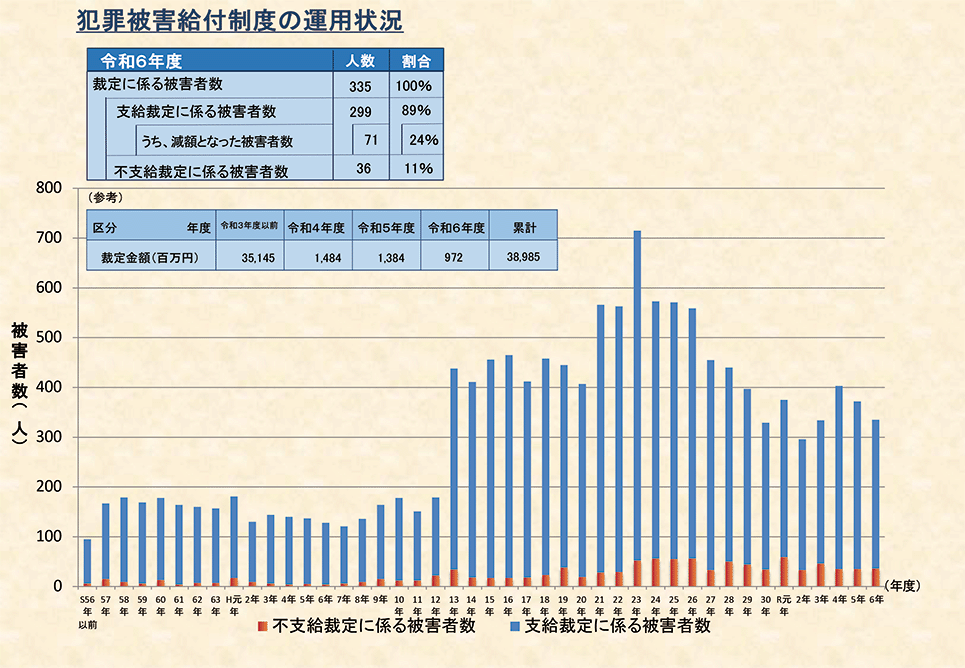
| 2023 | ¥1,484 million |
| 2024 | ¥1,384 million |
| 2025 | ¥972 million |
That is a fall of nearly 30 per cent in a single year.
There is no paradox. The transitional provision attached to the cabinet order settles it:
The revised provisions apply to a death, serious injury or disability caused by a criminal act carried out on or after the day this order comes into effect; for those caused by a criminal act that ended before that day, the previous provisions continue to apply.
The higher amounts attach to crimes committed from 15 June 2024. With a mean ruling period of nine months, almost none of the 335 rulings issued in the year to March 2025 can have been for a crime committed after that date. The fall happened entirely under the old schedule, and the new one will not show in these totals for some years.
What the fall does reflect cannot be settled from the published figures. It could be the number of rulings, or the mix of cases inside them. With only 335 rulings a year, a handful of large bereavement awards landing in one year rather than another moves the total by more than this. Reported crime in Japan fell for most of the past decade before turning back up, which is the sort of thing that shapes the input, but the year-on-year drop is too small a sample to attribute.
Eleven per cent are refused
The same table gives the outcome of every ruling in the year to March 2025.
| Outcome | People | Share of rulings |
|---|---|---|
| Rulings issued | 335 | 100% |
| Award granted | 299 | 89% |
| of which reduced | 71 | 21% (24% of awards) |
| Refused | 36 | 11% |
One ruling in nine refuses payment outright, and roughly one in five cuts the amount. Note the two denominators: the National Police Agency publishes the reduction figure as a share of awards, which is where 24 per cent comes from; against all rulings it is 21 per cent.
The grounds are in Article 6 of the 1980 Act. The state may withhold all or part of a payment where:
there is a relative relationship between the crime victim and the offender (including a de facto marital relationship)
or where the victim provoked the crime or was otherwise responsible for the harm, or where payment would not be socially appropriate.
The relative rule is the one that has needed the most repair. A scheme built for the victim of a stranger’s violence handles a killing inside a family differently, and the regulations grade the reduction by how close the relationship is. How much money each ground removes is not published. Successive amendments have carved out relief for domestic violence and for the abuse of children, older people and disabled people, most recently in 2014, which is a fair indication of how the untempered rule was working.
What a town hall adds
The national scheme is not the only money. Local governments run their own condolence payments, and the white paper counts them each April. As of April 2025:
- 23 prefectures, 20 designated cities and 1,099 municipalities operate a condolence payment for crime victims
- 4 further prefectures subsidise municipal payments rather than paying directly
- 2 prefectures, 1 designated city and 10 municipalities run a living-expenses loan scheme
Japan has 47 prefectures and about 1,700 municipalities, so a condolence payment now exists in most places and a loan scheme in almost none.
These are small sums next to a bereavement award, and they are not standardised: what a family receives depends on which town hall it belongs to. The National Police Agency says it will keep pressing for the schemes to be introduced “at the same level nationwide as far as possible,” which is an admission that they are not.
The relevance to timing is that a local payment can be made quickly, in weeks rather than months, while the national ruling is still being prepared. None of these schemes appears in the English-language record at all.
If you do not live in Japan
Article 3 sets the boundary in a single clause. The state pays crime victims and their families, excluding those who, at the time of the crime, both
did not hold Japanese nationality and had no address in Japan
Both conditions have to be met for the exclusion to apply. A foreign national living in Japan is covered. A tourist is not, and neither is anyone else passing through.
This is not a hypothetical. In the year to March 2023, one claim was refused on precisely that ground.
The deadline is in Article 10. A claim must be filed within two years of learning of the death, serious injury or disability, and within seven years of the day it occurred. There is one escape: where the claimant could not apply because the offender had unlawfully confined them, or for another unavoidable reason, they have six months from the day that reason ends.
What is settled, and what is not
Settled. The mean ruling period in the year to March 2025 was 9.0 months and the median was 5.1, both measured from application to ruling, and both worse than the year before. The mean was 6.6 months five years earlier. There were 335 rulings: 299 awards, 71 of them reduced, and 36 refusals. The total awarded was ¥972 million, down from ¥1,384 million. Provisional payments were decided for 43 victims. The minimum daily base amount for a bereavement award doubled in June 2024 and a supplement was added, taking the worked example for a child’s death from ¥3.2 million to ¥10.6 million. Those higher rates apply only to crimes committed from 15 June 2024, so they have not yet reached the payout totals. Article 3 excludes claimants who at the time of the crime had neither Japanese nationality nor an address in Japan.
Not settled. The current distribution of ruling periods. The most recent reading is 75 per cent of rulings within a year, for the year to March 2023; the two figures before it, 13 and 12 per cent over a year, are five-year averages and are not measured the same way. Nothing of the kind has been published for the two years since, so whether a quarter of rulings still runs past twelve months is unknown. Application counts for the two most recent years are not in the white paper either, so the ratio of applications to rulings cannot be brought up to date.
Not established. Why the long cases are long. No official document analyses it. The description above is drawn from the design of the scheme and from one official’s account of the spread at a public meeting, not from a published finding.
In this article
- Quick answer
- The only English guide is twenty years old
- The five months is not wrong
- The distribution the average hides
- Nobody has published why
- Three benefits, and the largest is not death
- The remedy is being used more
- What an award is worth
- In 2024 the floor was raised sharply
- The new rates have not reached the figures yet
- Eleven per cent are refused
- What a town hall adds
- If you do not live in Japan
- What is settled, and what is not